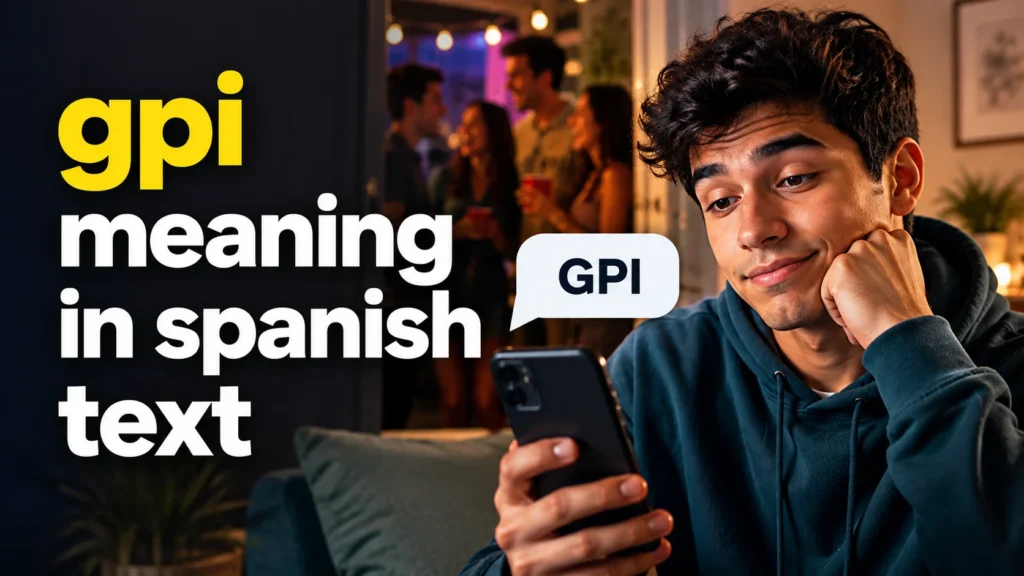
If someone replies “GPI” after seeing your party photos, dinner story, vacation post, or weekend plans, they probably are not simply thanking you. What does gpi meaning in spanish text?
The most common GPI meaning in Spanish text is “Gracias Por Invitar,” which translates to “Thanks for inviting” or “Thanks for the invite.” In digital conversations, however, people commonly use it sarcastically when they were not invited at all.
Imagine posting a photo of pizza with your friends and receiving:
“GPI 🙄”
The person is essentially saying:
“Wow, thanks for inviting me… even though you didn’t.”
That combination of humor, disappointment, and mild social pressure makes GPI more interesting than its literal translation suggests.
This guide explains its real meaning, emotional tone, social-media use, cultural context, common variations, and how to respond naturally when someone sends it.
GPI Meaning in Spanish Text – Quick Meaning
GPI stands for “Gracias Por Invitar.”
The Spanish phrase literally means:
- Gracias = Thanks
- Por = For
- Invitar = To invite / inviting
So, literally:
GPI = Thanks for inviting.
In everyday Spanish-language texting, however, it is frequently sarcastic. Someone may use GPI after discovering that friends went somewhere without inviting them.
The emotional meaning is closer to:
- “Thanks for inviting me… not.”
- “Wow, you forgot about me.”
- “And where was my invitation?”
- “You guys went without me?”
- “Okay, I see how it is.”
- “Next time, invite me!”
For example:
“¿Fueron a la playa? GPI 😂”
“You went to the beach? Thanks for the invite 😂”
Another example:
“Gpi, ni me avisaron 😭”
“Thanks for inviting me, you didn’t even tell me 😭”
Or simply:
“GPI 🙄”
The final example can sound more annoyed because the eye-roll emoji makes the sarcasm obvious.
Origin & Background
Where Did GPI Come From?
GPI developed from the Spanish phrase “gracias por invitar.”
Long before people shortened it online, Spanish speakers could use “gracias por invitar” genuinely to thank someone for an invitation.
For example:
“Gracias por invitarme a tu fiesta.”
means:
“Thank you for inviting me to your party.”
Digital communication made shorter forms useful, and the initials G-P-I became a convenient way to express the phrase in chats and comments.
Spanish-language sources describe GPI as informal electronic communication rather than a standard formal abbreviation.
How Sarcasm Changed Its Meaning
The interesting part is that online GPI often communicates the opposite of its literal words.
When someone writes:
“GPI”
after discovering that you went somewhere without them, they are obviously not thanking you for an invitation.
There was no invitation.
That contradiction creates the joke.
It works much like someone saying in English:
“Thanks for the invite!”
after seeing pictures from a gathering they were excluded from.
Cultural Influence
Spanish-speaking online communities have turned short expressions into efficient ways of showing humor, teasing, disappointment, and affection.
GPI fits naturally into that communication style because three letters can communicate an entire social situation.
The person feels excluded.
They want you to notice.
Yet they may not want to turn it into a serious confrontation.
GPI allows them to say all of that quickly.
Social Media Impact
GPI appears across informal digital spaces rather than belonging to one particular platform. Spanish-language coverage has documented its use on WhatsApp, Facebook, Instagram, TikTok, and similar social networks.
A picture can trigger it immediately.
You post dinner.
Friend: “GPI.”
You post a concert.
Friend: “¿Y mi invitación? GPI 😭”
You post a road trip.
Friend: “GPI x1000.”
The abbreviation has become particularly useful because social media constantly shows us activities we were not part of.
Real-Life Conversations
Seeing GPI inside natural conversations makes its tone much easier to understand.
WhatsApp: Friendly Complaint
Person A:
Ayer fuimos por tacos después de clase.
Person B:
¿Y yo qué? GPI 😂
Person A:
JAJA perdón, fue improvisado. La próxima vienes.
Person B:
Más te vale 😌
Here, GPI is playful.
Person B is saying, “Why didn’t you invite me?” but the laughing emoji shows there is probably no serious conflict.
Instagram DMs: Feeling Left Out
Person A:
Posts a story from a birthday dinner.
Person B:
Wowww, GPI 😒
and,
Person A:
No fue mi fiesta 😭 me invitaron de último momento.
Person B:
Bueno, te perdono jajaja.
The eye-roll emoji gives GPI a little more emotional weight.
The person may actually feel excluded, even though they keep the conversation playful.
TikTok Comments: Pure Humor
Person A:
Posts: “POV: spontaneous beach trip with the best people.”
Person B:
GPI 😭😭😭
and,
Person A:
Next one you’re coming 😂
Person B:
I’m saving this comment as evidence.
Here, GPI functions almost like a meme.
The person is jokingly documenting their exclusion rather than starting a real argument.
Text Message: More Serious Tone
Person A:
We all went out for Ana’s birthday yesterday.
Person B:
Oh. GPI.
Person A:
I thought Ana invited you.
Person B:
No one even told me about it.
This GPI feels different.
There are no laughing emojis, and the follow-up reveals genuine hurt.
The letters are the same, but the emotional meaning is much more serious.
Emotional & Psychological Meaning
What Emotion Does GPI Express?
GPI can carry several emotions at once.
Common possibilities include:
- Playful annoyance
- Sarcasm
- Disappointment
- Jealousy
- FOMO
- Feeling forgotten
- Friendly teasing
- Genuine hurt
- Desire to be included
The key emotional idea is exclusion.
Someone sees something enjoyable happening without them and wants to acknowledge that they noticed.
Why People Use It
Directly saying:
“I feel hurt because you didn’t invite me”
can feel too serious for a casual friendship.
“GPI 😂” feels safer.
It allows someone to communicate mild disappointment while keeping the interaction socially light.
There is also an element of plausible deniability.
If the other person responds seriously, the sender can say:
“I was joking!”
Yet the message may still contain a small amount of truth.
A Personal-Style Scenario
Imagine opening Instagram and seeing four close friends sitting at your favorite café.
No one mentioned the plan.
You feel a small sting because you normally go together.
and,
You could ignore it.
You could send an angry message.
Instead, you reply:
“GPI 😭”
Your friends immediately understand.
You wanted to be included, but you are giving them an opportunity to explain without creating unnecessary drama.
That is exactly the emotional space where GPI works best.
Usage in Different Contexts
Social Media
GPI is especially natural in story replies and comments.
Someone posts:
“Best dinner ever.”
A friend comments:
“GPI 🙄”
The meaning is:
“Looks great. Why wasn’t I invited?”
The same abbreviation can appear under travel posts, birthday photos, restaurant stories, concerts, shopping trips, and group activities.
Friends & Relationships
Among close friends, GPI is frequently humorous.
A friend might write:
“Went for coffee without me? GPI.”
Within romantic relationships, it can become slightly more emotionally complicated.
If your partner posts an outing you knew nothing about, “GPI” might communicate genuine irritation rather than simple humor.
Context determines the emotional intensity.
Work / Professional Settings
GPI is generally unsuitable for formal professional communication.
Writing “GPI” to a manager who attended an important business dinner without you could sound immature or passive-aggressive.
Professional environments require clearer wording.
Something such as:
“I’d be interested in joining similar events in the future.”
communicates the idea more appropriately.
Casual vs Serious Tone
Casual:
“Pizza without me?? GPI 😂”
Serious:
“Everyone from the team was invited except me. GPI.”
The first sounds playful.
The second may contain a genuine complaint.
Always read the surrounding conversation before deciding what the sender means emotionally.
When NOT to Use It
Formal Communication
Avoid GPI in:
- Business emails
- Academic writing
- Job applications
- Official letters
- Customer-service communication
- Formal invitations
It belongs mainly to informal digital conversation.
When Someone Could Feel Accused
Even playful sarcasm can create tension.
Suppose two friends went somewhere because they needed to discuss something private.
Commenting:
“GPI 🙄”
could pressure them unnecessarily.
Not every activity requires everyone to be invited.
Serious Friendship Problems
If you genuinely feel repeatedly excluded, GPI may hide the real problem instead of solving it.
Rather than repeatedly sending sarcastic comments, say what you actually feel.
For example:
“I’ve noticed I’ve been left out of several plans recently. Is everything okay between us?”
Clear communication is healthier when the issue matters.
Cultural Sensitivity
Not every Spanish learner or Spanish speaker will recognize the abbreviation immediately.
Digital slang varies between communities, age groups, countries, and individual social circles.
If someone asks what GPI means, explain it rather than treating them as though they should already know.
Common Misunderstandings
GPI Is Always a Genuine Thank-You
This is the biggest misunderstanding.
Although gracias por invitar literally expresses gratitude, online GPI often appears precisely because the person wasn’t invited.
GPI Is Always Angry
No.
Someone sending:
“GPI 😂”
may be completely joking.
Someone sending:
“GPI.”
after discovering that every other friend was invited may genuinely be upset.
Tone changes the meaning.
GPI Is an English Acronym
In casual texting, its widely recognized social meaning comes from Spanish:
Gracias Por Invitar.
The same letters can represent unrelated technical or organizational terms elsewhere, so context still matters.
GPI Means “Gracias Por Invitarme”
You may see people explain it as “gracias por invitarme,” meaning “thanks for inviting me.”
The conventional initials, however, correspond directly to:
Gracias Por Invitar.
Both ideas communicate essentially the same social message in casual usage.
GPI Compared With Similar Expressions
| Expression | Meaning | Typical Tone | Example |
|---|---|---|---|
| GPI | Gracias por invitar | Sarcastic/playful | “GPI 😭” |
| Gracias por invitar | Thanks for inviting | Genuine or sarcastic | “Gracias por invitar 😂” |
| ¿Y yo? | What about me? | Playful/complaining | “¿Y yo? 😭” |
| ¿Y mi invitación? | And my invitation? | Teasing | “¿Y mi invitación?” |
| NTP | No te preocupes | Reassuring | “NTP, todo bien.” |
| NTC | No te creas | Joking clarification | “NTC 😂” |
| FOMO | Fear of missing out | Feeling excluded | “Major FOMO.” |
| Me invitan | Invite me | Direct/playful | “La próxima me invitan.” |
| Qué mala onda | That’s not cool | Negative | “Qué mala onda, no avisaron.” |
| Gracias por nada | Thanks for nothing | More negative | “Bueno, gracias por nada.” |
Key Insight
GPI is effective because it turns “I noticed you excluded me” into a short, socially lighter message. Depending on punctuation, emojis, and relationship context, it can range from affectionate teasing to genuine disappointment.
Variations / Types of GPI
1. GPI
Meaning: Gracias por invitar.
The standard form, often sarcastically pointing out that no invitation was received.
2. gpi
Meaning: Same as GPI.
Lowercase spelling usually feels relaxed and natural in casual messages.
3. GPI 😂
Meaning: “Thanks for inviting me—I’m joking.”
The laughing emoji strongly suggests friendly teasing.
4. GPI 😭
Meaning: “I wanted to come too!”
It commonly expresses exaggerated sadness or playful FOMO.
5. GPI 🙄
Meaning: “Seriously? You didn’t invite me?”
The eye-roll can add annoyance or sharper sarcasm.
6. GPI 😒
Meaning: “I’m not exactly happy about being left out.”
This version can feel more genuinely disappointed.
7. GPI 🙂
Meaning: Light or mildly sarcastic acknowledgment.
The smile can soften the complaint, although tone depends on the relationship.
8. GPI, eh
Meaning: “Nice of you to remember me.”
This variation adds conversational sarcasm.
9. GPI x2 / GPI x1000
Meaning: Stronger playful agreement with feeling excluded.
Someone may use this when another person has already commented GPI.
10. “Gracias por invitar 🙄”
Meaning: The full version of the same sarcastic message.
Writing everything out can sometimes make the sarcasm feel even more deliberate.
How to Respond When Someone Uses It
Your response should match the emotional tone.
Casual Replies
Try:
“Jajaja, la próxima te invito.”
“Fue improvisado 😭”
“Next time you’re coming!”
“Perdónnn 😂”
These acknowledge the joke without making things awkward.
Funny Replies
You could respond:
“Your invitation got lost in the mail 😂”
“GPI? I thought you could read my mind 😭”
“Next time I’ll send a formal invitation.”
“Consider this your invitation for round two 😂”
Humor works best when you know the person is not genuinely hurt.
Mature Replies
If their message seems serious, try:
“Sorry, I didn’t realize you wanted to come.”
“I should’ve told you. That’s on me.”
“It was last minute, but I’ll make sure to let you know next time.”
These replies acknowledge the person’s feelings instead of dismissing them.
Respectful Replies
If you are uncertain about their tone:
“Were you actually upset we didn’t invite you?”
This creates space for honest communication.
A three-letter joke sometimes contains a real feeling.
Regional & Cultural Usage
Western Culture
Among Spanish-speaking and bilingual communities in the Americas, GPI works naturally as an online shorthand for gracias por invitar.
English-speaking users may understand its humor once they know the Spanish phrase because it resembles the sarcastic English expression “thanks for the invite.”
Asian Culture
GPI is not a general Asian texting abbreviation.
It is more likely to appear among Spanish learners, bilingual communities, international online groups, or people consuming Spanish-language social content.
Its meaning remains “gracias por invitar” when used in that Spanish texting context.
Middle Eastern Culture
Similarly, GPI is not inherently Middle Eastern slang.
Spanish-speaking residents, language learners, international friendship groups, and social-media users may still use it.
The internet allows slang to cross geographical boundaries quickly.
Global Internet Usage
Today, people encounter abbreviations through memes, influencers, comments, gaming communities, and multilingual friend groups.
As a result, someone does not necessarily need to live in a Spanish-speaking country to encounter GPI.
Still, its slang meaning remains culturally connected to Spanish.
Gen Z vs Millennials
Younger users often communicate emotions through extremely compact combinations of abbreviations and emojis.
“GPI 😭”
can therefore feel perfectly natural in a Gen Z group chat.
Millennials also use shortened online expressions, particularly on WhatsApp, Facebook, and Instagram.
Individual communication habits matter more than assigning strict slang rules to an entire generation.
Is GPI Safe for Kids?
Yes. GPI is generally safe for kids and teenagers.
“Gracias por invitar” contains no sexual, offensive, or explicit meaning.
The main issue is tone.
Because it is often sarcastic, children should understand that writing “GPI” after being excluded could sound passive-aggressive depending on the situation.
Among friends joking about a missed pizza trip, it is usually harmless.
During a serious disagreement, clearer communication may be better.
FAQs
What Does GPI Mean in Spanish Text?
GPI means “Gracias Por Invitar,” or “Thanks for inviting.” In texting and social media, it is commonly used sarcastically when someone was not actually invited.
Is GPI Spanish Slang?
Yes. GPI is an informal Spanish digital expression formed from the initials of gracias por invitar. It is associated with chats, comments, and social-media communication rather than formal Spanish writing.
Is GPI Sarcastic?
Very often, yes.
If someone writes GPI after seeing you enjoying an event without them, they are usually jokingly or sarcastically pointing out that they were left out.
What Does GPI Mean on Instagram?
On Instagram, GPI usually means “gracias por invitar.” Someone may comment it under photos or reply to a story showing an outing they were not invited to.
What Does GPI Mean on TikTok?
On TikTok, GPI can appear in comments when a creator or friend shows a party, meal, trip, or activity that looks enjoyable. The commenter is essentially joking, “And why wasn’t I invited?”
What Should I Reply to GPI?
A natural reply could be:
“Jajaja, la próxima te invito 😂”
That means:
“Haha, I’ll invite you next time.”
If the person seems genuinely hurt, acknowledge that instead of treating the message only as a joke.
Does GPI Have Other Meanings?
Yes. The letters GPI can represent unrelated terms in business, science, organizations, or technical fields.
However, when GPI appears in a Spanish casual text, social-media comment, or conversation about an outing, “gracias por invitar” is the interpretation you should consider first.
Conclusion
Understanding the GPI meaning in Spanish text becomes easy once you recognize the sarcasm behind it.
Literally, GPI means “Gracias Por Invitar” — “Thanks for inviting.”
Socially, it often means something closer to:
“Thanks for NOT inviting me.”
That difference is what gives the expression its personality.
“GPI 😂” may be nothing more than friendly teasing between people who are close.
“GPI 😒” can reveal genuine disappointment.
A plain “GPI.” after someone discovers they were deliberately excluded may carry much more emotional weight.
Instead of judging the letters alone, look at the relationship, emojis, punctuation, and events surrounding the conversation.
GPI is a perfect example of how modern texting compresses a surprisingly complicated feeling into only three letters: humor on the surface, a little FOMO underneath, and sometimes a quiet reminder saying, “Hey, don’t forget me next time.”