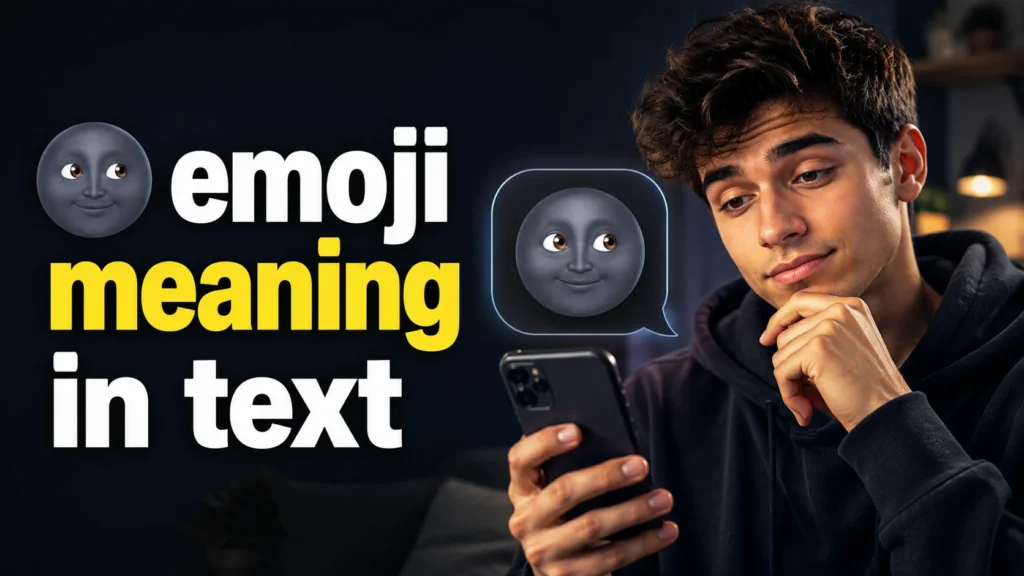
The 🌚 emoji meaning in text is rarely as simple as “the moon.” In chats, comments, and DMs, the New Moon Face emoji often carries a playful, suspicious, awkward, flirty, sarcastic, or slightly mischievous tone.
Someone may send 🌚 after making a bold joke, hinting at something without saying it directly, teasing a friend, or reacting to an awkward situation.
For example:
“You said you don’t like him, but you liked all his photos 🌚”
Here, 🌚 feels like a knowing look. It suggests, “I noticed something.”
The emoji is popular because it can communicate an entire facial expression without using words. Yet that flexibility also creates confusion.
This guide explains the 🌚 emoji meaning in texting, relationships, flirting, social media, friendships, awkward conversations, and different cultural contexts so you can understand exactly what someone may be implying.
🌚 Emoji Meaning in Text – Quick Meaning
The 🌚 emoji is officially known as the New Moon Face emoji.
Literally, it represents a dark new moon with a human-like face.
In texting, however, 🌚 commonly expresses:
- Mischief
- Suspicion
- Sarcasm
- Flirting
- Awkward humor
- A hidden meaning
- “I know what you did”
- Playful teasing
- A suggestive joke
- Side-eye energy
- Secret excitement
- “You know what I mean”
Its meaning depends heavily on the sentence surrounding it.
For example:
“So you two were alone last night 🌚”
Here, 🌚 suggests teasing or suspicion.
“I may have eaten your fries 🌚”
This feels mischievous.
“You look good today 🌚”
Depending on the relationship, this could feel playful or flirtatious.
The easiest way to understand 🌚 is to imagine someone giving you a knowing, slightly suspicious smile.
Origin & Background
Where Does the 🌚 Emoji Come From?
The 🌚 emoji represents the new moon phase, when the Moon appears mostly dark from Earth.
Its unusual facial expression quickly gave it a second life in digital communication.
Instead of being used only in conversations about astronomy or nighttime, people began using it as an emotional reaction.
The dark face, subtle smile, and sideways-looking expression made it perfect for messages involving jokes, secrets, awkwardness, and suggestive thoughts.
How Its Meaning Evolved
At first glance, 🌚 looks mysterious.
That mystery is exactly what made it useful in online communication.
Users started placing it after sentences where they wanted to imply something without explaining it openly.
For example:
“Interesting how you only dress like that when he is around 🌚”
The emoji changes the sentence from a simple observation into playful suspicion.
Over time, 🌚 became associated with the digital equivalent of:
“I see what you’re doing.”
“Hmm, suspicious.”
“Don’t pretend I didn’t notice.”
“You know what I’m implying.”
Cultural Influence
Emojis often gain meanings that are very different from their official descriptions.
🌚 is a strong example.
While its literal meaning relates to the Moon, online culture transformed it into an expression of social awareness, teasing, irony, flirtation, and hidden intentions.
Its power comes from ambiguity.
You can send 🌚 without directly accusing, flirting, or saying something embarrassing.
That makes it useful when people want to keep a conversation playful.
Social Media Impact
TikTok, Instagram, Snapchat, WhatsApp, X, Facebook, and group chats have helped make 🌚 recognizable as a reaction emoji.
People commonly use it after:
- Romantic comments
- Relationship gossip
- Confessions
- Awkward jokes
- Screenshots
- Suspicious behavior
- Double meanings
- “Caught you” moments
It has become less about the Moon and more about the expression on the Moon’s face.
Real-Life Conversations
The best way to understand the 🌚 emoji meaning in text is to see how it works inside realistic conversations.
WhatsApp Conversation: Playful Suspicion
Person A:
I wasn’t talking to Ryan that long.
Person B:
You were online with him until 2 AM 🌚
and,
Person A:
Stoppp 😭 we were just talking.
Person B:
Sureeee 🌚
Here, 🌚 means:
“I don’t completely believe you.”
The conversation is playful rather than aggressive.
Instagram DM: Flirty Meaning
Person A:
That outfit looked really good on you.
Person B:
Oh really? 🌚
Person A:
You already knew that.
Person B:
Maybe I wanted you to say it 😂
The emoji adds flirtation.
It creates a knowing, slightly teasing tone.
TikTok Comments: Hidden Meaning
Person A:
Posts: “When your best friend suddenly starts dressing better after meeting someone.”
Person B:
I wonder who this is about 🌚
and,
Person A:
No names mentioned 😂
Person B:
I know everything.
Here, 🌚 suggests:
“I know the hidden story behind this.”
Text Messages: Mischievous Confession
Person A:
Who finished the chocolate in the fridge?
Person B:
No idea 🌚
and,
Person A:
You literally have the wrapper next to you.
Person B:
Evidence means nothing 😂
In this example, 🌚 represents playful guilt.
The sender knows they have been caught but is joking about it.
Emotional & Psychological Meaning
What Emotion Does 🌚 Express?
🌚 does not represent one specific emotion.
Instead, it often combines several subtle emotional signals.
It may communicate:
- Curiosity
- Suspicion
- Flirtation
- Embarrassment
- Playful guilt
- Sarcasm
- Teasing
- Secret knowledge
- Mischief
- Awkward amusement
The emoji works because it looks like someone knows something they are not openly saying.
Why People Use It
Sometimes words are too direct.
Imagine telling someone:
“I think you secretly like him.”
That can feel confrontational.
Writing:
“You talk about him a lot 🌚”
feels lighter.
The emoji lets the sender imply the same idea without turning it into a serious accusation.
It creates emotional distance between the message and its hidden meaning.
The “I Know Something” Effect
One of the strongest psychological meanings behind 🌚 is awareness.
It often says:
“I noticed that.”
“You aren’t fooling me.”
“There’s more to this story.”
That is why the emoji appears frequently in conversations about crushes, dating, secrets, and embarrassing moments.
A Personal-Style Scenario
Imagine telling your friend:
“I don’t care if he texts me.”
Ten minutes later, you immediately reply when he sends a message.
Your friend texts:
“That was fast 🌚”
They are not discussing astronomy.
They are calling attention to the contradiction between what you said and what you did.
The emoji keeps the teasing light enough that you can laugh rather than feel directly challenged.
Usage in Different Contexts
Social Media
On social media, 🌚 often reacts to content with an obvious hidden story.
Someone posts:
“Best night ever ❤️”
A friend comments:
“Interesting 🌚”
That friend may suspect there is romantic context behind the post.
Under funny videos, 🌚 can also signal:
“We all know what this really means.”
Friends & Relationships
Between friends, 🌚 usually means playful teasing.
For example:
“You said you weren’t hungry but ate half my food 🌚”
In romantic conversations, it may become flirtier.
For example:
“You miss me, don’t you? 🌚”
That message sounds playful and confident.
The emoji can make a direct romantic question feel less serious.
When a Guy Sends 🌚
If a guy sends 🌚, he may be:
- Flirting
- Teasing you
- Hinting at something
- Questioning what you said
- Making a playful double meaning
- Suggesting he noticed something
For example:
“You looked good today 🌚”
This could be flirtatious.
However, one emoji alone does not prove romantic interest.
Look at his overall behavior and conversation.
When a Girl Sends 🌚
From a girl, 🌚 can carry the same basic meanings.
She may be teasing, suspicious, joking, or flirting.
For example:
“So who’s that girl in your story? 🌚”
This could indicate curiosity, teasing, or even mild jealousy depending on the relationship.
Work / Professional Settings
🌚 is generally too informal for professional communication.
Imagine receiving:
“The client still hasn’t approved the budget 🌚”
The emoji makes the message seem sarcastic or mysterious.
That may work in a close coworker group chat but can appear inappropriate in formal emails or messages to managers.
Casual vs Serious Tone
In casual conversation:
“You deleted that message pretty quickly 🌚”
This sounds teasing.
In a serious argument:
“So that’s what you’ve been hiding 🌚”
The same emoji could feel sarcastic or passive-aggressive.
Context changes everything.
When NOT to Use It
During Serious Emotional Conversations
If someone shares genuinely upsetting news, 🌚 can feel insensitive.
For example:
“My relationship just ended.”
Replying with:
“🌚”
would be confusing and potentially disrespectful.
Use clear emotional support instead.
In Professional Communication
Avoid 🌚 in:
- Job applications
- Business emails
- Customer complaints
- Academic communication
- Formal workplace messages
- Official announcements
Its ambiguous emotional tone makes it unsuitable for situations requiring clarity.
With People Who May Misread Sarcasm
Some people interpret emojis literally.
Others may not be familiar with 🌚 as internet slang.
Sending:
“Nice excuse 🌚”
could sound harsher than intended.
If clarity matters, use words.
When Flirting Could Be Unwelcome
🌚 sometimes creates suggestive or flirty undertones.
Avoid using it in a way that pressures someone or makes them uncomfortable.
A playful emoji is only playful when both people are comfortable with the tone.
Common Misunderstandings
🌚 Always Means Something Sexual
No.
Although 🌚 can sometimes accompany suggestive jokes or flirting, it is not automatically sexual.
It frequently means simple mischief, suspicion, or teasing.
🌚 Means Someone Is Angry
Usually not.
The emoji tends to feel playful rather than openly angry.
However, when combined with cold or confrontational words, it may sound sarcastic.
🌚 Is Just a Moon Emoji
Literally, yes.
Socially, not always.
In texting, its facial expression usually carries more meaning than the lunar symbolism.
🌚 Always Means Flirting
No.
A friend can send 🌚 without any romantic intention.
For example:
“You said you’d study but you’ve been gaming for four hours 🌚”
That is teasing, not necessarily flirting.
The Meaning Is Always Obvious
It isn’t.
A message like:
“Okay 🌚”
could communicate sarcasm, suspicion, flirtation, or simply humor.
The previous messages matter.
🌚 Compared With Similar Emojis and Expressions
| Emoji / Expression | Common Meaning | Typical Tone | Example |
|---|---|---|---|
| 🌚 | Mischief, suspicion, hidden meaning | Playful | “So that’s your crush 🌚” |
| 👀 | Watching, curiosity | Curious | “Who’s that? 👀” |
| 😏 | Smugness, flirting | Flirty/confident | “You know you missed me 😏” |
| 🤨 | Doubt, suspicion | Questioning | “Really? 🤨” |
| 😈 | Mischief, naughty humor | Bold/playful | “I have an idea 😈” |
| 🙄 | Annoyance, disbelief | Sarcastic | “Sure 🙄” |
| 🤭 | Shyness, gossip, embarrassment | Playful | “Oops 🤭” |
| 😭 | Strong emotion, exaggerated humor | Dramatic | “Stoppp 😭” |
| “Hmm” | Thinking or suspicion | Neutral/playful | “Hmm, interesting.” |
| “Sus” | Suspicious | Casual | “That’s kinda sus.” |
Key Insight
🌚 usually sits somewhere between 👀 curiosity, 😏 flirtation, and 🤨 suspicion. Its strongest feature is that it lets the sender imply something without stating it directly.
Variations / Types
1. 🌚
Meaning: Mischief or hidden meaning.
The basic version can suggest “I know what’s going on.”
2. 🌚🌚
Meaning: Stronger teasing.
Repeating the emoji makes the reaction feel more dramatic.
3. 😂🌚
Meaning: Playful joke with a hidden implication.
The laughing emoji makes the tone less serious.
4. 👀🌚
Meaning: “I’m watching and I noticed something.”
This combination often suggests gossip or romantic curiosity.
5. 😏🌚
Meaning: Strong flirtation or suggestive teasing.
The smirking face increases the romantic or mischievous feeling.
6. “Okay 🌚”
Meaning: Suspicious acceptance.
It can sound like:
“I’ll pretend I believe you.”
7. “Sure 🌚”
Meaning: Playful disbelief.
The sender probably doubts what you said.
8. “Interesting 🌚”
Meaning: “There’s more to this story.”
Often used when someone notices suspicious or romantic behavior.
9. “Why though? 🌚”
Meaning: Curious teasing.
It encourages the other person to explain themselves.
10. “I see you 🌚”
Meaning: “I noticed what you’re doing.”
This usually sounds playful and slightly mischievous.
How to Respond When Someone Uses It
The best response depends on the tone.
Casual Replies
You can say:
“What? 😂”
“Why that face? 😭”
“Don’t start 🌚”
“You’re imagining things 😂”
These work well between friends.
Funny Replies
Try:
“I don’t like that moon looking at me 😂”
“You know too much.”
“Mind your business 😭”
“That emoji is making accusations.”
These keep the joke going.
Flirty Replies
If the conversation is clearly mutual and playful:
“What are you thinking? 👀”
“Say what you mean 🌚”
“Why are you looking at me like that?”
“You’re suspiciously curious 😂”
These invite the other person to explain their hint.
Mature Replies
If the message feels uncomfortable:
“What did you mean by that?”
“Are you joking or being serious?”
“I’m not sure how to read that.”
Direct communication is better than guessing.
Respectful Replies
If someone appears suspicious:
“If you’re wondering about something, just ask me.”
This prevents a small emoji from turning into unnecessary misunderstanding.
Regional & Cultural Usage
Western Culture
In English-language internet culture, 🌚 is commonly used for mischief, sarcasm, double meanings, or knowing reactions.
It appears frequently in casual group chats, memes, dating conversations, and social-media comments.
Asian Culture
Across many Asian online communities, emojis are heavily integrated into informal messaging.
🌚 may similarly communicate awkward humor, suspicion, teasing, or “I know what you’re implying.”
Exact interpretations vary by community and language.
Middle Eastern Culture
In Middle Eastern online conversations, 🌚 may also appear in bilingual chats involving English, Arabic, Urdu, or other languages.
It often serves the same emotional purpose: playful suspicion, teasing, or hidden meaning.
The surrounding words remain more important than geography.
Global Internet Usage
Internet culture spreads emoji meanings rapidly.
A teenager in one country may use 🌚 almost identically to someone thousands of miles away because both learned its tone through memes, comments, and social platforms.
Still, individual texting habits vary.
Gen Z vs Millennials
Gen Z frequently uses emojis in ironic or layered ways.
For some younger users, 🌚 can immediately signal:
“That’s suspicious.”
“I see what you’re doing.”
“There’s definitely a story here.”
Millennials may use it similarly, although 👀 and 😏 are also common alternatives.
Age provides a clue, not a guaranteed meaning.
Is 🌚 Safe for Kids?
Yes, the 🌚 emoji itself is safe for kids.
Its official meaning is simply the New Moon Face.
Most everyday uses involve jokes, teasing, awkwardness, or mischief.
However, the emoji can occasionally appear beside suggestive adult jokes.
Parents should therefore consider the surrounding message rather than assuming the emoji itself is inappropriate.
A child sending:
“You ate my cookies 🌚”
is using it harmlessly.
Context is what determines meaning.
FAQs
What Does 🌚 Mean in Texting?
🌚 usually expresses mischief, suspicion, teasing, sarcasm, or a hidden meaning. It often feels like someone giving you a knowing look.
What Does 🌚 Mean From a Guy?
From a guy, 🌚 may mean he is teasing, flirting, questioning something you said, or hinting at something indirectly. The conversation around it determines whether the tone is romantic.
What Does 🌚 Mean From a Girl?
A girl may use 🌚 to tease you, show suspicion, make a playful joke, or flirt. It does not automatically indicate romantic interest.
Is 🌚 a Flirty Emoji?
It can be. 🌚 often becomes flirty when paired with compliments, romantic questions, or suggestive comments. In other contexts, it simply means mischief or suspicion.
What Does 🌚 Mean After a Compliment?
If someone says, “You looked good today 🌚,” the emoji may add playful or flirtatious energy. It can suggest the compliment has a little extra meaning behind it.
What Does 🌚 Mean With 👀?
The combination 👀🌚 usually means “I’m watching,” “I noticed something,” or “There’s definitely something going on here.” It commonly appears in gossip or romantic teasing.
Is 🌚 Rude?
Usually not. It is generally playful. However, it can feel sarcastic or passive-aggressive when used during serious disagreements or sensitive conversations.
Conclusion
The 🌚 emoji meaning in text goes far beyond its literal identity as the New Moon Face.
In everyday digital conversation, 🌚 often represents a knowing look.
It can say:
“I noticed that.”
“You’re not fooling me.”
“Interesting…”
“There’s definitely more to this.”
Or even:
“You know exactly what I’m thinking.”
That is why the emoji works so well in flirting, friendship jokes, gossip, awkward moments, and playful accusations.
A message such as “Sure 🌚” may express disbelief, while “You look nice 🌚” can sound flirtatious. “Who were you with? 🌚” feels curious and suspicious.
The real meaning comes from the combination of words, relationship, timing, punctuation, and context.
Rather than assuming 🌚 always means flirting or something inappropriate, read the whole conversation.
Sometimes it carries a hidden romantic hint.
Sometimes it simply means your friend has caught you eating the last slice of pizza and wants you to know that they know.
Either way, 🌚 has become one of those emojis that says far more with one mysterious face than a full sentence sometimes could.