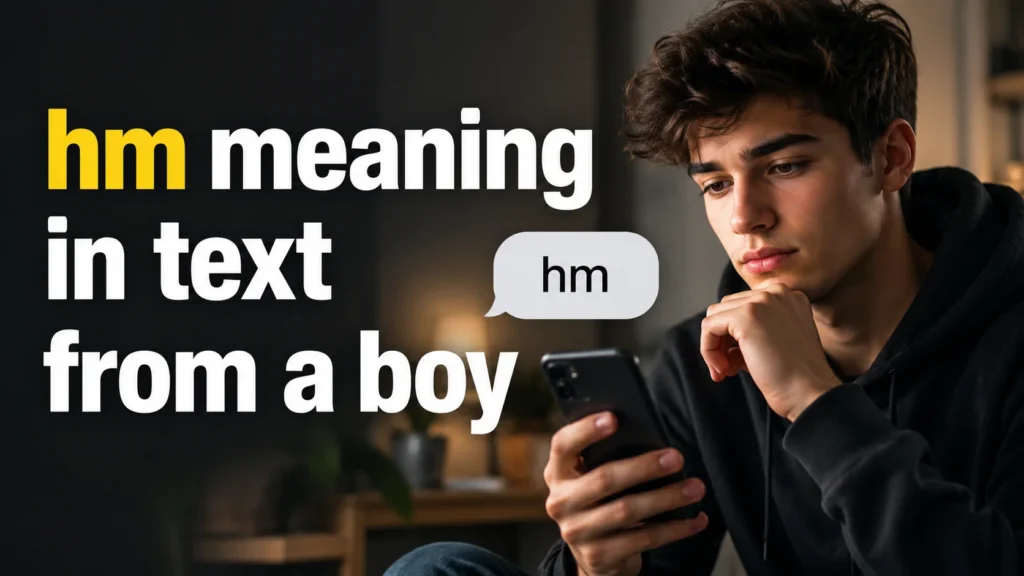
If a boy replies with “hm” in a text, it can feel surprisingly confusing. The message is only two letters, yet it may leave you wondering whether he is interested, annoyed, thinking, bored, jealous, or simply unsure what to say.
The hm meaning in text from a boy depends heavily on the conversation, his usual texting style, and what you said immediately before it.
Sometimes “hm” is just a thoughtful pause. In other situations, it can signal doubt, emotional distance, hesitation, mild annoyance, or even playful curiosity.
The difficult part is that texting removes facial expressions and tone of voice. A simple “hm” can therefore carry very different emotional meanings depending on context.
This guide explains what “hm” usually means when a guy sends it, how to read the tone behind it, and how to respond without overthinking the message.
HM Meaning in Text From a Boy – Quick Meaning
When a boy texts “hm,” it usually means he is thinking about something, unsure how to respond, questioning what you said, or reacting without giving a full answer.
It can mean:
- “I’m thinking about that.”
- “I’m not sure.”
- “Interesting.”
- “I don’t fully believe you.”
- “I don’t know what to say.”
- “Something about that bothers me.”
- “Tell me more.”
The exact meaning depends on the message before it.
For example:
“Hm, maybe you’re right.”
Here, he sounds thoughtful.
“Hm… who is that guy?”
This can sound curious or slightly jealous.
“hm”
A lowercase, one-word reply may feel dry or emotionally distant depending on his normal texting habits.
The safest interpretation is that “hm” shows some kind of mental reaction rather than a clear emotional statement.
Origin & Background
Where Does “Hm” Come From?
“Hmm” and “hm” imitate a natural sound people make when they are thinking.
People have made sounds like “hmm” in spoken conversation for generations. In face-to-face communication, someone might pause, narrow their eyes, and say “hmm” while considering what another person has said.
Texting simply turned that sound into written language.
“Hmm” is usually the longer form, while “hm” is shorter and often feels more casual.
How Texting Changed Its Meaning
In digital conversation, punctuation and spelling can change the emotional feel dramatically.
Compare:
“Hmm” can sound thoughtful.
“Hmmm” may sound curious, suspicious, teasing, or interested.
“Hm.” can feel more serious or closed off.
“hm” may appear casual, dry, or neutral.
Because people cannot hear the speaker’s voice, readers naturally try to interpret small details such as capitalization, punctuation, response speed, and surrounding messages.
Social Media Influence
Platforms such as Instagram, TikTok, Snapchat, WhatsApp, and messaging apps have made ultra-short reactions increasingly normal.
Rather than typing:
“I’m thinking about what you just said.”
Someone may simply write:
“hm.”
The meaning has therefore expanded beyond thinking. It can now communicate hesitation, disbelief, suspicion, curiosity, awkwardness, or emotional distance.
Real-Life Conversations
Understanding hm meaning in text from a boy becomes much easier when you see how it behaves in realistic conversations.
WhatsApp Conversation: He Is Thinking
Person A:
Would you ever move to another city for work?
and,
Person B:
Hm, maybe if the opportunity was really good.
Person A:
Same. I don’t think I could leave without a strong reason.
Here, “hm” simply shows that he is considering the question before answering.
There is no obvious negative emotion.
Instagram DM: He Might Be Curious
Person A:
I went out with some friends yesterday.
and,
Person B:
Hm 👀 who did you go with?
Person A:
Just Sara, Ali, and a few people from university.
In this conversation, the boy’s “hm” sounds curious.
Depending on the relationship, it could even suggest mild jealousy or romantic interest.
The eye emoji strengthens that interpretation.
TikTok Comments: Playful Suspicion
Person A:
I definitely wasn’t talking about you in this video 😂
and,
Person B:
Hm sure 😂
Person A:
I swear 😭
Here, “hm” means something close to:
“I don’t completely believe you.”
However, the laughing emojis show that the interaction is playful rather than serious.
Text Message: He Sounds Distant
Person A:
Are you upset with me?
and,
Person B:
hm
Person A:
You seem different today.
In this situation, the reply can feel emotionally cold.
It does not automatically prove that he is angry, but the lack of explanation may indicate that something is bothering him.
Context matters more than the word itself.
Emotional & Psychological Meaning
What Emotion Does “Hm” Express?
“HM” does not represent one fixed emotion.
Instead, it often shows that the person is processing something internally.
A boy might use it when he feels:
- Curious
- Unsure
- Skeptical
- Confused
- Slightly annoyed
- Interested
- Jealous
- Thoughtful
- Emotionally tired
- Unsure what to say next
This ambiguity is exactly why the message can feel so intense when it comes from someone you like.
Why Boys May Use Short Replies Like “Hm”
Some people naturally communicate with short messages.
A boy may write “hm” because he does not feel the need to explain every thought immediately.
Others use it when they want the other person to continue talking.
For example:
You: “Something strange happened today.”
Him: “Hm?”
That usually means:
“What happened?”
It is an invitation to continue.
A Personal-Style Scenario
Imagine you tell a guy you have been talking to:
“Someone asked me out today.”
He replies:
“Hm.”
If he usually sends expressive messages, that sudden short response may feel unusual.
You might wonder whether he is jealous.
That interpretation is possible, but the next message matters more.
If he follows with:
“Did you say yes?”
There may be emotional curiosity behind the “hm.”
If he instead changes the subject, it may simply have been a neutral reaction.
Reading a single word in isolation can easily create unnecessary assumptions.
Usage in Different Contexts
Social Media
On Instagram, TikTok, Snapchat, and similar platforms, “hm” frequently appears as a quick reaction.
For example:
“Hm interesting 👀”
This often suggests curiosity.
“Hmm okayyy 😂”
This may sound teasing.
“hm.”
This can appear more serious.
Social media conversations rely heavily on emojis and punctuation, so those details can help clarify intention.
Friends & Relationships
Between friends, “hm” is usually harmless.
A friend might text:
“Hm, where should we go?”
That simply indicates thought.
In romantic conversations, however, people often attach more emotional meaning to short replies.
If a boy sends “hm” after hearing about another guy, it might indicate jealousy.
If he sends it after a serious relationship question, he might be processing his answer.
Do not treat either interpretation as certain without additional context.
Work / Professional Settings
In professional communication, “hm” can sound too casual.
For example:
Manager:
Can you complete the report by Thursday?
Employee:
Hm.
That response can sound unclear or even dismissive.
A stronger professional reply would be:
“I should be able to complete it by Thursday. I’ll confirm this afternoon.”
Short reactions work better in informal conversations.
Casual vs Serious Tone
In casual texting, “hm” can be completely normal.
In a serious conversation, it may feel vague.
For example:
“I need to talk to you about something important.”
“Hm?”
This means “What is it?”
However:
“I don’t think our relationship feels the same anymore.”
“Hm.”
That response may come across as detached because the conversation requires more emotional engagement.
When NOT to Use It
During Sensitive Conversations
Avoid replying only with “hm” when someone shares something emotionally serious.
If someone says:
“My grandfather is in the hospital.”
Replying:
“hm”
can seem uncaring even if that was not your intention.
A better response would acknowledge their feelings.
When Clear Communication Is Required
“HM” is also unsuitable when someone needs a direct answer.
For example:
“Are you coming to the meeting at 3 PM?”
“hm”
does not provide useful information.
Use “yes,” “no,” or explain your situation clearly.
During Conflict
If someone is already upset, a short “hm” may make things worse.
It can sound dismissive, sarcastic, or passive-aggressive.
Clear communication is safer during arguments.
Across Different Cultures
Very short replies are interpreted differently across cultures and generations.
Some people consider “hm” a completely normal acknowledgment.
Others may see it as rude or uninterested.
If you are speaking with someone from a different cultural background, avoid assuming emotional meaning too quickly.
Common Misunderstandings
“Hm” Always Means He Is Angry
No.
A boy may simply be thinking.
If the rest of the conversation is friendly, there is little reason to assume anger from one short reply.
“Hm” Means He Does Not Like Me
Not necessarily.
Some people naturally use short responses.
Look at his overall communication pattern instead.
Does he initiate conversations?
and,
Does he ask questions?
Does he continue the conversation?
Those signals are much more useful than one “hm.”
“Hm” Means Jealousy
Sometimes it can.
For example:
You:
I was hanging out with Daniel yesterday.
Him:
Hm. You two seem pretty close.
That sounds more emotionally loaded.
However, “hm” by itself does not prove jealousy.
“Hmm” and “Hm” Are Exactly the Same
They are related, but they can feel slightly different.
“Hmm” often appears softer and more thoughtful.
“Hm” may feel shorter, quicker, or more serious.
Still, texting habits vary from person to person.
HM Compared With Similar Text Expressions
| Expression | Common Meaning | Typical Tone | Example |
|---|---|---|---|
| HM | Thinking, uncertainty, reaction | Neutral to skeptical | “Hm, maybe.” |
| Hmm | Thinking or curiosity | Softer | “Hmm, interesting.” |
| Hmmm | Suspicion, teasing, interest | Playful or curious | “Hmmm who is she? 👀” |
| Oh | Recognition or surprise | Neutral | “Oh, I didn’t know.” |
| Okay | Acceptance | Neutral | “Okay, sounds good.” |
| K | Acknowledgment | Sometimes dry | “K.” |
| IDK | I don’t know | Casual | “IDK honestly.” |
| Nah | No / disagreement | Casual | “Nah, I’m good.” |
| Sure | Agreement | Neutral or sarcastic | “Sure, why not?” |
| Absolutely | Strong agreement | Positive | “Absolutely, I’m in.” |
Key Insight
The biggest difference is that “hm” often reflects internal thought rather than a complete answer. You usually need the surrounding messages to understand whether that thought is curious, doubtful, jealous, annoyed, or neutral.
Variations / Types of HM
1. “Hm”
Meaning: Thinking or mild uncertainty.
This is the standard version and usually feels neutral.
2. “Hmm”
Meaning: Thoughtful consideration.
It often sounds slightly softer than “hm.”
3. “Hmmm”
Meaning: Curiosity, teasing, or suspicion.
Extra letters can make the reaction feel more expressive.
4. “Hm?”
Meaning: “What?” or “Tell me more.”
The question mark turns it into a request for clarification.
5. “Hmm?”
Meaning: Confusion or curiosity.
It may mean he did not understand what you said.
6. “Hm.”
Meaning: Serious acknowledgment.
The period can make the message feel colder or more final.
7. “Hmmm 👀”
Meaning: Playful suspicion or interest.
This is common when someone notices something interesting about your romantic or social life.
8. “Hmm okay”
Meaning: Hesitant acceptance.
He may accept what you said while still having doubts.
9. “Hm interesting”
Meaning: Genuine curiosity or careful consideration.
This usually invites further conversation.
10. “Hmmm 😂”
Meaning: Playful disbelief.
The laughing emoji keeps the tone light.
How to Respond When Someone Uses It
The right response depends on the tone of the conversation.
Casual Replies
You can say:
“What are you thinking? 😂”
“Hmm what?”
“Why the hm? 😭”
“What’s on your mind?”
These keep the conversation moving without sounding confrontational.
Funny Replies
Try:
“That hm sounds suspicious 😂”
“Don’t hm me 😭”
“I can hear the judgment through the screen 😂”
“What does THAT hm mean? 👀”
These work well when you already have a playful relationship.
Mature Replies
If the topic is serious, say:
“Take your time. Tell me what you’re thinking.”
“You seem unsure. What part are you thinking about?”
“If something is bothering you, you can tell me.”
These responses encourage clearer communication.
Respectful Replies
If you are unsure about his intention, avoid accusations.
Instead of:
“Why are you mad?”
Try:
“You sound a little unsure. Did you mean something by that?”
This gives him space to explain without forcing an emotion onto him.
Regional & Cultural Usage
Western Culture
In English-speaking Western texting culture, “hm” or “hmm” commonly expresses thinking, uncertainty, suspicion, or curiosity.
Among younger users, stretched versions such as “hmmm” can also sound flirtatious or playful.
Context remains important.
Asian Culture
Short acknowledgments are common in many Asian digital communication styles.
Depending on the person’s English habits, “hm” may simply function as a neutral response without carrying the emotional weight an English-speaking reader might assume.
Some people also use “hmm” as a polite way to show they are listening.
Middle Eastern Culture
In English-language texting across Middle Eastern communities, “hm” is also widely used to signal thought, uncertainty, or acknowledgment.
People who switch between Arabic, Urdu, English, or other languages may use short English reactions differently depending on their usual texting habits.
The relationship between the speakers often matters more than geography.
Global Internet Usage
Online communication has made “hm,” “hmm,” and “hmmm” globally recognizable.
Memes and social media have also given “hmmm” a playful “something is suspicious here” feeling.
This means the same letters can carry either a normal conversational meaning or a humorous internet-style meaning.
Gen Z vs Millennials
Gen Z users may interpret punctuation and message length very carefully.
For example:
“hm” can look casual.
“hm.” may feel serious.
“hmmm 👀” often feels teasing or curious.
Millennials also use these distinctions, but individual habits matter much more than generation alone.
Avoid treating punctuation rules as universal.
Is HM Safe for Kids?
Yes, “hm” is completely safe for children in ordinary contexts.
It is not an offensive or adult expression.
It simply represents a thinking sound or short reaction.
Parents should still teach children that extremely short replies can sometimes sound rude during serious conversations.
For example, if someone shares sad news, a caring response is more appropriate than simply texting “hm.”
FAQs
What Does HM Mean in Text From a Boy?
“HM” usually means a boy is thinking, unsure, curious, skeptical, or unsure how to respond. The exact meaning depends on the conversation and his texting style.
What Does “Hm” Mean From a Guy You Like?
If a guy you like sends “hm,” he may be thinking about what you said or reacting cautiously. It does not automatically mean he has lost interest.
Does “Hm” Mean a Boy Is Jealous?
It can indicate jealousy when the conversation involves another guy, dating, or attention from someone else. However, “hm” alone is not enough to prove jealousy.
Is “Hm” a Dry Reply?
Sometimes.
A standalone lowercase “hm” can feel dry, particularly if the sender normally texts enthusiastically. For naturally short texters, it may simply be normal communication.
What Does “Hmmm” Mean From a Boy?
“Hmmm” often suggests deeper thought, curiosity, suspicion, teasing, or playful interest. The longer spelling generally feels more expressive than “hm.”
What Does “Hm?” Mean in Text?
“HM?” usually means “What?” “Why?” or “Tell me more.” The question mark makes the expression more curious and conversational.
How Should I Reply When a Guy Says “Hm”?
A simple response such as “What are you thinking?” or “Why the hm? 😂” works well. During serious conversations, ask calmly whether something is bothering him.
Conclusion
The hm meaning in text from a boy is usually much simpler than it first appears. Most of the time, he is thinking, hesitating, reacting, or waiting for more information.
Still, context can change everything.
A playful “hmmm 👀” may show curiosity or flirtation, while a cold “hm.” during an argument may suggest emotional distance. A relaxed “hm, maybe” is often nothing more than ordinary thinking.
Rather than judging the relationship from two letters, look at his complete communication pattern.
How often does he message you? However, Does he ask questions? Does he make an effort to continue conversations? Does his behavior match his words?
Those patterns reveal far more than one mysterious “hm.”
When you are genuinely confused, the healthiest response is often the easiest one:
“What are you thinking?”
Sometimes clear communication saves you from creating an entire story around two very small letters.