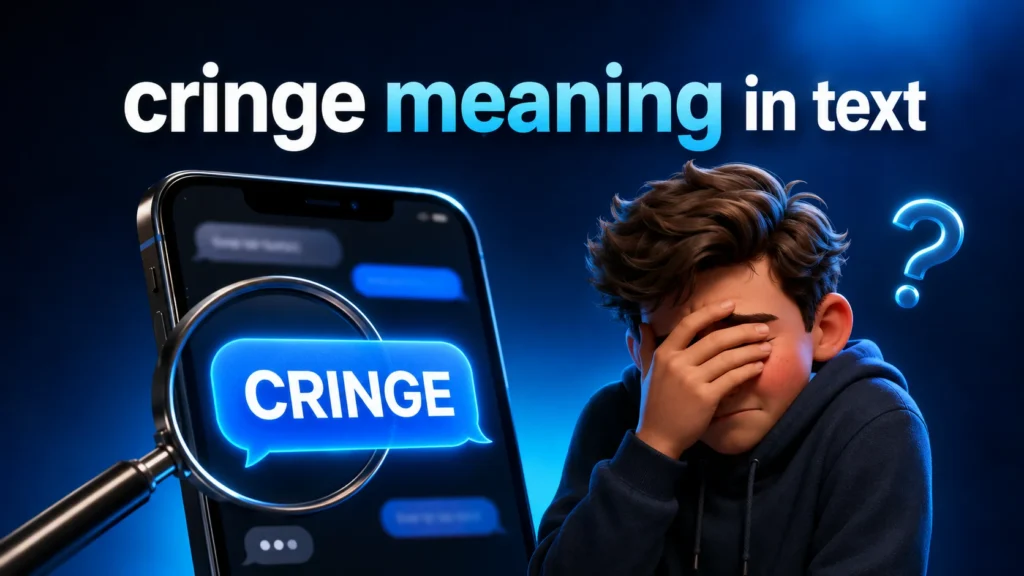
The cringe meaning in text usually describes something embarrassing, awkward, uncomfortable, or painfully uncool. When someone replies, “That’s cringe,” they mean that a message, joke, video, or behavior made them feel secondhand embarrassment.
However, the word is highly dependent on tone. Friends may use “cringe” playfully to tease each other, while a stranger may use it as a harsh insult. In other cases, someone may call their own behavior cringe because they regret being overly emotional or awkward.
People often search for this term after receiving a short response such as “cringe,” “so cringe,” or “I’m cringing.” Since text messages lack facial expressions and vocal tone, it can be difficult to know whether the sender is joking, criticizing, or genuinely uncomfortable.
Understanding the surrounding conversation, emojis, and your relationship with the sender will help you interpret the message correctly.
Cringe Meaning in Text – Quick Meaning
In texting, cringe means embarrassing, awkward, uncomfortable, or difficult to watch. It often describes something that causes secondhand embarrassment.
A quick breakdown includes:
- “That’s cringe” means “That is embarrassing or awkward.”
- “I’m cringing” means “I feel uncomfortable or embarrassed.”
- “So cringe” expresses stronger disapproval.
- “Cringe but funny” describes something embarrassing yet entertaining.
- “I was cringe” shows embarrassment about past behavior.
- “Cringe-worthy” means extremely awkward or embarrassing.
The word can describe messages, jokes, flirting, videos, fashion, opinions, or public behavior.
Examples in Text Messages
“He posted their private conversation online. That’s so cringe.”
Here, cringe expresses disapproval and secondhand embarrassment.
“I just remembered what I said last night. I’m cringing.”
The sender feels embarrassed about their own behavior.
“Your dance was cringe 😂 but honestly hilarious.”
In this example, the laughing emoji makes the criticism feel playful.
Origin and Background of Cringe
The word “cringe” existed long before social media. Traditionally, it described a physical reaction such as shrinking back, bending away, or showing discomfort because of fear, embarrassment, or disgust.
For example, someone might physically cringe after hearing an unpleasant sound. The body reacts before the person has time to explain the feeling.
From Physical Reaction to Social Slang
Over time, “cringe” developed a figurative meaning. Instead of describing only a physical movement, people began using it for the emotional discomfort caused by awkward behavior.
The phrase “cringe-worthy” became a familiar way to describe embarrassing situations. Eventually, online communities shortened this idea to the single word “cringe.”
Therefore, “That is cringe-worthy” became “That’s cringe.”
Cultural Influence
Comedy shows, reality television, talent competitions, and awkward interviews helped popularize secondhand embarrassment as entertainment. Viewers often watched uncomfortable moments while covering their faces or looking away.
This emotional response became closely connected with cringe culture. People could feel embarrassed on behalf of someone who did not appear embarrassed themselves.
Internet communities later began collecting and sharing awkward posts, failed jokes, dramatic messages, and uncomfortable videos as “cringe content.”
Social Media Impact
TikTok, YouTube, Instagram, Reddit, X, and gaming communities made “cringe” a common online judgment. Users can dismiss an entire video, opinion, or trend by posting one word.
Common comments include:
- “This is painful to watch.”
- “The secondhand embarrassment!”
- “Why is this so cringe?”
- “I physically cringed.”
- “Delete this before anyone sees it.”
The word became popular because it communicates a strong emotional reaction quickly. However, its popularity also made it easy to overuse.
How Its Meaning Evolved
Originally, cringe focused on a person’s reaction to fear or discomfort. Today, it commonly evaluates someone else’s behavior.
It can also describe personal growth. Someone may look at an old photo, caption, or romantic message and say, “I was so cringe.” In this case, the person recognizes that their past behavior no longer matches who they are.
More recently, people have challenged the habit of calling everything sincere “cringe.” A person who openly enjoys a hobby or expresses genuine emotion may seem vulnerable, but that does not automatically make their behavior embarrassing.
Real-Life Conversations Using Cringe
These conversations demonstrate how the cringe meaning in text changes according to tone and context.
WhatsApp Conversation
Person A: I sent him a five-paragraph message after one date.
and,
Person B: Please tell me you’re joking.
Person A: I wish I were. I’m cringing so badly now.
Person B: It’s okay. You were being honest—just give him space.
Here, “I’m cringing” expresses regret and embarrassment about being emotionally intense.
Instagram DM
Person A: Did you see that motivational reel I posted?
Person B: Yes! It was actually inspiring.
Person A: Really? I worried it might look cringe.
Person B: Not at all. Being sincere isn’t embarrassing.
In this exchange, the sender fears social judgment, while the friend offers reassurance.
TikTok Comments
Creator: Watch me try the dance trend after practicing for ten minutes.
Commenter A: This is so cringe 😭
Creator: I know, but I had fun!
Commenter B: Honestly, confidence makes it entertaining.
The first comment is critical, but the creator refuses to feel ashamed.
Text Messages Between Friends
Person A: I called my teacher “Mom” in front of the whole class.
Person B: No! That is painfully cringe 😂
Person A: I wanted the floor to swallow me.
Person B: Don’t worry. Everyone will forget by tomorrow.
Here, “cringe” playfully describes an embarrassing mistake rather than attacking the person’s character.
Emotional and Psychological Meaning of Cringe
Cringe often expresses secondhand embarrassment. You feel uncomfortable because another person has broken an unspoken social rule, acted without self-awareness, or revealed too much.
The emotion combines embarrassment, discomfort, judgment, and sometimes sympathy. You may want to look away while still feeling curious about what happens next.
What Emotion Does It Express?
Depending on context, cringe can communicate:
- Embarrassment
- Social discomfort
- Disapproval
- Awkwardness
- Regret
- Disgust
- Nervous amusement
- Secondhand shame
- Playful teasing
- Fear of being judged
“Cringe 😂” may sound amused, while “That was cringe.” can feel cold and dismissive.
Why People Use It
People use the word because it summarizes a complicated reaction. Instead of explaining why a joke felt forced or why a message seemed overly dramatic, they simply call it cringe.
The term can also protect the speaker from vulnerability. Calling romance, enthusiasm, or affection “cringe” allows someone to distance themselves from emotions that make them uncomfortable.
Sometimes, people use it to enforce group expectations. If one friend behaves differently, others may label that behavior cringe to signal that it does not fit the group’s idea of what is acceptable.
What It Reveals About Modern Communication
Online culture encourages people to judge content instantly. A video may receive comments within seconds, often without any effort to understand the creator.
Consequently, “cringe” can become a shortcut that ends discussion rather than encouraging it. It tells everyone that something is socially unacceptable without clearly explaining why.
At the same time, the word can promote self-awareness. Lightheartedly recognizing an awkward moment helps people laugh, recover, and move forward.
A Personal-Style Scenario
Imagine posting a video of yourself singing because you finally feel confident. A stranger comments, “Cringe.”
For a moment, you consider deleting it. Then a friend reminds you that enjoying something openly is not shameful. The stranger may simply feel uncomfortable seeing someone express confidence.
That experience reveals an important difference: something can make one viewer uncomfortable without being objectively embarrassing.
Usage in Different Contexts
The meaning of cringe changes across social media, friendships, relationships, and professional communication.
On Social Media
On social media, users apply “cringe” to videos, trends, jokes, captions, challenges, and opinions. It may describe content that appears forced, outdated, overly dramatic, or desperate for attention.
Examples include:
- “That prank was cringe.”
- “The acting made me cringe.”
- “This trend is becoming cringe.”
- “My old captions were painfully cringe.”
- “The comments are worse than the video.”
Because online audiences are diverse, one person’s cringe may be another person’s harmless fun.
Among Friends and in Relationships
Close friends often use cringe as playful teasing. They may laugh about an awkward dance, old photo, failed pickup line, or embarrassing memory.
In romantic relationships, the word requires more care. Calling a sincere love message cringe can make someone feel rejected or emotionally unsafe.
Instead of saying, “Your message was cringe,” a kinder response might be, “That was sweet, although it caught me by surprise.”
In Work and Professional Settings
“Cringe” is usually too informal and judgmental for professional communication. It offers criticism without explaining what needs improvement.
Instead of writing, “The presentation was cringe,” say:
- “The humor did not suit the audience.”
- “The tone felt less formal than expected.”
- “Some examples may make clients uncomfortable.”
- “The delivery could sound more natural.”
Specific feedback is more respectful and useful.
Casual Versus Serious Tone
In a casual conversation, “That selfie pose is cringe 😂” may be affectionate teasing. In a serious disagreement, “Everything you do is cringe” becomes a personal insult.
Emojis, punctuation, and context affect the tone. Laughing emojis may soften the message, but they do not automatically remove its hurtful impact.
When Not to Use Cringe
Avoid using cringe when someone is being sincere, vulnerable, or emotionally honest. A quick judgment can discourage them from expressing themselves again.
It is also inappropriate when discussing:
- Grief or loss
- Mental health struggles
- Personal insecurities
- Cultural or religious practices
- Disabilities or medical conditions
- A child’s creative effort
- Someone’s accent or language ability
- Serious relationship feelings
- Workplace performance reviews
- Traumatic experiences
Cultural Sensitivity
Social rules vary between cultures. Behavior that seems overly expressive in one culture may be normal, respectful, or joyful in another.
For example, public affection, emotional speeches, humor, clothing, and celebrations have different meanings across communities. Calling unfamiliar traditions cringe can appear disrespectful or culturally insensitive.
Situations That May Cause Misunderstanding
Do not send only “cringe” when the other person cannot hear your tone. They may interpret friendly teasing as harsh criticism.
If you are joking, add enough context to make your intention clear. Better yet, avoid the word if the person is likely to feel insecure about the subject.
Common Misunderstandings About Cringe
One common mistake is believing that cringe has an objective definition. In reality, it is usually a personal reaction.
Something is not automatically wrong simply because one person finds it embarrassing.
Does Cringe Mean Disgusting?
Not always. Cringe usually means awkward or embarrassing, while “disgusting” expresses stronger physical or moral disgust.
However, the emotions can overlap. A person may cringe at something that feels both unpleasant and socially uncomfortable.
Does Cringe Mean Unfunny?
Sometimes. A forced or unsuccessful joke may be called cringe because it creates awkward silence instead of laughter.
Still, cringe can describe funny content too. People often enjoy comedy precisely because the situation is painfully awkward.
Is Cringe Always an Insult?
No. Friends may use it affectionately, and people often apply it to themselves. “I was so cringe in school” is a self-aware comment rather than an attack.
When directed at someone’s sincere effort, however, it can certainly feel insulting.
Does Being Cringe Mean Someone Is Bad?
No. Awkward behavior does not define a person’s character. Everyone has embarrassing moments, especially while learning, growing, or trying something unfamiliar.
Cringe Compared With Similar Expressions
| Expression | Meaning | Typical Tone | Example |
|---|---|---|---|
| Cringe | Embarrassing or uncomfortable | Critical or playful | “That message was cringe.” |
| Awkward | Socially uncomfortable | Usually neutral | “That silence was awkward.” |
| Embarrassing | Causes shame or discomfort | Direct | “Forgetting his name was embarrassing.” |
| Cringe-worthy | Extremely embarrassing | Stronger criticism | “The speech was cringe-worthy.” |
| Secondhand embarrassment | Embarrassment for another person | Descriptive | “I felt secondhand embarrassment.” |
| Ick | Sudden loss of attraction | Personal or romantic | “That behavior gave me the ick.” |
| Corny | Overly sentimental or unoriginal | Mildly critical | “The joke was corny.” |
| Cheesy | Predictable but sometimes charming | Playful | “The movie was cheesy but sweet.” |
| Uncomfortable | Causes uneasiness | Neutral or serious | “That comment made me uncomfortable.” |
| Cool | Impressive or socially appealing | Opposite meaning | “That performance was cool.” |
| Based | Bold or confidently authentic | Often approving | “That opinion is based.” |
| Wholesome | Sincere and emotionally positive | Warm approval | “Their friendship is wholesome.” |
Key Insight
Cringe usually communicates embarrassment, but it is more subjective than words such as “inappropriate” or “harmful.” Consider whether the behavior is genuinely wrong or merely sincere, unfamiliar, or unfashionable.
Variations and Types of Cringe
1. “Cringe”
Sent alone, it means the sender finds something embarrassing or uncomfortable. Its shortness can make it sound harsh.
2. “That’s Cringe”
This directly labels a message, action, or piece of content as embarrassing. Tone determines whether it is teasing or critical.
3. “So Cringe”
“So” strengthens the judgment. It suggests that the behavior caused considerable secondhand embarrassment.
4. “I’m Cringing”
The sender is currently experiencing discomfort or embarrassment. They may be reacting to themselves or another person.
5. “I Cringed”
This means something produced an immediate awkward reaction. It often refers to a specific moment.
6. “Cringe-Worthy”
Something cringe-worthy strongly deserves an embarrassed reaction. This version often appears in reviews or descriptions.
7. “Cringey”
“Cringey” is an informal adjective meaning awkward or embarrassing. For example, “That pickup line was cringey.”
8. “Painfully Cringe”
This describes something so awkward that it feels emotionally difficult to watch. The phrase is usually exaggerated for effect.
9. “Cringe but Funny”
The content is embarrassing yet entertaining. The speaker may disapprove while still enjoying it.
10. “Cute Cringe”
This describes something awkward but endearing, such as an overly romantic message or nervous confession.
11. “Old-School Cringe”
The phrase refers to outdated styles, captions, jokes, or trends that now seem embarrassing.
12. “Cringe Culture”
Cringe culture involves publicly mocking people for awkward, enthusiastic, or socially unconventional behavior.
How to Respond When Someone Uses Cringe
Your response should depend on whether the sender is joking, giving feedback, or attempting to insult you.
Casual Replies
- “Okay, maybe it was a little awkward.”
- “I know, but I still enjoyed it.”
- “What part made you cringe?”
- “Fair enough—we all have different tastes.”
- “I’ll survive the embarrassment.”
Funny Replies
- “Cringe is temporary; screenshots are forever.”
- “I’m confidently cringe.”
- “At least I committed to it.”
- “Thanks, I practiced being awkward.”
- “My dignity left the chat hours ago.”
Mature Replies
- “Can you explain what felt uncomfortable?”
- “I understand that it wasn’t your style.”
- “I was being sincere, even if it seemed awkward.”
- “Specific feedback would be more helpful.”
- “People should be allowed to enjoy harmless things.”
Respectful Replies
- “I didn’t mean to make you uncomfortable.”
- “Thank you for telling me how it came across.”
- “Let’s discuss it without insulting each other.”
- “I respect your opinion, but I see it differently.”
- “Please don’t mock something personal to me.”
Regional and Cultural Usage
Western Culture
In Western internet culture, cringe frequently describes awkward entertainment, forced humor, outdated trends, and overly dramatic posts.
The term is widely understood among younger users, although older adults may use “embarrassing” or “awkward” instead.
Asian Culture
Young users across Asian countries commonly encounter cringe through English-language memes, gaming, TikTok, and entertainment content.
Local ideas about modesty, public emotion, and social harmony can influence what behavior people consider embarrassing.
Middle Eastern Culture
English-speaking users in Middle Eastern communities may use cringe for awkward videos, fashion, flirting, or online trends.
However, cultural and religious expectations differ greatly. A respectful user should avoid applying the label broadly to unfamiliar traditions or expressions.
Global Internet Usage
Across global platforms, cringe has become a flexible reaction word. Users often understand it even when English is not their first language.
Nevertheless, humor does not translate perfectly. What seems awkward in one online community may seem creative, normal, or charming in another.
Gen Z Versus Millennials
Gen Z frequently uses cringe as a quick comment, meme reaction, or ironic self-description. Many Gen Z users also say, “Cringe is dead,” to encourage people to enjoy things without fearing judgment.
Millennials may associate cringe with awkward television, old social media posts, embarrassing photographs, and memories from their teenage years.
Both generations use the term, but younger users often apply it more rapidly and ironically.
Is Cringe Safe for Kids?
Yes, the word cringe is generally safe for kids. It is not inherently sexual or profane.
However, children may use it to shame classmates for their interests, appearance, creativity, or emotional expression. Parents and teachers should explain that finding something awkward does not justify bullying.
A child-friendly explanation is: “Cringe means something makes you feel embarrassed or uncomfortable, sometimes because it seems socially awkward.”
Frequently Asked Questions
What does cringe mean in a text message?
Cringe means something is embarrassing, awkward, uncomfortable, or difficult to watch. It often expresses secondhand embarrassment.
What does it mean when someone calls you cringe?
It means they consider your behavior awkward or embarrassing. They may be teasing, criticizing, or attempting to insult you, depending on the tone.
Is cringe a bad word?
No, cringe is not a swear word. However, it can still hurt someone when used to mock their personality, emotions, culture, or sincere effort.
What does “I’m cringing” mean in text?
“I’m cringing” means the person currently feels embarrassed or uncomfortable. They may feel that way about themselves or something they witnessed.
What does “cringe” mean from a girl?
From a girl, cringe has the same basic meaning: awkward or embarrassing. Look at the conversation and emojis to determine whether she is teasing or genuinely uncomfortable.
What does “cringe” mean from a guy?
From a guy, cringe usually means he finds something embarrassing, forced, or uncomfortable. His relationship with you and usual texting style reveal whether it is playful or serious.
Is cringe the same as awkward?
The meanings overlap, but they are not identical. Awkward describes an uncomfortable situation, while cringe emphasizes the embarrassed reaction it produces.
Conclusion
The cringe meaning in text is usually “embarrassing, awkward, uncomfortable, or painfully uncool.” It often describes the feeling of secondhand embarrassment caused by a message, joke, video, or social situation.
Still, the word is subjective. One person may find a romantic message cringe, while another considers it sincere and sweet. Likewise, an unusual hobby may seem embarrassing to outsiders but meaningful to the person enjoying it.
When someone texts “cringe,” examine the conversation, punctuation, emojis, and your relationship. Close friends may be teasing, while a blunt one-word response from a stranger may be dismissive.
Use the term carefully, especially when someone is being vulnerable. Harmless enthusiasm should not automatically become a reason for shame. Sometimes, having the confidence to be yourself matters more than appearing perfectly cool.