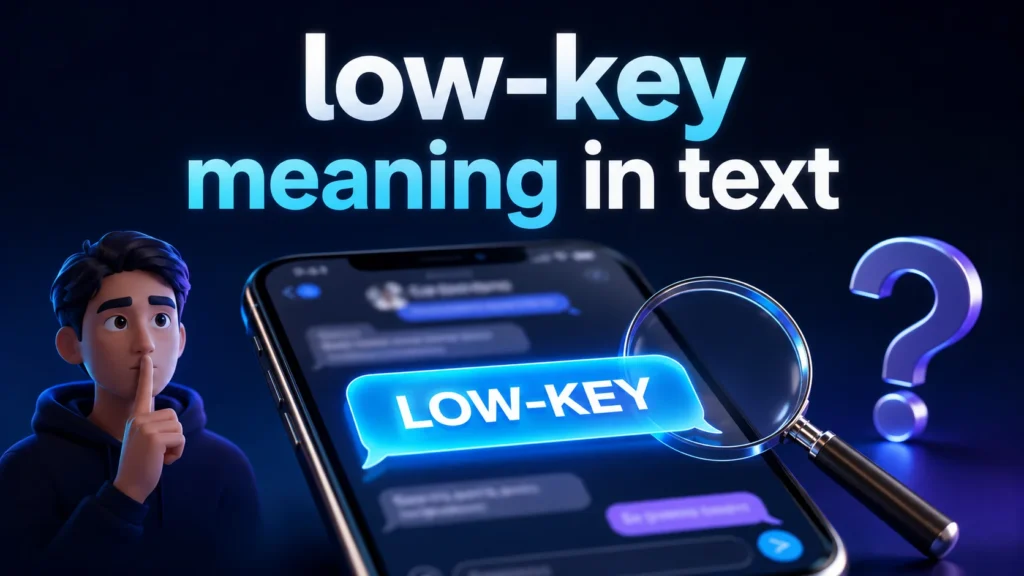
The low-key meaning in text is usually “slightly,” “secretly,” “quietly,” or “without making a big deal about it.” People use the phrase when they want to express a feeling or opinion in a relaxed, understated way.
For example, “I low-key miss you” means the sender misses you but may feel shy, uncertain, or unwilling to admit it openly. Meanwhile, “Let’s keep it low-key” means the person wants something simple, private, or not overly exciting.
People often search for this phrase because its meaning changes with context. It can describe hidden attraction, mild excitement, private plans, or a calm personality.
Moreover, text messages do not include facial expressions or vocal tone. Understanding the surrounding conversation helps you decide whether “low-key” sounds playful, romantic, serious, or secretive.
Low-Key Meaning in Text – Quick Meaning
In texting, low-key means quietly, secretly, slightly, or in a restrained way. It allows someone to express a thought without making it sound too strong or dramatic.
The phrase commonly has two uses:
- As an adverb: “I low-key like him” means “I secretly or somewhat like him.”
- As an adjective: “We had a low-key evening” means “We had a quiet, simple evening.”
It can also soften an honest confession. Instead of saying, “I really want to go,” someone might write, “I low-key want to go.”
Simple Examples
“I low-key miss our old conversations.”
The sender quietly admits that they miss talking to someone.
“That outfit is low-key amazing.”
The outfit is surprisingly impressive, even if it does not immediately attract attention.
“Let’s keep the party low-key.”
The speaker wants a small, relaxed celebration rather than a large event.
Therefore, context decides whether the phrase means “secretly,” “somewhat,” or “calm and private.”
Origin and Background of Low-Key
“Low-key” existed long before texting and social media. Traditionally, it described something quiet, modest, restrained, or lacking strong intensity.
The expression is connected to the idea of keeping something at a lower emotional or visual level. Something low-key does not demand attention.
Traditional Meaning
Historically, people used “low-key” as an adjective in phrases such as “a low-key celebration” or “a low-key personality.” In these examples, it describes something calm, simple, or understated.
The term also appears in photography and visual art. Low-key lighting uses shadows, darker tones, and limited brightness to create a dramatic mood.
However, everyday slang developed differently. Speakers began placing “low-key” before verbs and feelings to make statements sound less direct.
Cultural Influence
Youth culture helped transform the phrase from a description into an emotional modifier. Saying “I low-key love this song” feels less intense than declaring, “I absolutely love this song.”
This softer style suits modern conversations because many people want to express themselves without appearing overly emotional. It allows vulnerability while preserving a sense of casual confidence.
Hip-hop, entertainment, television, and online communities also helped popularize the slang usage. Eventually, “low-key” became common in conversations about attraction, opinions, plans, and personal preferences.
Social Media Impact
TikTok, Instagram, Snapchat, X, and messaging apps have made the term even more flexible. Users place it in captions, comments, memes, and reaction posts.
Popular examples include:
- “Low-key obsessed with this look.”
- “I low-key want to delete everything.”
- “This song low-key changed my mood.”
- “They would low-key make a cute couple.”
- “I’m low-key nervous about tomorrow.”
Social media users often exaggerate while pretending to understate their feelings. Consequently, “low-key obsessed” may actually indicate strong excitement rather than mild interest.
How the Meaning Evolved
The original meaning focused on being calm, quiet, or unnoticed. Modern slang expanded it to include private emotions and reluctant admissions.
Today, “low-key” may mean:
- Secretly
- Somewhat
- Honestly
- Quietly
- Unexpectedly
- Without attracting attention
- More than someone wants to admit
- In a simple or relaxed way
Although these meanings overlap, the surrounding sentence usually makes the intended message clear.
Real-Life Conversations Using Low-Key
The following conversations show how the low-key meaning in text changes according to the platform and relationship.
WhatsApp Conversation
Person A: Are you doing anything for your birthday?
Person B: I’m thinking of keeping it low-key this year.
and,
Person A: Dinner with a few close friends?
Person B: Exactly. Nothing big, just good food and peaceful company.
Here, “keeping it low-key” means planning a small, relaxed celebration.
Instagram DM
Person A: You liked all of Hamza’s new photos.
Person B: Stop noticing everything!
and,
Person A: Do you like him?
Person B: I low-key do, but please don’t tell anyone yet.
In this conversation, the sender admits a secret or developing attraction.
TikTok Comments
Creator: Trying this hairstyle even though I wasn’t sure about it.
Commenter A: It low-key suits you better than the old one.
Creator: I was thinking the same thing!
Commenter B: Not even low-key—it looks amazing.
The first commenter gives understated praise. The second person strengthens the compliment by rejecting the understatement.
Text Messages Between Friends
Person A: Are you ready for tomorrow’s presentation?
and,
Person B: I low-key feel terrified.
Person A: You know the material better than anyone. You’ll be fine.
Person B: Thank you. I needed that reassurance.
Here, “low-key” softens a genuine admission of anxiety.
Emotional and Psychological Meaning of Low-Key
Low-key frequently communicates feelings that the sender does not want to state too strongly. It creates emotional distance between the person and the confession.
For instance, “I miss you” sounds direct and vulnerable. “I low-key miss you” expresses the same basic emotion but adds uncertainty, restraint, or playful self-protection.
What Emotion Does It Express?
Depending on the message, low-key can express:
- Shyness
- Hidden attraction
- Mild excitement
- Private happiness
- Nervousness
- Embarrassment
- Reluctant agreement
- Understated admiration
- Secret disappointment
- A desire for privacy
The phrase itself is not positive or negative. Instead, it changes the intensity of the words that follow.
Why People Use It
People often use low-key to protect themselves from embarrassment. If the other person responds badly, the sender can pretend the feeling was not very serious.
It also makes strong statements sound conversational. “I’m low-key obsessed with this series” feels playful, whereas “I’m obsessed” sounds more intense.
Furthermore, low-key can test another person’s reaction. Someone may write, “I low-key like you” to reveal interest without making a formal romantic confession.
What It Reveals About Modern Communication
Modern texting often rewards emotional understatement. People may worry that direct enthusiasm will look desperate, dramatic, or uncool.
As a result, low-key provides a comfortable middle ground. It allows someone to be honest without appearing completely exposed.
However, this indirect style can cause confusion. A person may describe a strong feeling as “low-key,” leaving the reader unsure whether the statement is serious.
A Personal-Style Scenario
Imagine that a close friend sends you a photograph from a trip you took together. You reply, “I low-key miss those days.”
Although the sentence sounds casual, the feeling may be deeper. Perhaps you miss the friendship, freedom, or happiness associated with that memory.
In situations like this, low-key does not make the emotion meaningless. Instead, it helps the sender express something personal without making the conversation uncomfortable.
Usage in Different Contexts
The interpretation of low-key depends on the topic, relationship, and emotional tone.
On Social Media
On social media, low-key often introduces an opinion, reaction, or confession. People use it to sound casual while sharing what they genuinely think.
Examples include:
- “This movie was low-key emotional.”
- “I low-key need that jacket.”
- “She low-key won the trend.”
- “This place is low-key beautiful.”
- “I low-key agree with him.”
In many cases, the speaker is deliberately understating a strong reaction.
Among Friends and in Relationships
Friends may use low-key to admit preferences or tease each other. “You low-key enjoyed that party” suggests the person had more fun than they want to admit.
In romantic conversations, the phrase may signal attraction. “I low-key like you” usually means genuine interest, although the sender may still feel uncertain.
Nevertheless, one message does not automatically confirm a serious romantic intention. Consider the person’s behavior, consistency, and the rest of the conversation.
In Work and Professional Settings
Low-key can describe a relaxed event in friendly workplace communication. For example, “We’re having a low-key team lunch on Friday” sounds natural and appropriate.
However, the slang usage may feel too casual in formal emails, reports, or client communication. Instead of writing, “I’m low-key concerned about the deadline,” say, “I have some concerns about meeting the deadline.”
Professional language should communicate the exact level of importance without emotional ambiguity.
Casual Versus Serious Tone
In casual conversation, low-key can be playful:
- “I low-key want another slice of cake.”
- “That joke was low-key funny.”
- “I low-key knew you would say that.”
In a serious situation, the same wording may minimize an important concern:
- “I’m low-key feeling unsafe.”
- “I’m low-key struggling.”
- “This situation is low-key dangerous.”
Serious feelings deserve clear language. If help or immediate action is needed, avoid understating the problem.
When Not to Use Low-Key
Low-key is useful for casual expression, but it may weaken messages that require clarity, urgency, or emotional honesty.
Avoid using it for:
- Emergencies
- Medical symptoms
- Safety concerns
- Serious mental health struggles
- Legal instructions
- Workplace complaints
- Important deadlines
- Formal apologies
- Relationship boundaries
- Major personal decisions
For example, “I’m low-key having trouble breathing” does not communicate the seriousness of the situation. A direct request for medical help would be safer.
Inappropriate Contexts
Do not use low-key to minimize another person’s experience. Saying, “You’re low-key overreacting” may sound dismissive, especially when the person is upset.
Likewise, formal documents and academic writing usually require more precise language. Words such as “somewhat,” “privately,” “subtly,” or “moderately” may communicate the intended meaning more accurately.
Cultural Sensitivity
Not every English speaker understands the modern slang meaning. Some people may recognize only the traditional definition of quiet or understated.
Consequently, “I low-key dislike this decision” could confuse an international colleague. Direct wording prevents misunderstanding across cultures and generations.
Situations That May Cause Misunderstanding
The phrase may hide the actual intensity of an emotion. “I low-key love you” could mean mild attraction, a shy confession, or strong affection disguised as humor.
If the message affects an important friendship or relationship, ask what the sender means instead of relying on one phrase.
Common Misunderstandings About Low-Key
A frequent mistake is assuming that low-key always means secretly. While secrecy is one possible meaning, the phrase may also mean slightly, calmly, or without attracting attention.
Does Low-Key Mean Secretly?
Sometimes. “I low-key have a crush on her” often means the speaker has not openly shared the attraction.
However, “We had a low-key weekend” does not suggest a secret weekend. It simply means the weekend was quiet and relaxed.
Does Low-Key Mean a Little?
Often, yes. “I’m low-key tired” may mean “I’m a little tired.”
Still, online slang frequently uses understatement for emphasis. A person saying “I’m low-key obsessed” may actually be extremely enthusiastic.
Is Low-Key Always Romantic?
No. The phrase can describe food, clothing, music, places, opinions, stress, and everyday plans.
It becomes romantic only when the surrounding message involves attraction, affection, dating, or relationships.
Does Low-Key Mean Unimportant?
Not necessarily. Low-key describes how someone expresses or presents something, not how important it truly is.
A low-key wedding can still be deeply meaningful. Similarly, a low-key confession may contain strong emotion.
Low-Key Compared With Similar Expressions
| Expression | Meaning | Typical Tone | Example |
|---|---|---|---|
| Low-key | Secretly, slightly, or quietly | Casual and understated | “I low-key like this song.” |
| High-key | Openly, strongly, or obviously | Excited and direct | “I high-key love this song.” |
| Secretly | Without others knowing | Private | “I secretly hope she comes.” |
| Kinda | To some degree | Very casual | “I kinda miss him.” |
| Sort of | Partly or somewhat | Uncertain | “I sort of understand.” |
| Honestly | Expresses a genuine opinion | Direct | “Honestly, that was impressive.” |
| Subtly | In a quiet, less noticeable way | Neutral | “She subtly changed the topic.” |
| Under the radar | Without attracting attention | Private or strategic | “We kept the project under the radar.” |
| Chill | Relaxed and easygoing | Casual | “It was a chill evening.” |
| Quietly | Without attention or noise | Neutral | “I’m quietly hoping they win.” |
| Loudly | Openly and noticeably | Opposite meaning | “She proudly supported the idea.” |
| Obviously | Clearly or unmistakably | Direct | “He obviously likes her.” |
Key Insight
Low-key can reduce the apparent strength of a statement, but it does not always reduce the real emotion behind it. Tone and context reveal whether the sender feels something mildly or is hiding a stronger reaction.
Variations and Types of Low-Key
1. “I Low-Key Like You”
The sender admits attraction in a cautious way. The interest is usually genuine, but the person may feel shy or uncertain.
2. “I Low-Key Miss You”
This means the person misses you but does not want to sound overly emotional. It may also test whether you feel the same way.
3. “I’m Low-Key Obsessed”
The sender strongly enjoys something while presenting the excitement as casual. This variation is often intentionally exaggerated.
4. “That’s Low-Key Funny”
Something is funnier than expected. The speaker may be reluctantly admitting that the joke worked.
5. “Low-Key Cute”
A person, object, outfit, or situation is quietly or unexpectedly attractive. It usually functions as a positive compliment.
6. “Low-Key Annoyed”
The person feels irritated but may not be extremely angry. Alternatively, they may be hiding stronger frustration.
7. “Low-Key Nervous”
The sender feels some anxiety about an upcoming situation. The phrase softens the emotional admission.
8. “Keep It Low-Key”
This means to keep something quiet, private, simple, or free from unnecessary attention.
9. “A Low-Key Event”
This describes a small, relaxed, and informal gathering. It does not necessarily mean the event is secret.
10. “Low-Key Agree”
The speaker agrees but may feel reluctant to say so openly. Perhaps the opinion is unpopular within their social group.
11. “Low-Key Jealous”
The person admits experiencing some jealousy. The casual wording may hide embarrassment about the feeling.
12. “Low-Key Fire”
In slang, “fire” means excellent. Therefore, “low-key fire” describes something surprisingly good or impressive.
How to Respond When Someone Uses Low-Key
Your response should match the topic and the sender’s emotional openness.
Casual Replies
- “Honestly, same.”
- “I had a feeling!”
- “You might be right.”
- “That makes sense.”
- “Why only low-key?”
- “I kind of feel that way too.”
Funny Replies
- “That doesn’t sound very low-key anymore.”
- “Your secret is safe with me.”
- “Low-key? You mention it every day.”
- “Just admit you love it.”
- “That was the loudest low-key confession ever.”
- “Should I act surprised?”
Mature Replies
- “Thank you for being honest.”
- “Do you want to talk more about that?”
- “I appreciate you telling me how you feel.”
- “You don’t need to minimize it with me.”
- “Is it a small concern or something more serious?”
- “I’d rather understand your real feelings.”
Respectful Replies
- “Just to clarify, do you mean secretly or slightly?”
- “I understand. I won’t share it with anyone.”
- “There’s no pressure to explain more than you want.”
- “I respect how you feel.”
- “Would you prefer to keep this private?”
- “Let me know how I can support you.”
When the message involves anxiety, sadness, or safety, respond to the underlying feeling instead of focusing only on the slang.
Regional and Cultural Usage
Western Culture
In the United States, Canada, the United Kingdom, and other English-speaking regions, low-key is common in informal conversation. Young people often use it to express restrained opinions or feelings.
The traditional meaning also remains popular. People frequently describe birthdays, clothing, restaurants, and personalities as low-key when they are simple or understated.
Asian Culture
English-speaking social media users across Asian cultures commonly use low-key through global entertainment, memes, and youth slang.
However, indirect emotional expression already plays an important role in many communities. As a result, the phrase may feel particularly useful when discussing attraction, disagreement, or personal preferences without sounding confrontational.
Middle Eastern Culture
Young English-speaking users in Middle Eastern communities may use low-key in captions, private messages, and conversations about relationships or entertainment.
When privacy and family expectations matter, “keep it low-key” may specifically suggest avoiding public attention. Still, individual families and communities differ considerably.
Global Internet Usage
Across the internet, low-key has become a widely recognized way to soften a statement. Users apply it to everything from romantic feelings to restaurant reviews.
Nevertheless, second-language speakers may interpret it literally. Clearer wording is best when the conversation involves serious information.
Gen Z Versus Millennials
Gen Z commonly uses low-key as an adverb before emotions and opinions, such as “I low-key need this” or “That low-key hurt.”
Millennials also use the slang, although many are familiar with its older adjectival meaning, such as “a low-key dinner.”
Both generations understand the phrase, but Gen Z usage often relies more heavily on irony, exaggeration, and emotional understatement.
Is Low-Key Safe for Kids?
Yes, low-key is generally safe for kids. It is not a swear word, sexual expression, or inherently offensive term.
Children may use it to mean secretly, slightly, calmly, or without attracting attention. For example, “I low-key like that game” is harmless.
However, parents should examine the full message. “Keep this low-key” may involve an innocent surprise, but it could also encourage secrecy about something inappropriate.
A child-friendly explanation is: “Low-key means quietly, a little, or without making a big deal about something.”
Frequently Asked Questions
What does low-key mean in a text message?
Low-key usually means secretly, slightly, quietly, or without making something seem important. The exact meaning depends on the sentence and emotional context.
What does “I low-key like you” mean?
It usually means the sender feels attracted to you but is expressing it cautiously. They may feel shy, uncertain, or worried about your response.
What does “I low-key miss you” mean?
It means the person misses you but does not want to state the feeling too strongly. The message may be a subtle attempt to reconnect.
Does low-key mean secretly?
Low-key can mean secretly, especially when describing feelings or opinions. However, it can also mean somewhat, understated, calm, or simple.
What is the opposite of low-key?
“High-key” is the common slang opposite. It means openly, strongly, obviously, or without hiding the intensity of a feeling.
Is low-key a compliment?
It can be. Expressions such as “low-key beautiful,” “low-key funny,” and “low-key amazing” communicate understated or unexpected praise.
What does “keep it low-key” mean?
“Keep it low-key” means keep something quiet, private, simple, or away from public attention. Context determines whether the speaker wants privacy or merely a relaxed atmosphere.
Conclusion
The low-key meaning in text is usually “secretly,” “slightly,” “quietly,” or “without making a big deal about it.” It helps people express attraction, excitement, nervousness, disagreement, or admiration in a casual way.
However, low-key does not always mean the emotion is weak. Someone who says, “I low-key miss you” may be hiding deep feelings behind relaxed wording. Likewise, “low-key obsessed” often expresses considerable enthusiasm.
The phrase can also retain its traditional meaning. A low-key party is simple and relaxed, while a request to keep something low-key usually means avoiding unnecessary attention.
Whenever the meaning feels unclear, look at the topic, relationship, emojis, and sender’s usual communication style. If the message involves serious emotions, asking a kind follow-up question is better than making an assumption.
Used naturally, low-key makes conversations sound modern and emotionally relaxed. Now you can recognize whether someone is expressing a mild opinion, sharing a private feeling, or quietly admitting more than they first intended.