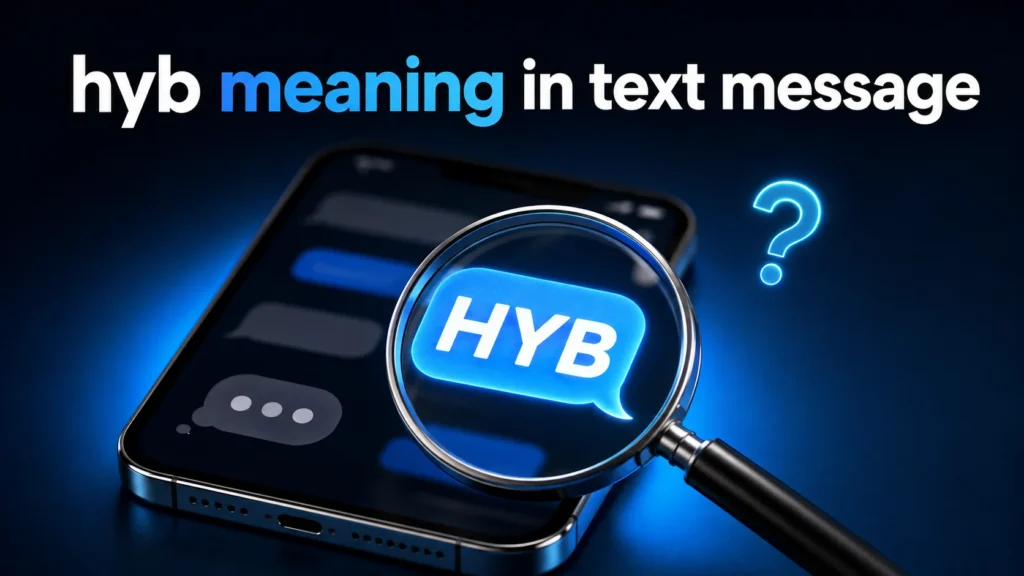
The HYB meaning in text message is usually “How you been?” It is a casual way to ask how someone has been doing, especially when you have not spoken for a while.
You might receive “HYB?” from an old friend, former classmate, distant relative, or someone trying to restart a quiet conversation. In some situations, it may even come from a crush or an ex who wants to reconnect.
However, HYB has a few less common meanings, including “handle your business” and “hit you back.” This overlap can make a short message surprisingly confusing.
The safest way to understand HYB is to examine the words around it, your relationship with the sender, and the direction of the conversation.
HYB Meaning in Text Message – Quick Meaning
HYB most commonly stands for “How you been?” It is an informal version of “How have you been?”
People use it to:
- Check on someone’s well-being
- Restart a conversation
- Reconnect after a period of silence
- Show friendly interest
- Ask what has happened recently
- Break the ice without writing a long introduction
Both Dictionary.com and NoSlang recognize “how you been?” as a common meaning of HYB.
Simple Examples
“Hey, HYB? It’s been ages!”
The sender is casually asking for an update after a long absence.
“I saw your graduation pictures. HYB lately?”
Here, HYB begins a friendly conversation inspired by a recent post.
“HYB, stranger? 👀”
This version sounds playful and may be friendly, teasing, or slightly flirtatious.
HYB can also mean something different when it appears inside a longer sentence:
“I’m busy right now. I’ll HYB later.”
In this example, it probably means “hit you back,” or contact you later.
Origin and Background
HYB developed from the culture of shortening common expressions for digital communication. Early mobile phones made typing slower, while SMS character limits encouraged people to communicate with fewer letters.
Expressions such as LOL, BRB, HRU, HBU, and TTYL became familiar because they saved time. HYB followed the same practical pattern.
When HYB means “how you been?”:
- H represents “how.”
- Y represents “you.”
- B represents “been.”
The complete grammatical question would be “How have you been?” Still, casual speech often removes “have,” producing “How you been?” Texting captures that relaxed spoken style.
Cultural Influence
Asking someone how they have been is a common social ritual. It shows interest while allowing the other person to decide how much they want to share.
HYB makes that check-in feel less formal. It is particularly useful when two people have not spoken recently but do not want the reunion to feel awkward.
For example, “Please tell me how you have been since we last spoke” sounds formal and emotionally serious. By comparison, “Hey, HYB?” sounds natural and low-pressure.
Social Media Impact
Snapchat, Instagram, TikTok, WhatsApp, and other messaging platforms helped abbreviations like HYB spread across different communities.
A person may reply to an old friend’s Instagram story with “HYB?” instead of creating a long opening message. Likewise, someone might use it on Snapchat after noticing that a friend has been inactive.
The phrase works well online because it creates an opening without demanding a detailed response.
How the Meaning Evolved
Although “how you been?” remains the most likely interpretation, HYB has acquired several alternative meanings.
“Handle your business” is an established secondary use. It tells someone to deal with a responsibility or personal matter.
Some users also interpret HYB as “hit you back,” meaning they will reply or contact someone later. This use is easier to identify when words such as “later,” “soon,” or “after work” appear nearby.
Real-Life Conversations
WhatsApp Conversation
Person A: I just found our old university group photos.
and,
Person B: Those days were unforgettable 😂
Person A: Seriously! HYB? We haven’t talked in months.
Person B: I’ve been good, just extremely busy with work. How about you?
Here, HYB means “how you been?” Person A is genuinely interested in catching up after a long communication gap.
Instagram DM
Person A: Hey, your travel photos appeared on my feed. HYB, stranger? 👀
Person B: I’m good! I’ve been travelling for work. HYB?
Person A: Not bad. We should catch up properly sometime.
The word “stranger” makes the opening playful. Depending on their history, the exchange could be friendly or mildly flirtatious.
TikTok Comments
Creator: Sometimes you outgrow people without having an argument.
Old Friend: This reminded me of our school days. HYB?
Creator: I’m doing better now. I hope you are too.
HYB serves as a soft attempt to reconnect. The commenter appears nostalgic but avoids making the interaction too emotionally intense.
Personal Text Message
Person A: Can you call me when you’re free?
Person B: I’m in a meeting. I’ll HYB after 4.
Person A: No problem. It isn’t urgent.
In this conversation, HYB probably means “hit you back.” The time reference makes that interpretation more logical than “how you been?”
Emotional and Psychological Meaning
When HYB means “how you been?”, it usually expresses curiosity, care, nostalgia, or a desire to reconnect.
The phrase can seem simple, but its emotional meaning depends heavily on timing. Receiving HYB from a close friend after two quiet days feels different from receiving it from an ex after two years.
What Emotion Does HYB Express?
HYB may communicate:
- Friendly concern
- Curiosity about your life
- Nostalgia for a past connection
- A desire to restart communication
- Playful romantic interest
- Concern after noticing your absence
- Politeness before making a request
- An attempt to repair emotional distance
The sender might sincerely want to know how you are. On the other hand, HYB can simply function as a convenient conversation starter.
Why People Use It
Reconnecting after a long silence can feel uncomfortable. People may worry that the other person is angry, uninterested, or unwilling to discuss the distance.
HYB reduces that pressure. It acknowledges the time apart without forcing either person to explain why communication stopped.
Still, a short check-in does not always indicate deep emotional investment. The sender’s later effort usually reveals more than the opening abbreviation.
A Personal-Style Scenario
Imagine that a close friend gradually stopped messaging after moving to another city. Neither of you had an argument, but months passed as work and responsibilities took over.
One evening, the friend replies to your WhatsApp status with, “Hey, HYB? I was thinking about you today.”
That message probably carries more than casual politeness. The added sentence shows genuine remembrance and a desire to rebuild the connection.
Usage in Different Contexts
Social Media
On social media, HYB often appears in comments, replies, and private messages. It can help someone move a public interaction into a personal conversation.
Common examples include:
- “Haven’t seen you post lately. HYB?”
- “Your new place looks amazing! HYB?”
- “HYB, bro? We need to catch up.”
- “Just found your account again. HYB?”
A stranger using HYB may simply be starting a conversation. Nevertheless, you are not obligated to share personal information with someone you do not know.
Friends and Relationships
Between friends, HYB usually sounds relaxed and caring. It often means, “Tell me what has been happening in your life.”
In romantic situations, the same letters can carry additional emotional weight. “HYB?” alone is not proof of attraction, but “HYB, beautiful? I’ve missed talking to you” clearly sounds more personal.
When an ex sends HYB, the person may be curious, lonely, nostalgic, or interested in reconnecting. One message does not reveal the complete intention, so watch what follows.
Work and Professional Settings
HYB is generally too casual for formal emails, job applications, or communication with unfamiliar clients.
It may be acceptable between colleagues who already have a friendly relationship:
“Welcome back! HYB since the move?”
In more formal settings, write “How have you been?” or “I hope you have been well.” Complete wording appears clearer and more professional.
Casual Versus Serious Tone
Punctuation and additional words shape the message:
- “HYB?” — neutral, casual check-in
- “Heyyy, HYB? 😊” — warm or possibly flirtatious
- “HYB lately?” — asks about recent life
- “HYB, stranger?” — playful acknowledgment of silence
- “HYB??” — surprised or especially curious
- “HYB.” — may feel flat, serious, or emotionally distant
- “HYB after everything?” — potentially confrontational
Do not interpret the abbreviation separately from its punctuation and surrounding language.
When Not to Use HYB
Formal Communication
Avoid HYB when contacting a professor, employer, customer, interviewer, or professional connection for the first time. The abbreviation may appear careless or unclear.
Serious Emotional Situations
If someone has experienced grief, illness, or a major personal problem, “HYB?” may feel too casual.
A more thoughtful message would be:
“I’ve been thinking about you. How have you been coping?”
Clear words show greater sensitivity when the situation is emotionally significant.
When You Actually Need Something
Some people begin with HYB and immediately ask for money, a favour, or professional help. That approach can make the greeting feel insincere.
If you have a request, be honest about it instead of pretending that the message is only a friendly check-in.
After Ignoring Someone
Sending “HYB?” after repeatedly ignoring another person may seem dismissive. Acknowledge the silence first:
“I’m sorry I disappeared. The past few weeks were difficult. How have you been?”
When Someone Requested Distance
Do not use HYB as an excuse to ignore a clear boundary. If someone asked for no contact, a casual greeting can still feel intrusive.
Common Misunderstandings
HYB Does Not Always Mean “How You Been?”
“How you been?” is normally the first interpretation, especially when HYB appears as a question or greeting. Yet the position of the abbreviation can change its meaning.
Compare:
- “Hey, HYB?” — How you been?
- “You need to HYB.” — Handle your business.
- “I’ll HYB tonight.” — Hit you back.
The surrounding grammar provides the strongest clue.
HYB Versus HBY
HYB and HBY contain the same letters in a different order, but they usually mean different things.
- HYB: How you been?
- HBY: How about you?
If someone says, “I’m doing well, HBY?” they are returning the question. Writing HYB in that position may be a typo.
Assuming It Is Romantic
HYB is not inherently romantic. Friends, classmates, relatives, and coworkers can all use it.
A flirtatious interpretation becomes more likely when HYB appears with compliments, pet names, affectionate emojis, or repeated attempts to continue the conversation.
Confusing Interest With Commitment
Someone who sends “HYB?” is showing at least enough interest to open a conversation. However, the message does not prove that they want a friendship, relationship, or serious reunion.
Pay attention to whether they ask meaningful follow-up questions and communicate consistently.
Taking “Handle Your Business” Too Literally
When someone writes “HYB,” they may be encouraging you to focus, solve a problem, or take responsibility. The tone could be supportive, firm, or dismissive.
For example, “Forget the drama and HYB” means “focus on your responsibilities,” not “how have you been?”
Comparison With Similar Expressions
| Expression | Meaning | Typical use | Tone |
|---|---|---|---|
| HYB | How you been? | Reconnecting after time apart | Friendly or curious |
| HRU | How are you? | General check-in | Neutral |
| HBU | How about you? | Returning a question | Conversational |
| WSP | What’s up? | Casual greeting | Relaxed |
| WYD | What are you doing? | Asking about current activity | Direct and casual |
| WHYB | Where have you been? | Asking about someone’s absence | Curious or concerned |
| LMK | Let me know | Requesting an update | Practical |
| HMU | Hit me up | Asking someone to contact you | Casual |
| TTYL | Talk to you later | Ending a conversation | Friendly |
| IDRC | I don’t really care | Showing low interest | Distant or dismissive |
Key Insight
HYB usually focuses on the period since two people last communicated. HRU asks about the present, while HBU normally returns a question that has already been asked.
Variations and Types of HYB
1. HYB?
The standard version means “How you been?” It is a quick and neutral check-in.
2. Hey, HYB?
Adding “hey” makes the greeting feel warmer and more natural.
3. HYB Lately?
This version asks specifically about recent experiences, emotions, or life changes.
4. HYB, Stranger?
It playfully highlights that the two people have not communicated for some time.
5. HYB Bro?
This is a relaxed check-in between male friends or people who casually call each other “bro.”
6. HYB Girl?
The phrase may sound friendly, enthusiastic, or playful, depending on the relationship.
7. HYB? I Miss You
Adding “I miss you” gives the message emotional depth and shows that the sender wants to reconnect.
8. HYB? 👀
The eyes emoji adds curiosity. In some cases, it creates a teasing or flirtatious tone.
9. HYB? ❤️
A heart makes the check-in more affectionate. It may be romantic, familial, or deeply friendly.
10. I’ll HYB Later
Here, HYB likely means “hit you back.” The sender promises to contact or reply later.
11. Go HYB
In this structure, HYB probably means “handle your business.” It encourages someone to address a responsibility.
How to Respond When Someone Uses HYB
Casual Replies
- “I’ve been good! How about you?”
- “Not bad, just busy lately.”
- “I’m doing well. It’s been a while!”
- “Same old life 😂 HYB?”
- “Good overall. What’s new with you?”
Funny Replies
- “Alive, caffeinated, and somehow surviving.”
- “Busy pretending I have everything under control 😂”
- “I’ve been waiting for you to ask!”
- “Better now that you finally remembered me.”
- “That depends—how much time do you have?”
Mature Replies
- “I’ve had a challenging few months, but I’m doing better.”
- “A lot has changed. I’d be happy to catch up.”
- “I’ve been focusing on myself and making progress.”
- “Thank you for checking in. How have you been?”
- “Life has been busy, but I appreciate your message.”
Respectful Replies
- “I’ve been well, thank you. I hope you have too.”
- “Thank you for asking. Everything is going smoothly.”
- “I’m doing fine. It is nice to hear from you.”
- “I appreciate you checking in.”
- “I’ve been keeping busy. How may I help?”
If you are unsure what HYB means, simply ask, “Do you mean how I’ve been?” Clarification is better than replying to the wrong interpretation.
Regional and Cultural Usage
Western Culture
In Western texting culture, HYB commonly appears between friends, acquaintances, old classmates, and romantic interests. Its casual grammar matches everyday spoken English.
The phrase may also be used when someone wants to resume contact without directly discussing why the conversation stopped.
Asian Culture
English texting abbreviations are popular among younger people across many Asian countries. HYB may appear in bilingual conversations, especially on WhatsApp, Instagram, or Snapchat.
However, people communicating in a second language may confuse HYB with HBY. Writing the complete question is often better when clarity matters.
Middle Eastern Culture
HYB can be used among English-speaking friends, relatives, students, and online communities. Warm greetings are important in many Middle Eastern cultures, so a complete personal greeting may feel more respectful than an unexplained abbreviation.
Among close friends, though, HYB can sound natural and relaxed.
Global Internet Usage
The global internet does not give every abbreviation one fixed definition. Individual communities may use HYB for “how you been?”, “handle your business,” or “hit you back.”
Sentence structure remains more reliable than geography when interpreting it.
Gen Z Versus Millennials
Gen Z users may combine HYB with emojis, lowercase writing, playful teasing, or ironic language. Millennials may use it as a straightforward shortcut when reconnecting with an old contact.
Neither pattern is universal. Personal communication habits matter more than generation alone.
Is HYB Safe for Kids?
Yes, HYB is generally safe for children and teenagers. Its usual meaning, “how you been?”, is friendly and harmless.
Parents should still encourage children to be careful when strangers use casual messages to begin private conversations. A friendly abbreviation does not automatically mean the sender is trustworthy.
Children should avoid sharing their location, school details, private photographs, or other personal information with unknown users.
Frequently Asked Questions
What does HYB mean in a text message?
HYB usually means “How you been?” It is an informal way to ask how someone has been doing since the last conversation.
Can HYB mean “hit you back”?
Yes. In a sentence such as “I’m working, so I’ll HYB later,” it may mean “hit you back,” or contact you later.
What does HYB mean from a guy?
A guy who sends “HYB?” is normally asking how you have been. He may be friendly, curious, nostalgic, or interested in restarting the conversation.
What does HYB mean from a girl?
A girl may use HYB as a casual check-in after a period of silence. The message can be friendly or flirtatious, depending on the surrounding words and your relationship.
Is HYB a flirting abbreviation?
HYB is not automatically flirtatious. However, phrases such as “HYB, handsome?” or “HYB, stranger? I missed you” can carry romantic interest.
What is the difference between HYB and HBY?
HYB usually means “How you been?” HBY means “How about you?” and commonly appears when someone returns a question.
How should I answer HYB?
Briefly explain how you have been and return the question. For example: “I’ve been good, just busy with work. How have you been?”
Conclusion
The HYB meaning in text message is most commonly “How you been?” People use it to check on someone, restart a quiet conversation, or reconnect after spending time apart.
Still, HYB may occasionally mean “handle your business” or “hit you back.” A question mark usually points toward “how you been?”, while words such as “later” or “need to” suggest an alternative definition.
When the message comes from a friend, crush, or ex, avoid building a complete story around three letters. Look at the sender’s tone, follow-up questions, consistency, and your shared history.
Most of the time, “HYB?” is simply an open door. Your answer decides whether the conversation becomes a quick greeting, a meaningful reunion, or something more.