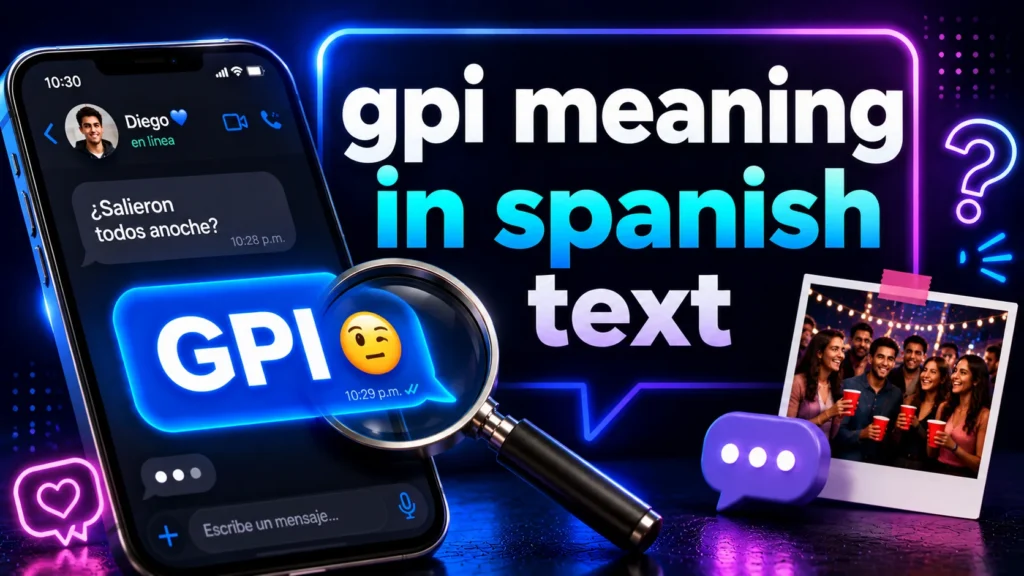
If you see “GPI” in a Spanish text, WhatsApp message, Instagram comment, or TikTok reply, it usually means “gracias por invitar.” In English, that translates to “thanks for inviting” or “thanks for the invite.” However, the real meaning is often more sarcastic than thankful.
Someone may comment “GPI 😂” after seeing photos of friends eating together, traveling, attending a party, or doing something fun without them. In that situation, they are really saying:
“Thanks for inviting me… even though you didn’t.”
The phrase is particularly associated with informal Mexican and Latin American internet culture. Spanish-language media describe GPI as a common social-media abbreviation used sarcastically when someone notices they were left out of an event, meeting, or trip.
That combination of humor, jealousy, and mild disappointment is what makes GPI interesting.
Understanding the GPI meaning in Spanish text is therefore about more than translating three words. You also need to understand the social tone behind them.
GPI Meaning in Spanish Text – Quick Meaning
What Does GPI Mean in Spanish?
GPI = Gracias Por Invitar
The literal English translation is:
“Thanks for inviting.”
In everyday online communication, it often means:
- “Thanks for inviting me… not.”
- “Why didn’t you invite me?”
- “I wanted to come too.”
- “Nice of you to leave me out.”
- “Next time, remember me.”
- “So everyone went except me?”
- “Looks fun. Where was my invitation?”
For example:
“¿Fueron por tacos sin mí? GPI 😂”
Translation:
“You went for tacos without me? Thanks for inviting 😂”
Another example:
“Qué bonito viaje, GPI 😒”
Translation:
“Nice trip, thanks for inviting me 😒”
And:
“Todos en la fiesta menos yo. GPI 😭”
Translation:
“Everyone’s at the party except me. Thanks for inviting 😭”
The abbreviation itself stays the same, but the emoji and situation reveal whether the sender is joking or genuinely annoyed.
Origin & Background of GPI
Where Did GPI Come From?
GPI developed from informal Spanish-language digital communication.
It takes the first letters of:
G — Gracias
P — Por
I — Invitar
That creates GPI.
The expression became especially recognizable in social-media conversations where people reacted to gatherings they were not invited to.
Although it is strongly associated with Mexican internet culture, it can also be understood or used by Spanish speakers elsewhere.
Reference sources describe GPI as the initials of “gracias por invitar” and specifically note its sarcastic use in Mexico when someone was excluded from an event, meeting, or trip.
Is GPI Official Spanish?
GPI is not a standard abbreviation for formal Spanish writing.
Reports quoting guidance from the Real Academia Española describe forms like “gpi” as abbreviations belonging to informal electronic communication, such as chats and short messages. They are not treated as standardized abbreviations for general formal writing.
That means GPI is perfectly natural in places like:
- TikTok
- Snapchat
- Group chats
- Casual text messages
It is much less appropriate in essays, professional emails, official letters, or academic writing.
Social Media Made GPI More Expressive
Social media gave GPI the perfect environment to grow.
Imagine opening Instagram and discovering that five of your friends went to your favorite restaurant.
You were never invited.
Rather than writing:
“Why didn’t anyone tell me?”
you simply comment:
“GPI 😭”
The message is short, funny, and immediately communicates that you noticed being left out.
That efficiency is one reason slang abbreviations spread so quickly online.
Real-Life Conversations Using GPI
WhatsApp Conversation
Person A: Ayer fuimos al nuevo restaurante del centro.
(Yesterday we went to the new restaurant downtown.)
Person B: ¿Todos fueron? GPI 😭
(Everyone went? Thanks for inviting me 😭)
Person A: JAJAJA fue de último momento.
(Haha, it was last minute.)
Person B: Siempre dicen eso 😂
(You always say that 😂)
Here, GPI expresses playful disappointment.
Instagram DM
Person A: Posts beach photos.
Person B: Wowww, qué bonito. GPI 😂
Person A: Jajaja la próxima vienes.
Person B: Eso dicen siempre 😭
The meaning is basically:
“Wow, beautiful. Thanks for inviting me.”
The sender is teasing because they were not included.
TikTok Comments
Creator: “Spontaneous road trip with the best group 🚗✨”
Friend: GPI 🤡
Creator: Tú dijiste que estabas ocupado 😭
Friend: Igual se invita 😂
Translation:
“You said you were busy.”
“You still invite me anyway.”
Here, GPI works as a playful complaint.
Text Message
Person A: Fuimos a ver la película anoche.
Person B: GPI.
and,
Person A: Pensé que ya la habías visto 😭
Person B: Igual quería ir 😂
A simple “GPI.” without a laughing emoji can sound more serious.
The punctuation gives the abbreviation more emotional weight.
Emotional & Psychological Meaning of GPI
GPI is a good example of verbal irony.
The words express gratitude:
“Gracias por invitar.”
The emotional message often expresses the opposite:
“You did not invite me.”
That contradiction makes the expression funny.
GPI Can Express FOMO
GPI often connects with the feeling commonly called FOMO, or “fear of missing out.”
You see people enjoying themselves somewhere and suddenly wish you had been included.
Instead of admitting:
“I feel excluded,”
you write:
“GPI 😭”
Humor protects the sender from sounding overly vulnerable.
GPI Can Hide Genuine Hurt
Not every GPI is completely playful.
Imagine you regularly spend weekends with the same friend group.
One Saturday, you open Instagram and discover everyone went out together without telling you.
You comment:
“GPI 🥲”
The message looks humorous, but underneath it might mean:
“I actually wish you had remembered me.”
That emotional ambiguity is important.
A friend may laugh at the message while still realizing that the sender felt excluded.
Why People Prefer GPI Over a Direct Complaint
Writing:
“Why wasn’t I invited?”
can create tension.
Writing:
“GPI 😂”
makes the same social point without immediately turning the situation into an argument.
The sender communicates awareness while leaving room for humor.
This indirectness is a major part of modern online communication.
Usage of GPI in Different Contexts
GPI on Instagram
Instagram is one of the most natural places to see GPI.
A friend uploads a restaurant story.
You reply:
“GPI 😭”
Someone posts vacation pictures.
You comment:
“GPI para la próxima 😂”
The abbreviation works because visual posts often reveal social plans after they happen.
GPI on WhatsApp
On WhatsApp, GPI frequently appears in group chats.
For example:
Person A: Estamos tomando café.
Person B: GPI 🙄
The sender is jokingly asking why nobody invited them.
GPI on TikTok
TikTok comments often exaggerate emotions for humor.
Someone posts:
“Dinner with my favorite people.”
A friend comments:
“GPI 💀”
The skull emoji makes the complaint dramatic and funny.
GPI Between Friends
Among close friends, GPI is usually playful.
Because everyone already understands the relationship, sarcasm is easier to interpret.
For example:
“¿Se fueron sin mí? GPI perros 😂”
The exact vocabulary will vary by friendship group and region, but the emotional idea remains the same.
GPI in Relationships
Couples may also use GPI.
For example:
“You got coffee without me? GPI 😒”
The sender may genuinely be slightly annoyed while still joking.
Moreover, GPI can therefore communicate both affection and mild complaint.
GPI at Work
GPI can appear in relaxed workplace chats:
“You all went for coffee? GPI 😂”
That may be fine among friendly coworkers.
However, using GPI after being excluded from a professional meeting could sound passive-aggressive.
For serious workplace communication, direct wording is safer.
When NOT to Use GPI
In Formal Spanish
Avoid GPI in:
- Academic assignments
- Professional emails
- Job applications
- Official letters
- Reports
- Business proposals
Write the complete phrase instead.
During Genuine Conflicts
If exclusion has seriously upset you, sarcasm may hide the real issue.
Instead of:
“GPI.”
you may need to say:
“Me hubiera gustado que me invitaran.”
That means:
“I would have liked you to invite me.”
It communicates the emotion clearly.
With People Who May Not Know the Slang
Spanish learners may not recognize GPI.
Even native speakers from different regions may not use the abbreviation regularly.
If the meaning matters, write the full phrase.
At Sensitive Private Events
Not every gathering requires an invitation.
Commenting “GPI” on a private family dinner, intimate celebration, work event, or personal occasion may make the other person uncomfortable.
When You Want to Avoid Passive-Aggressive Tone
“GPI 😒” can sound like criticism.
If you do not want the sender to think you are genuinely annoyed, use a laughing emoji or playful wording.
Common Misunderstandings About GPI
GPI Means a Genuine “Thank You”
Sometimes the words may be interpreted literally, but online GPI is strongly associated with sarcasm.
If someone was clearly not at the event, sarcastic meaning is more likely.
GPI Means “Gracias Por Invitarme”
People sometimes expand GPI as:
“Gracias por invitarme.”
That phrase means:
“Thanks for inviting me.”
However, the initials most directly correspond to:
Gracias Por Invitar.
In casual conversation, both explanations communicate essentially the same social idea.
GPI Is Used Everywhere in Spanish
Not exactly.
The abbreviation is particularly documented in Mexican internet culture. Other Latin American users may recognize it, but popularity varies by country, age, and online community.
GPI Is Always a Joke
No.
A laughing emoji can make it playful:
“GPI 😂”
An annoyed emoji can communicate real irritation:
“GPI 😒”
And a plain:
“GPI.”
may sound noticeably colder.
GPI Meaning Comparison Table
| Expression | Meaning | Typical Tone | Example |
|---|---|---|---|
| GPI | Gracias por invitar | Sarcastic/playful | “¿Cena sin mí? GPI 😂” |
| NTP | No te preocupes | Reassuring | “NTP, todo bien.” |
| NTC | No te creas | Playful | “Era broma, NTC.” |
| TQM | Te quiero mucho | Affectionate | “Buenas noches, TQM.” |
| XFA | Por favor | Casual | “Mándalo xfa.” |
| XQ | Porque / por qué | Casual | “Xq no viniste?” |
| GRX | Gracias | Friendly | “Grx por ayudar.” |
| FOMO | Fear of missing out | Excluded/anxious | “Tengo FOMO.” |
| “Thanks for the invite” | English equivalent | Sarcastic | “Nice party, thanks for the invite.” |
Key Insight
The real meaning of GPI is usually found in the irony. The sender says “thanks for inviting” precisely because no invitation was received.
Variations / Types of GPI
1. GPI
Meaning: Gracias por invitar.
The standard version.
2. gpi
Meaning: Same as GPI.
Lowercase does not normally change the meaning.
3. GPI 😂
Meaning: Playful teasing.
The sender is probably joking more than complaining.
4. GPI 😭
Meaning: Dramatic disappointment.
Often means:
“I wanted to come too!”
5. GPI 😒
Meaning: Mild irritation.
This version may sound more serious.
6. GPI 🥲
Meaning: Humorous but slightly hurt.
It can suggest genuine feelings of exclusion.
7. GPI 💔
Meaning: Stronger emotional disappointment.
Often exaggerated for humor, though context matters.
8. “Ah bueno, GPI”
Meaning: “Oh okay, thanks for inviting me.”
The phrase adds extra sarcasm.
9. “GPI para la próxima”
Meaning: “Remember to invite me next time.”
It turns the complaint into a future request.
10. “Qué padre, GPI”
Meaning: “How cool, thanks for inviting.”
This can sound particularly natural in Mexican casual conversation.
How to Respond When Someone Uses GPI
Casual Replies
You can answer:
- “Jajaja la próxima 😂”
- “Perdón 😭”
- “Fue improvisado.”
- “Te aviso la próxima.”
- “Ya estás invitado para la siguiente.”
Funny Replies
If you are close friends:
- “Tu invitación se perdió 😂”
- “Se me olvidó tu paloma mensajera.”
- “Pensé que podías leer mentes 😭”
- “La próxima organizas tú.”
- “No revisaste el correo 😂”
Mature Replies
If the person sounds genuinely hurt:
- “Perdón, no quería hacerte sentir excluido.”
- “La próxima te aviso directamente.”
- “Fue algo de último momento.”
- “Entiendo por qué te molestó.”
Respectful Replies
If you are unsure whether they are joking:
- “¿Lo dices en serio? 😅”
- “Perdón si te sentiste excluido.”
- “Claro, la próxima contamos contigo.”
- “No fue mi intención dejarte fuera.”
A good response recognizes that humor and genuine feelings can exist together.
Regional & Cultural Usage of GPI
Mexican Culture
GPI is especially associated with Mexican internet slang.
Mexican media describe it as an abbreviation for “gracias por invitar” used sarcastically when somebody discovers they were not invited to an event, trip, or gathering.
Other Latin American Countries
The abbreviation may also be understood throughout other Spanish-speaking communities, particularly because social-media slang travels across national borders.
Usage is not necessarily equally common everywhere.
Western English-Speaking Culture
English has a nearly identical sarcastic expression:
“Thanks for the invite.”
For example:
“You all went to the beach without me? Thanks for the invite 😂”
GPI performs essentially the same emotional function in Spanish.
Asian Culture
Spanish learners across Asia may encounter GPI through TikTok, music fandoms, gaming, Instagram, or Latin American friends.
The biggest challenge is recognizing that the phrase is often sarcastic rather than literal.
Middle Eastern Culture
Multilingual users may similarly encounter GPI in Spanish-language online communities.
Someone translating only “gracias por invitar” may miss the irony.
Understanding the social situation is therefore more important than translating the words individually.
Global Internet Usage
Modern slang rarely stays within one country.
TikTok videos, memes, influencers, music fandoms, and international group chats allow expressions such as GPI to travel rapidly.
Even users who are not Mexican may eventually recognize its sarcastic meaning.
Gen Z vs. Millennials
Gen Z users often combine GPI with dramatic emojis:
“GPI 😭💀”
Millennials may also use or recognize it, especially if they are active in Mexican or Latin American social-media culture.
Individual internet habits matter more than strict age categories.
Is GPI Safe for Kids?
Yes, GPI is generally safe for kids and teenagers.
It does not contain profanity or inherently adult meaning.
The abbreviation simply stands for:
Gracias por invitar.
A teenager writing:
“GPI 😭”
may simply be joking because friends went somewhere without them.
However, the emotional context can still matter.
If a child repeatedly talks about being excluded by friends, the issue may be social exclusion rather than the slang itself.
The expression is harmless; the situation behind it may occasionally deserve attention.
FAQs About GPI Meaning in Spanish Text
What does GPI mean in Spanish text?
GPI means “gracias por invitar,” or “thanks for inviting.” It is commonly used sarcastically when someone was not actually invited.
What does GPI mean on WhatsApp?
On WhatsApp, GPI usually means “gracias por invitar.” Someone may send it after learning that friends made plans without them.
What does GPI mean on Instagram?
On Instagram, GPI often appears as a reaction to photos or stories showing a party, restaurant visit, vacation, or group activity the commenter was not invited to.
What does GPI mean on TikTok?
On TikTok, GPI usually carries the same meaning: “gracias por invitar.” It is often used humorously or sarcastically in comments.
Is GPI sarcastic?
Very often, yes. The person literally says “thanks for inviting,” but the joke is that no invitation was actually received.
Is GPI Mexican slang?
GPI is especially associated with Mexican internet communication, although users elsewhere in the Spanish-speaking world may also understand or use it.
What should I reply to GPI?
If the message is playful, reply with something like “La próxima 😂” or “Perdón 😭.” If the person seems genuinely hurt, acknowledge that and explain what happened.
Conclusion
The GPI meaning in Spanish text is “gracias por invitar,” which literally means “thanks for inviting.”
The important part, however, is the sarcasm.
When someone sees photos of friends at dinner, a party, a concert, or a vacation and writes:
“GPI 😂”
they are usually saying:
“Thanks for inviting me… even though you didn’t.”
With 😭, the message becomes dramatically disappointed.
and,
With 😒, it can sound genuinely annoyed.
With 🥲, it may hide a little real hurt beneath the joke.
That is why context matters more than the abbreviation alone.
GPI works because three simple letters can communicate gratitude, sarcasm, FOMO, friendship, and mild disappointment all at once.
If you remember one thing, remember this:
When someone writes GPI after seeing an event they were not part of, they probably are not thanking you for the invitation.
They are reminding you that there never was one.