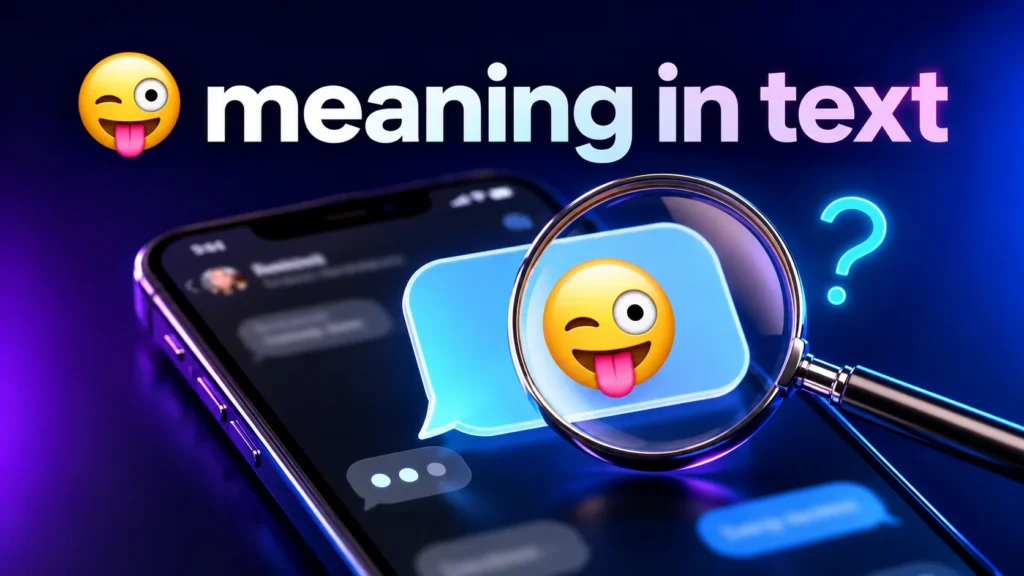
The 😜 meaning in text is usually playful teasing, cheeky humor, sarcasm, or lighthearted flirting. Officially known as the “winking face with tongue” emoji, it combines a wink with a silly expression to show that a message should not be taken too seriously.
People often search for its meaning because the same emoji can feel friendly, flirtatious, sarcastic, or even slightly rude depending on the conversation. A message such as “You wish you were this funny 😜” could be harmless teasing between friends or playful flirting between two people who like each other.
Therefore, understanding 😜 requires more than recognizing the face. You also need to consider your relationship with the sender, the message that came before it, and the emotional tone of the conversation.
😜 Meaning in Text – Quick Meaning
The most common 😜 meaning in text is:
- “I’m only joking.”
- “I’m teasing you.”
- “Don’t take that seriously.”
- “I’m being cheeky.”
- “I’m feeling playful.”
- “I might be flirting with you.”
The wink signals shared humor or a hidden intention. Meanwhile, the tongue makes the message look sillier and less serious.
For example:
“I ate the last piece of cake 😜”
Here, the sender admits something while making it sound playful.
“You know you missed me 😜”
This could be friendly teasing or light flirting.
“Obviously, I’m the smartest one here 😜”
In this example, the emoji shows that the confident statement is probably a joke.
Although 😜 usually has a positive tone, context is essential. If it follows criticism or an insensitive comment, the emoji may not make the message feel harmless.
Origin and Background of the 😜 Emoji
Where did 😜 come from?
Before emojis became common, internet users created playful faces with keyboard characters. Expressions such as “;P” or “;-P” represented a wink combined with a tongue sticking out.
The 😜 emoji developed as a colorful, easier-to-recognize version of that classic emoticon. Unicode officially calls it “Winking Face with Tongue.”
As smartphones and social media platforms became more popular, the emoji quickly found a place in casual digital conversations. Its exaggerated expression made it especially useful for communicating jokes that might otherwise sound serious.
Cultural influence
Sticking out the tongue has long been associated with silliness, teasing, childish rebellion, and playful disrespect in many cultures. Winking, however, often suggests a private joke, friendly secret, or flirtatious intention.
Combining those two expressions created an emoji that feels mischievous without normally appearing aggressive.
However, body language does not carry identical meanings everywhere. In some cultures, sticking out the tongue may appear disrespectful, particularly when used toward an older person or authority figure.
Social media impact
Instagram, TikTok, Snapchat, WhatsApp, and other platforms helped expand the use of 😜. People now place it after jokes, captions, challenges, teasing comments, and flirtatious messages.
On social media, it can also make confident statements sound less boastful. For instance, someone might post, “Best dancer in the group 😜” to show playful confidence rather than serious arrogance.
How its meaning evolved
Originally, the expression mostly communicated silliness. Over time, it gained additional meanings such as sarcasm, cheekiness, mischief, and flirting.
Today, the 😜 meaning in text depends heavily on the surrounding words. It can soften a joke, signal romantic interest, or simply show that the sender is in a fun mood.
Real-Life Conversations Using 😜
WhatsApp conversation between friends
Person A: Are you still coming, or will you cancel again?
Person B: I’m already getting ready!
Person A: That means you’ll arrive two hours late 😜
Person B: Wow, you know me too well.
In this conversation, Person A uses 😜 to tease a friend about a familiar habit. The emoji keeps the comment affectionate rather than critical.
Instagram DM with a flirtatious tone
Person A: That picture looks really good.
Person B: Only the picture? 😜
Person A: Fine, you look amazing too.
Here, 😜 adds playful flirtation. Person B is inviting another compliment without asking for it too seriously.
TikTok comment
Creator: I made this recipe without checking the instructions.
Commenter: We can tell 😜
Creator: At least I tried!
The comment is sarcastic, but the emoji makes it feel more like friendly teasing. Still, the relationship between the users matters. A stranger might interpret the same comment as slightly rude.
Everyday text message
Person A: Did you finish the assignment?
Person B: What assignment? 😜
Person A: Don’t scare me like that!
Person B: Relax, I finished it last night.
The emoji immediately hints that Person B is joking. Without it, the reply could create genuine confusion or worry.
Emotional and Psychological Meaning of 😜
What emotion does it express?
The 😜 emoji mainly expresses amusement, playfulness, mischief, or cheeky confidence. It allows someone to say something bold while leaving emotional room for humor.
A sender might use it when they want to tease you but do not want their words to sound cruel. Similarly, they may add it after a flirtatious statement to avoid feeling too emotionally exposed.
Why do people use it?
Text messages do not include vocal tone, facial expressions, or natural body language. As a result, even an innocent joke may appear serious or unfriendly.
The 😜 emoji works as a tone marker. It tells the reader, “Imagine me saying this with a playful face.”
People also use it to protect themselves from awkwardness. If a flirtatious comment receives a positive response, they can continue. If it does not, they can present the comment as a joke.
What it reveals about modern communication
Modern digital communication depends heavily on small visual signals. One emoji can change how an entire sentence feels.
For example, “You’re impossible” may sound frustrated. However, “You’re impossible 😜” usually sounds affectionate or amused.
I once received a message that said, “I guess you finally remembered me 😜.” Without the emoji, it could have sounded hurt or accusatory. With it, the message felt like a gentle invitation to reconnect. That small symbol transformed potential tension into warmth.
Usage of 😜 in Different Contexts
On social media
On Instagram and TikTok, 😜 commonly appears in funny captions, playful comments, dance videos, challenges, and confident selfies.
Examples include:
- “I said I wouldn’t buy anything 😜”
- “Try to keep up with me 😜”
- “Just causing a little trouble today 😜”
In these cases, the emoji presents the speaker as carefree, humorous, or mischievous.
Between friends
Friends use 😜 to make fun of each other’s habits, exaggerate their own abilities, or continue an inside joke.
A close friend might text, “You would be lost without me 😜.” The words sound boastful, but the playful face signals affection.
Nevertheless, friendship does not automatically make every joke acceptable. Sensitive subjects still require care.
In romantic relationships
Between partners or potential romantic interests, 😜 can communicate playful attraction. It often follows compliments, challenges, or suggestive jokes.
For example, “Maybe I dressed up for you 😜” can imply romantic interest without becoming overly serious.
If someone repeatedly combines 😜 with compliments, personal questions, or affectionate language, flirting is more likely. One emoji alone, however, does not prove attraction.
In professional settings
The emoji is generally too casual for formal emails, job applications, client complaints, or messages to senior management.
It may be acceptable in a relaxed workplace chat when colleagues already share an informal relationship. For example, “I promise I’ll stop changing the presentation 😜” may work within a friendly creative team.
Even so, a safer emoji such as 🙂 is usually better when professional boundaries are unclear.
Casual versus serious tone
The emoji naturally belongs in casual communication. It works well when the topic is light and everyone understands the humor.
In serious conversations about health, grief, conflict, money, or workplace performance, it can look dismissive. The words and situation should always guide your choice.
When Not to Use 😜
During serious emotional conversations
Avoid 😜 when someone is sharing sadness, anxiety, grief, or disappointment. Its playful expression may suggest that you are not taking their feelings seriously.
For example, replying “That’s unfortunate 😜” to bad news would appear insensitive.
In formal communication
Do not use it in academic applications, official complaints, legal messages, condolences, or formal business correspondence. Its cheeky personality can weaken the seriousness of your message.
After an insulting statement
An emoji does not automatically turn an insult into a joke. A message such as “You’re really bad at this 😜” may still hurt the recipient.
If your humor targets someone’s appearance, intelligence, culture, family, health, or insecurity, reconsider the message entirely.
With someone you barely know
A new contact may misunderstand teasing because they do not yet recognize your personality. In addition, 😜 can appear flirtatious even when that was not your intention.
Start with clearer, more neutral language until you understand the other person’s communication style.
Across cultural or generational boundaries
Some people view tongue-out emojis as childish or disrespectful. Others may interpret the wink as romantic.
If the reader comes from a different cultural background or belongs to a different generation, use words to make your intention clearer.
Common Misunderstandings About 😜
It does not always mean flirting
One of the biggest misunderstandings is that 😜 automatically signals romantic interest. Friends, siblings, and coworkers may use it simply to show humor.
Look for other clues, such as frequent compliments, private jokes, affectionate nicknames, or attempts to spend time together.
It does not excuse rude behavior
Some senders place 😜 after an offensive comment and expect the emoji to erase its impact. However, the recipient may still feel insulted.
Tone markers help explain intention, but they do not remove responsibility for hurtful words.
It is not the same as 😛
Both emojis show a tongue, but 😛 usually communicates simple silliness. The wink in 😜 adds mischief, teasing, or a possible hidden meaning.
Sarcasm can still be confusing
The emoji often signals sarcasm, but not everyone interprets sarcasm in the same way. If the topic matters, direct communication is safer.
Its meaning can change within seconds
“Bring me coffee 😜” may be a playful request. In contrast, “You forgot my coffee again 😜” could contain real frustration hidden behind humor.
Pay attention to the history of the conversation instead of judging the emoji in isolation.
😜 Compared With Similar Emojis and Expressions
| Emoji or expression | Common meaning | Difference from 😜 | Typical tone |
|---|---|---|---|
| 😜 | Teasing, mischief, playful flirting | Combines a wink with silliness | Cheeky |
| 😛 | Fun, silliness, joking | Less suggestive and less mischievous | Goofy |
| 😉 | Hint, secret, or flirtation | More subtle and mature | Flirtatious |
| 🤪 | Wild excitement or ridiculous behavior | More chaotic and exaggerated | Crazy-fun |
| 😏 | Confidence, suggestion, or smugness | More suggestive and less innocent | Flirty or smug |
| 😂 | Strong laughter | Expresses reaction rather than teasing | Amused |
| 🙃 | Awkwardness, irony, or hidden frustration | Often contains emotional discomfort | Ironic |
| “Just kidding” | Clarifies that something was a joke | More direct than an emoji | Neutral |
| “Seriously” | Shows sincerity or emphasis | Often opposite to 😜 | Earnest |
| 😐 | Lack of amusement or emotion | Contrasts with playful energy | Flat |
Key Insight
Among similar expressions, 😜 is especially useful when a sender wants to combine humor with a small amount of mischief. It feels bolder than 😛 but usually less suggestive than 😏.
Variations and Types of 😜 Usage
1. Playful teasing
It means, “I’m making fun of you affectionately.”
Example: “You finally replied after a hundred years 😜”
2. Light flirting
It adds romantic energy without making the message too direct.
Example: “Maybe I was hoping you’d notice me 😜”
3. Friendly sarcasm
It signals that a statement means something different from its literal wording.
Example: “Yes, waking up at 6 a.m. is my favorite thing 😜”
4. Cheeky confidence
It makes a proud statement sound entertaining instead of arrogant.
Example: “Naturally, I won again 😜”
5. Harmless mischief
It suggests that the sender has done something slightly naughty but amusing.
Example: “I may have borrowed your charger 😜”
6. An inside joke
It reminds the recipient of shared knowledge that other people may not understand.
Example: “Let’s not order the extra-spicy one this time 😜”
7. Softening a request
It makes a casual request sound less demanding.
Example: “You can bring snacks when you come 😜”
8. Playful challenge
It invites the other person to compete or prove something.
Example: “I bet you can’t beat my score 😜”
9. Mock innocence
The sender acts innocent while clearly admitting playful responsibility.
Example: “Who, me? I would never do that 😜”
10. Hidden frustration
Sometimes the humor covers genuine annoyance or disappointment.
Example: “Nice of you to remember my birthday 😜”
This variation requires special attention because the sender may be expressing hurt indirectly.
How to Respond When Someone Uses 😜
Your response should match both the words and your relationship with the sender.
Casual replies
- “Haha, I know you’re joking.”
- “You’re too much 😄”
- “Okay, I’ll let that one pass.”
- “I knew you’d say that!”
Funny replies
- “Bold words from you 😂”
- “Troublemaker detected.”
- “I’m saving this message as evidence.”
- “You’re officially banned from making jokes.”
Flirtatious replies
Use these only when you are comfortable with the tone:
- “Is that your way of flirting? 😉”
- “Maybe I did miss you.”
- “Careful, I might believe you.”
- “You’re enjoying this too much 😏”
Mature replies
If the message feels unclear or slightly hurtful, answer directly:
- “Are you joking, or is something bothering you?”
- “I’m not sure how to read that.”
- “I know you added an emoji, but that comment felt personal.”
- “Can you explain what you meant?”
Respectful replies
When you want to remain friendly without encouraging teasing or flirting, try:
- “Haha, understood.”
- “Thanks for clarifying.”
- “I see what you mean.”
- “Let’s keep it simple.”
You are never required to match someone’s playful or flirtatious energy. A calm reply can gently establish your preferred tone.
Regional and Cultural Usage of 😜
Western culture
In many Western online conversations, 😜 commonly represents teasing, sarcasm, flirtation, or playful rebellion. Friends may use it freely, especially in private messages.
Even so, it remains inappropriate in most formal situations.
Asian culture
Across many Asian communities, the emoji is popular among younger users on messaging platforms. It commonly signals cuteness, friendliness, or light teasing.
However, using a tongue-out expression toward elders, teachers, or supervisors may seem disrespectful in more traditional environments.
Middle Eastern culture
Younger users may use 😜 similarly to Western social media users, particularly in friendly conversations. Still, flirtatious interpretations can carry greater sensitivity depending on family expectations, religious values, and social boundaries.
Context and familiarity are particularly important when messaging someone of another gender or a person you do not know well.
Global internet usage
Across global platforms, 😜 functions as a quick symbol for “I’m joking” or “I’m being playful.” Its broad popularity makes it recognizable, but not completely universal.
Words are helpful whenever cultural differences could affect interpretation.
Gen Z versus Millennials
Millennials often use 😜 in a direct, cheerful way similar to older keyboard expressions such as “;P.” For them, it may feel nostalgic and naturally playful.
Some Gen Z users also use it sincerely, although others may use it ironically or consider it slightly old-fashioned. They might prefer 😭, 💀, or 🤪 to express laughter and chaotic humor.
Neither usage is wrong. Digital language constantly changes as generations develop new communication habits.
Is 😜 Safe for Kids?
Yes, 😜 is generally safe for children because it usually represents silliness, joking, or playful teasing. The emoji itself does not contain an adult meaning.
However, parents should teach children that context matters. A harmless-looking emoji can appear in bullying, inappropriate flirting, or messages from strangers.
Children should understand that adding 😜 does not make an unkind comment acceptable. They should also tell a trusted adult if an online message makes them confused or uncomfortable.
Frequently Asked Questions
What does 😜 mean when a guy sends it?
When a guy sends 😜, he may be joking, teasing, acting cheeky, or flirting. Consider his words and usual behavior before assuming romantic interest.
What does 😜 mean when a girl sends it?
When a girl sends 😜, it commonly shows playful teasing, friendliness, sarcasm, or light flirtation. The surrounding conversation reveals which meaning is most likely.
Is 😜 a flirting emoji?
Yes, 😜 can be a flirting emoji, especially when used with compliments, romantic jokes, or playful challenges. However, it also appears frequently in non-romantic conversations.
What is the difference between 😜 and 😉?
The 😜 emoji feels sillier and more mischievous, while 😉 usually communicates a subtle hint, private joke, or smoother form of flirtation.
Does 😜 mean “just kidding”?
Often, yes. People add 😜 to show that a bold, sarcastic, or exaggerated statement should not be interpreted literally.
Can 😜 be considered rude?
It can appear rude in formal conversations, after an insult, or when used with someone from a culture that views tongue-out expressions as disrespectful.
How do I know if 😜 is friendly or sarcastic?
Read the full message and consider your relationship with the sender. Warm language suggests friendly humor, while criticism or unresolved tension may indicate sarcasm or hidden frustration.
Conclusion
The 😜 meaning in text usually involves playful teasing, cheeky humor, light sarcasm, or casual flirting. Its wink suggests shared understanding, while its tongue-out expression tells the reader not to take the message too seriously.
Still, no emoji has one guaranteed interpretation. The same symbol can feel affectionate between close friends, flirtatious between romantic interests, or disrespectful in a formal conversation.
When you receive 😜, focus on the sender’s words, your relationship, and the wider emotional context. When you use it yourself, make sure the other person will understand your humor. Used thoughtfully, this expressive little face can bring warmth, personality, and playful energy to an ordinary text.