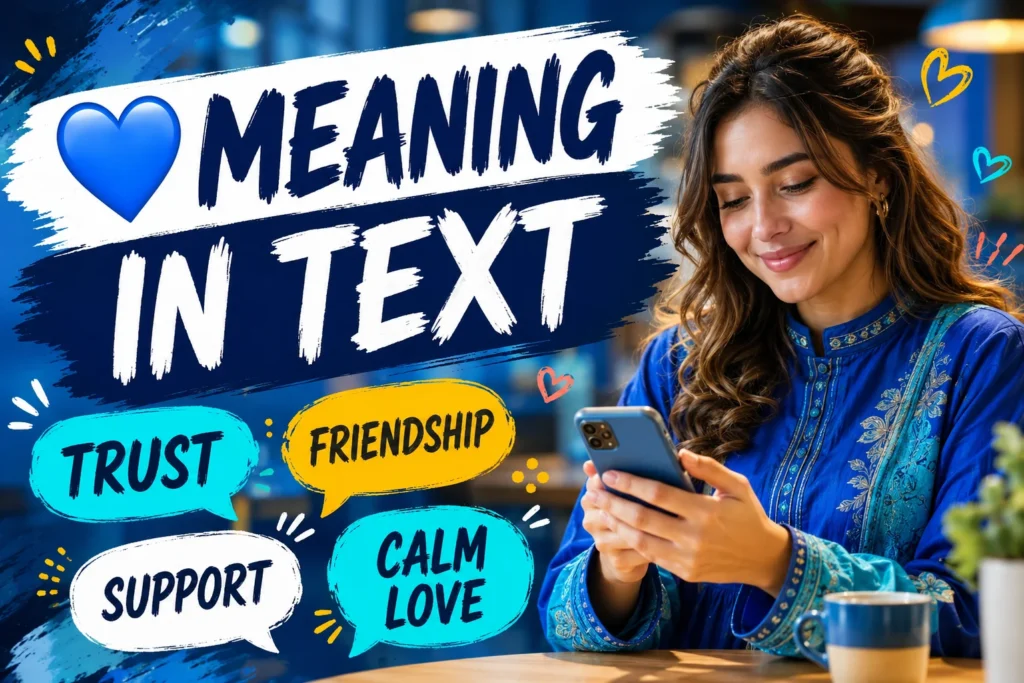
The 💙 meaning in text is usually trust, loyalty, friendship, emotional support, peace, or caring affection. Known as the blue heart emoji, it often expresses love that feels calm, reliable, and less openly romantic than a red heart.
When someone sends 💙, they may be saying:
- “I care about you.”
- “I trust you.”
- “I’m here for you.”
- “You’re a loyal friend.”
- “I support you.”
- “I feel emotionally close to you.”
- “I love you, but I’m keeping the tone gentle.”
- “Blue is connected to this person, team, or cause.”
The meaning depends on your relationship and the surrounding message. A best friend sending “Proud of you 💙” probably means supportive friendship. A romantic interest writing “Goodnight, beautiful 💙” may be expressing quiet affection.
Unlike ❤️, the blue heart does not automatically suggest passionate romance. Its emotional energy is often steadier, safer, and more reserved.
💙 Meaning in Text – Quick Explanation
The blue heart emoji represents several related emotions:
- Loyalty and commitment
- Trust and emotional safety
- Platonic friendship
- Peace and calmness
- Gentle romantic affection
- Support during difficult moments
- Love for something associated with blue
- Team, school, or national pride
- Awareness of certain causes
- Aesthetic use in captions
Examples include:
“Thank you for always listening 💙”
“You’ve got this—I believe in you 💙”
“Sleep well. Talk tomorrow 💙”
The first two examples clearly communicate trust and emotional support. The third could be friendly or romantic depending on who sent it.
What Does 💙 Mean When Sent Alone?
A single 💙 may function as:
- A quiet “I love you”
- “Thank you”
- “I support you”
- “I’m thinking about you”
- A warm acknowledgement
- A reaction to emotional news
- A way to end the conversation affectionately
Look at what you sent immediately before it.
If you wrote, “Thanks for helping me today,” and received 💙, it probably means “Of course—I care about you.”
If you wrote, “I miss you,” and received only 💙, the response acknowledges your affection but may remain emotionally cautious. It does not necessarily confirm romantic feelings.
Origin and Background of the Blue Heart Emoji
Heart symbols represented love long before digital communication existed. Emojis expanded that familiar symbol into different colours, allowing users to express distinct emotional moods without writing full explanations.
The red heart became associated with direct love and passion. The blue heart gradually developed a calmer identity connected to trust, loyalty, peace, friendship, and emotional stability.
Colour psychology also influences interpretation. Blue is commonly associated with:
- Calmness
- Security
- Reliability
- Confidence
- Sadness
- Depth
- Honesty
- Professionalism
These associations help explain why 💙 often feels loyal and reassuring rather than intensely passionate.
How Social Media Expanded Its Meaning
On social media, 💙 is not limited to personal affection. Users may choose it because blue matches:
- A photograph or outfit
- A sports team
- A school or university
- A national flag
- A music artist’s branding
- A fictional character
- An awareness campaign
- An ocean or sky theme
- A fandom’s official colour
This means a blue heart in a public caption may be aesthetic or symbolic rather than emotional.
For example:
“Perfect day by the ocean 💙”
Here, the emoji complements the blue water and peaceful atmosphere. It does not refer to a relationship.
Real-Life Conversations Using 💙
These conversations show how the meaning changes according to the sender, platform, and emotional context.
WhatsApp: Supportive Friendship
Person A: I’m nervous about tomorrow’s interview.
Person B: You’ve prepared for this. Trust yourself.
Person A: I’ll try.
Person B: You’re going to do great 💙
The blue heart expresses reassurance, loyalty, and emotional support. Nothing in the conversation clearly suggests romance.
Instagram DM: Possible Romantic Interest
Person A: That new picture is beautiful.
Person B: Thank you! I wasn’t sure whether to post it.
Person A: You should never doubt yourself 💙
Person B: You always know what to say.
The compliment and personal reassurance may indicate attraction. However, 💙 keeps the tone gentler than ❤️ or 😘.
Snapchat: Quiet Affection
Person A: Goodnight. Don’t stay awake too late.
Person B: I’ll try. Goodnight 💙
Person A: Sleep well.
The blue heart creates warmth without making the exchange overly romantic. It could appear between close friends, partners, or people still exploring their feelings.
Text Message: Family Love
Parent: Let me know when you arrive safely.
Child: I’m home now.
Parent: Good. Love you 💙
Child: Love you too 💙
Here, 💙 communicates family affection and care. Heart emojis are not limited to romantic relationships.
Emotional and Psychological Meaning of 💙
The blue heart often communicates safe love—affection built on reliability, comfort, and trust rather than excitement alone.
A red heart can feel intense. It may suggest romance, passion, or a direct emotional declaration. Someone who wants to show care without creating that pressure may choose 💙.
This makes the emoji especially useful when people want to express:
- Emotional closeness without labelling the relationship
- Friendship that feels deep and dependable
- Romantic interest without appearing too forward
- Support without using many words
- Appreciation that feels sincere but controlled
- Love during a calm or serious conversation
What 💙 May Reveal About the Sender
The sender may see you as:
- A trusted friend
- A safe person
- Someone they respect
- A dependable partner
- A meaningful emotional connection
- Someone who needs encouragement
- Part of their chosen community
Imagine telling a friend that you have been struggling emotionally. They respond, “You don’t have to handle everything alone. Call me whenever you need to talk 💙.”
The blue heart reinforces the message’s emotional safety. It says their support is steady rather than performative.
Yet emojis should never be interpreted separately from behaviour. Someone who sends 💙 but repeatedly ignores your boundaries is not demonstrating genuine loyalty. Consistent actions reveal more than a coloured heart.
How 💙 Is Used in Different Contexts
In SMS, iMessage, and WhatsApp
In direct messages, 💙 often carries a personal emotional meaning. Common examples include:
- “I’m proud of you 💙”
- “Thanks for being here 💙”
- “Goodnight 💙”
- “I miss talking to you 💙”
- “Stay safe 💙”
- “You can always trust me 💙”
The shorter and more private the message, the more important the relationship becomes in determining its meaning.
On Instagram
Instagram users add 💙 to:
- Friendship photos
- Blue-themed outfits
- Ocean or sky pictures
- Motivational posts
- Sports content
- Birthday messages
- Memorial posts
- Fan edits
- Couple pictures
A comment saying “Stunning 💙” is generally a supportive compliment. Repeated blue hearts from one person may show special attention, but they are not proof of romantic interest.
On Snapchat
On Snapchat, 💙 may accompany goodnight messages, selfies, supportive replies, or streak conversations.
A person sending “Morning 💙” every day may be building emotional closeness. The pattern of consistent attention is more meaningful than the emoji itself.
On TikTok
TikTok users place 💙 in comments to express support, admiration, fandom loyalty, or connection with blue-themed content.
For example:
“This song helped me through so much 💙”
The emoji conveys personal emotional value rather than romantic attraction.
Between Friends
The blue heart is one of the safest heart colours for friendship. It often communicates:
- “You are important to me.”
- “I value our bond.”
- “I trust you.”
- “I support you.”
- “Our friendship is strong.”
Some friends use 💙 as their shared signature heart because it feels affectionate without inviting romantic misunderstanding.
In Romantic Relationships
Partners may use 💙 to express stable and loyal love. It can feel especially meaningful in long-term relationships where emotional security matters more than dramatic displays.
A partner might send:
“No matter what happens, I’m on your side 💙”
The heart represents dependable commitment.
At Work or in Professional Messages
💙 may be acceptable in supportive workplace group chats, charity campaigns, or brand communication. It is still informal and should be used carefully.
A manager writing “Great work today 💙” may simply express team appreciation. However, sending hearts privately to a colleague can be misinterpreted if the relationship is not already friendly.
When Not to Use 💙
Although the blue heart is gentler than many romantic emojis, it can still create emotional ambiguity.
Avoid using it:
- When romantic boundaries are unclear
- In highly formal emails
- With clients who expect professional language
- During serious conflict without an explanation
- After hurting someone’s feelings
- As a substitute for a genuine apology
- When discussing sensitive loss without supportive words
- To encourage emotional intimacy you do not intend
- When the recipient has asked for distance
- In situations where a particular heart colour has a known group meaning
Do Not Use It to Avoid Clear Communication
If someone asks whether you have romantic feelings, replying only with 💙 may confuse them. A heart is not a complete answer.
Instead, communicate honestly:
“I care about you deeply as a friend, but I don’t have romantic feelings.”
Or:
“Yes, I’m starting to like you, but I want to take things slowly.”
Clear words protect both people from unnecessary emotional uncertainty.
Be Careful During Apologies
A message such as “Sorry you feel that way 💙” can appear dismissive. The heart does not replace accountability.
A sincere apology should identify the mistake, recognise its impact, and explain how the behaviour will change.
Common Misunderstandings About 💙
It Does Not Always Mean the Friend Zone
Because 💙 is associated with friendship, some people assume receiving it means romantic rejection. That conclusion is too simple.
A romantic partner can use 💙 to symbolise trust and committed love. A crush may choose it because ❤️ feels too intense at an early stage.
It Is Not Automatically Romantic
A blue heart from a friend, sibling, teammate, or family member is usually platonic. Do not treat every heart emoji as romantic interest.
It Does Not Always Mean Sadness
Blue can represent sadness, but 💙 generally communicates support, peace, or loyal affection. A sad meaning becomes more likely when combined with phrases about loss, loneliness, or missing someone.
It Can Be Purely Aesthetic
Someone may add 💙 because it matches a blue outfit, ocean photograph, team colour, or graphic design. In that context, colour coordination matters more than emotional symbolism.
One Blue Heart Is Not a Confession
A single emoji does not confirm love. Look for consistent signs such as personal compliments, private attention, affectionate language, invitations to spend time together, and clear statements of interest.
Meaning Varies Between Individuals
Some people carefully assign meanings to different heart colours. Others choose whichever colour they like visually. Personal habits often matter more than online heart-colour charts.
💙 Compared With Other Heart Emojis
| Emoji | Common meaning | Typical emotional tone | Example |
|---|---|---|---|
| 💙 | Trust, loyalty, friendship | Calm and dependable | “I’m here for you 💙” |
| ❤️ | Love and passion | Direct and romantic | “I love you ❤️” |
| 🩷 | Sweet affection and tenderness | Cute and gentle | “You’re adorable 🩷” |
| 💜 | Compassion, admiration, or attraction | Warm and distinctive | “You’re amazing 💜” |
| 💛 | Happiness and friendship | Bright and cheerful | “Best friends forever 💛” |
| 💚 | Nature, growth, support, or jealousy | Fresh or complex | “Proud of your progress 💚” |
| 🧡 | Warmth and care | Friendly and comforting | “Thinking of you 🧡” |
| 🖤 | Dark humour, grief, or alternative style | Deep or edgy | “Love this look 🖤” |
| 🤍 | Pure love, peace, or sympathy | Soft and sincere | “Rest peacefully 🤍” |
| 🤎 | Warmth, comfort, and grounded love | Natural and cosy | “Home feels good 🤎” |
| 🩵 | Gentle care and tranquillity | Light and peaceful | “Sending calm thoughts 🩵” |
| 💔 | Heartbreak and emotional pain | Sad and vulnerable | “I can’t believe it’s over 💔” |
Key Insight
💙 sits between friendship and romance. It is more emotionally affectionate than a basic smile but usually less passionate than ❤️. Context determines which side of that emotional line it occupies.
Popular Variations and Types of 💙
1. One Blue Heart 💙
A single blue heart communicates gentle care, support, or loyalty. It keeps the message simple and emotionally controlled.
2. Two Blue Hearts 💙💙
Two hearts increase warmth. They may indicate stronger appreciation, close friendship, or enthusiastic support.
3. Three Blue Hearts 💙💙💙
Three blue hearts create a more expressive reaction. This variation often appears in comments, fan posts, birthdays, or emotional messages.
4. 💙✨
Sparkles make the heart feel celebratory, magical, or aesthetically pleasing. It is common under beautiful photographs and positive announcements.
5. 💙🥺
The pleading face adds vulnerability. This combination may mean “I care about you so much,” “I miss you,” or “That touched me emotionally.”
6. 💙😊
The smiling face produces a friendly, wholesome tone. It normally represents happiness, appreciation, and platonic warmth.
7. 💙😘
The kissing emoji makes the blue heart more romantic or intimate. It commonly appears between partners and affectionate family members.
8. 💙🤞
This combination expresses hopeful support:
“Good luck tomorrow 💙🤞”
9. 💙🫂
The hug symbol adds comfort and emotional presence. It may mean “I’m sending you a hug” or “You’re not alone.”
10. 💙🌊
The wave gives the blue heart an ocean, holiday, or peaceful aesthetic. It is usually visual rather than romantic.
11. 💙🦋
This combination may represent beauty, transformation, healing, or a soft blue aesthetic.
12. ❤️💙
Red and blue hearts together may represent two teams, flag colours, contrasting personalities, or a balance between passion and loyalty.
How to Respond When Someone Sends 💙
Choose a reply that matches your relationship and emotional comfort.
Friendly Replies
- “Thank you 💙”
- “You’re the best.”
- “I appreciate you.”
- “Always here for you too.”
- “Sending a blue heart back 💙”
- “So grateful for our friendship.”
Supportive Replies
- “That means a lot to me.”
- “Thank you for being here.”
- “I’m here whenever you need me too.”
- “We’ll get through this together.”
- “Your support really helps.”
- “I needed to hear that today.”
Romantic Replies
Use these when you welcome the affection:
- “You have my heart too 💙”
- “I miss you.”
- “Goodnight, my favourite person 💙”
- “You always make me feel safe.”
- “Love you more.”
- “I can’t wait to see you again.”
Funny Replies
- “Why blue? Am I emotionally colour-coded now?”
- “Blue heart received and approved.”
- “Adding that to my heart collection.”
- “Does this mean I’m your favourite?”
- “Very calm and mysterious of you.”
- “I expected at least three hearts.”
Neutral Replies
- “That’s kind of you.”
- “Thank you for thinking of me.”
- “I appreciate the message.”
- “Take care of yourself too.”
- “That made me smile.”
If You Are Unsure About Their Intention
Ask gently:
- “What does the blue heart mean to you?”
- “Is that a friendship heart?”
- “You’ve been sending me lots of blue hearts lately.”
- “Are you being sweet or trying to tell me something?”
A light question can clarify the tone without creating unnecessary pressure.
Regional, Cultural, and Generational Usage
Western Digital Culture
In many Western online communities, 💙 represents trust, friendship, calmness, or support. It is also widely used for sports teams, public services, political branding, and causes connected with blue.
These associations vary, so the surrounding post remains important.
Asian Digital Culture
The blue heart may represent peaceful affection, fandom identity, visual aesthetics, or loyalty to a public figure. K-pop and other fandom communities often use heart colours connected with an artist, group, or fan identity.
Its romantic meaning is possible but not automatic.
Middle Eastern Digital Culture
💙 can offer a modest way to express care without using the more openly romantic red heart. Friends and family members may use it to show trust, support, and emotional warmth.
Global Fandom Culture
Fans may use 💙 because blue is associated with:
- An artist
- A character
- A sports team
- A fandom
- An album
- A uniform
- A flag
- A campaign
Within these communities, the heart can signal belonging rather than personal affection.
Gen Z Versus Millennials
Gen Z users often select heart colours for very specific aesthetics, moods, fandoms, or relationship tones. They may use 💙 to show calm affection without the intensity of ❤️.
Millennials also use it for friendship, support, and team loyalty. Individual habits matter more than age, especially because heart-colour meanings are not fixed rules.
Is 💙 Safe for Kids?
The blue heart is generally safe for children and teenagers. It usually represents friendship, trust, family affection, or support.
Parents should still examine the complete conversation. Repeated affectionate messages from an unknown adult may require attention, even when the emoji itself is harmless.
Children should understand that they do not have to return hearts or affection when a conversation makes them uncomfortable.
Frequently Asked Questions About 💙
What does 💙 mean in a text message?
The blue heart usually means trust, loyalty, friendship, emotional support, or calm affection. It may also express gentle romantic interest depending on the relationship.
What does 💙 mean from a girl?
From a girl, 💙 may indicate friendship, trust, support, or reserved romantic affection. Compliments, frequent private messages, and romantic language provide stronger clues.
What does 💙 mean from a guy?
From a guy, 💙 may communicate loyalty, care, friendship, or quiet romantic interest. It can be a safer emotional choice when he does not want to send a passionate red heart.
Does 💙 mean the friend zone?
Not necessarily. It is common between friends, but couples and romantic interests also use it. One blue heart cannot define the entire relationship.
Is 💙 romantic?
It can be romantic, especially in goodnight messages, compliments, or conversations about missing someone. Its romantic energy is usually calmer and less direct than ❤️.
What does 💙 mean on Snapchat?
On Snapchat, 💙 may express friendship, trust, support, or gentle affection. The message and relationship determine whether it is platonic or romantic.
What is the difference between 💙 and 🩵?
💙 usually represents deeper loyalty, trust, and steady affection. 🩵 often feels lighter, softer, more peaceful, or aesthetically delicate.
Conclusion
The 💙 meaning in text is mainly trust, loyalty, friendship, support, and calm affection. It communicates care without always carrying the passionate romantic intensity of a red heart.
A friend may send 💙 to say, “I’m here for you.” A partner may use it to represent dependable love. A crush might choose it to show interest without being too direct. On social media, it may simply match a blue outfit, ocean photograph, sports team, or fandom.
Do not interpret the emoji through colour alone. Read the complete message, consider the relationship, and notice the sender’s usual behaviour. Consistent support and honest communication reveal far more than a single heart.
Whether friendly or romantic, 💙 usually carries a reassuring message: you are valued, trusted, and emotionally supported.