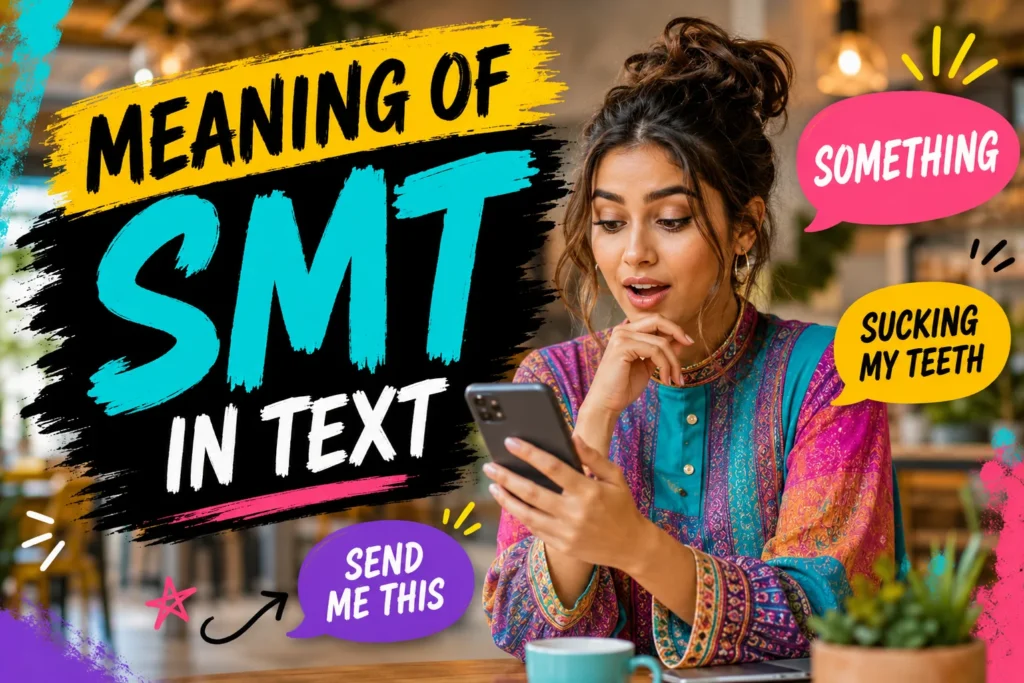
The most common meaning of SMT in text is “something.” However, SMT can also mean “sucking my teeth” when expressing annoyance or “send me that” when requesting a photo, video, link, or post.
The correct interpretation depends on where SMT appears and what the conversation is about.
Compare these examples:
- “I need to tell you smt.” = “I need to tell you something.”
- “You cancelled again? SMT.” = “Sucking my teeth”—showing annoyance.
- “That video is hilarious! SMT.” = “Send me that.”
- “There’s smt different about you.” = “There’s something different about you.”
Lowercase smt within a sentence usually means “something.” Uppercase SMT sent as a reaction may mean “sucking my teeth.” On Instagram or Snapchat, SMT beside a post often means “send me that.”
Capitalisation is only a clue, not a strict rule. You must read the full conversation to understand what the sender intends.
SMT Meaning in Text – Quick Explanation
SMT has three widely recognised meanings in casual digital communication:
1. Something
This is a shortened spelling of “something,” commonly used in quick messages.
“Can I ask you smt?”
Translation:
“Can I ask you something?”
2. Sucking My Teeth
This meaning describes a physical reaction that communicates irritation, disbelief, disappointment, or disapproval. It resembles writing “tsk,” “ugh,” or “seriously?”
“SMT, I already explained this.”
The sender is probably frustrated.
3. Send Me That or Send Me This
On image- and video-based platforms, SMT may be a request to share content.
“That recipe looks amazing—SMT!”
Here, the sender wants the recipe, post, link, or video.
Other interpretations exist in gaming, technology, music, and specialist communities, but these three are the most relevant to ordinary texting.
Origin and Background of SMT
SMT did not develop from a single expression. Different communities independently shortened several phrases into the same three letters.
The “something” meaning developed through vowel removal. Texting culture regularly shortens familiar words:
- Something becomes smt
- Please becomes pls
- People becomes ppl
- Tomorrow becomes tmr
- Message becomes msg
- Right now becomes rn
The reader mentally restores the missing letters because the word’s position makes its meaning obvious.
“Sucking my teeth” comes from a real nonverbal gesture. A person pulls air through or around their teeth to create a sharp sound that communicates annoyance, disbelief, impatience, or judgment.
Turning the gesture into SMT allows users to reproduce that emotional reaction in a text conversation. It works similarly to “tsk,” “smh,” or an eye-roll emoji.
“Send me that” developed from fast social-media interaction. When someone sees a meme, outfit, song, recipe, or video they want, SMT provides a quick sharing request.
How Social Media Expanded Its Meaning
Each platform encourages a different interpretation because users perform different actions there.
In a normal text conversation, “I have smt to tell you” clearly means “something.”
On Instagram, a reply saying “SMT 😍” beneath a picture may mean “send me that.” The visible content makes the request understandable.
On Snapchat, a standalone “SMT” after disappointing news may mean “sucking my teeth.”
The letters do not change, but the digital environment supplies the missing context.
Real-Life Conversations Using SMT
These examples demonstrate how the meaning of SMT changes across platforms and emotional situations.
WhatsApp: Something
Person A: Are you still awake?
Person B: Yes. Why?
Person A: I need to tell you smt important.
Person B: Okay, I’m listening.
Here, smt replaces “something.” Its position before “important” makes that meaning grammatically clear.
Instagram DM: Send Me That
Person A: Look at this birthday cake design!
Person B: That would be perfect for my sister. SMT please 😍
Person A: I’ll send you the original post.
The request for the post confirms that SMT means “send me that” or “send me this.”
Snapchat: Sucking My Teeth
Person A: I forgot to bring your charger again.
Person B: SMT. You said that yesterday too.
Person A: I know. I’ll bring it tomorrow.
The repeated mistake causes frustration. SMT represents a disapproving sound rather than the word “something.”
Text Message: Playful Ambiguity
Person A: There’s smt different about you today.
Person B: Different in a good way?
and,
Person A: Maybe 😏
Person B: Now you have to explain.
SMT means “something,” but the unfinished observation and smirking emoji give the message a flirtatious quality.
Emotional and Psychological Meaning of SMT
When SMT means “something,” it normally carries little emotion by itself. The words around it create the mood:
“Smt amazing happened!”
This feels excited.
“Smt feels wrong.”
This feels concerned or suspicious.
“I need to tell you smt.”
This creates curiosity and possibly anxiety.
The shorthand can make a message feel casual, but it does not remove the emotional effect of the complete sentence.
SMT as an Emotional Reaction
“Sucking my teeth” communicates frustration without requiring a detailed explanation. The sender may feel:
- Annoyed
- Disappointed
- Unimpressed
- Skeptical
- Impatient
- Disrespected
- Emotionally tired
- Playfully irritated
Imagine that a friend cancels plans for the third time and writes, “Sorry, maybe next week.” You reply, “SMT.”
That response communicates restrained frustration. You are not directly arguing, but you are clearly showing that their behaviour bothers you.
This indirect style can prevent immediate conflict. However, it may also feel passive-aggressive because the sender expresses displeasure without explaining what needs to change.
SMT as Social Connection
When SMT means “send me that,” its emotion is usually positive. The sender likes the content enough to request it.
It may indicate:
- Interest in a product
- Appreciation of a meme
- Excitement about a recipe
- Desire to save a picture
- Curiosity about a song
- Shared humour between friends
In this context, SMT supports connection through content sharing rather than expressing annoyance.
SMT Meaning on Different Platforms
SMS and iMessage
In ordinary text messages, smt most often means “something.”
Examples:
- “I forgot smt at home.”
- “Do you want smt to eat?”
- “Smt happened at school.”
- “I have smt for you.”
- “Can we talk about smt?”
If SMT appears alone after disappointing information, “sucking my teeth” becomes more likely.
WhatsApp users employ smt as a fast replacement for “something” in private and group chats.
“Can someone send me smt from today’s class?”
The abbreviation may also represent “sucking my teeth” during arguments or gossip:
“SMT, she’s starting that drama again.”
On Instagram, SMT frequently means “send me this” or “send me that” when it appears beside visual content.
Examples include:
- “SMT, I need this outfit.”
- “That wallpaper is perfect. SMT!”
- “Please SMT the recipe.”
- “This edit is amazing—SMT.”
In a regular Instagram DM sentence, smt may still mean “something”:
“There’s smt I want to ask you.”
Snapchat
On Snapchat, SMT may mean “sucking my teeth,” “send me that,” or “something.”
Look at what appeared immediately before it:
- A frustrating story suggests “sucking my teeth.”
- A picture or video suggests “send me that.”
- A complete sentence suggests “something.”
TikTok
In TikTok captions and comments, smt often replaces “something”:
“Smt about this song feels different.”
Under a video, “SMT” may request the original clip, product link, or sound. In an argument or reaction thread, it may express annoyance.
Discord and Gaming Chats
In a casual Discord conversation, smt usually means “something.” In gaming communities, uppercase SMT may refer to Shin Megami Tensei, a Japanese role-playing game series.
For example:
“Which SMT game should I start with?”
That sentence is clearly about gaming, not texting slang.
Professional and Technical Settings
SMT should not automatically be treated as slang in professional contexts. It can stand for surface-mount technology, an electronics-manufacturing method.
Other industries may assign it different specialist definitions. Formal documents should define the acronym when it first appears.
When Not to Use SMT
Avoid SMT when the reader may not know which meaning you intend. The abbreviation is highly dependent on context and can create unnecessary confusion.
Do not use it:
- In formal emails
- In academic assignments
- In professional reports
- With clients or customers
- In emergency instructions
- In sensitive emotional conversations
- When communicating across language barriers
- When a technical meaning may compete with the slang
- When the recipient is unfamiliar with internet shorthand
- During serious conflict requiring direct communication
Avoid “Sucking My Teeth” in Respectful Conversations
Using SMT as a frustrated reaction may feel disrespectful when speaking to a teacher, parent, manager, customer, or unfamiliar person.
Instead of:
“SMT, I already sent it.”
Write:
“I sent the document earlier, but I’m happy to forward it again.”
The second response communicates the same information without displaying irritation.
Do Not Use SMT in a Serious Apology
A vague or annoyed abbreviation can worsen a sensitive situation. If you hurt someone, explain yourself clearly instead of relying on slang.
Direct communication demonstrates maturity and reduces the chance of misunderstanding.
Common Misunderstandings About SMT
SMT Does Not Have One Universal Meaning
The most common error is treating one interpretation as correct everywhere. “Something,” “sucking my teeth,” and “send me that” are all genuine uses.
Lowercase and Uppercase Provide Clues
Lowercase smt inside a sentence often means “something”:
“I want smt sweet.”
Uppercase SMT used as a standalone reaction may mean “sucking my teeth”:
“They cancelled the event again.”
“SMT.”
This pattern is helpful but not absolute.
“Send Me This” and “Send Me That” Are Similar
Some users expand SMT as “send me this,” while others understand it as “send me that.” Both communicate the same practical request: share the item or content being discussed.
SMT Is Not the Same as SMH
- SMT: Something, sucking my teeth, or send me that
- SMH: Shaking my head
When they express frustration, their emotional effect can be similar. Their literal meanings remain different.
SMT Is Not Always Negative
“Sucking my teeth” has a negative or skeptical tone, but “something” is neutral and “send me that” is usually friendly.
Capital SMT May Be Technical
In electronics, SMT commonly refers to surface-mount technology. In gaming, it can refer to Shin Megami Tensei. The subject of the conversation identifies the intended meaning.
SMT Compared With Similar Texting Slang
| Term | Common meaning | Typical tone | Example |
|---|---|---|---|
| SMT | Something | Neutral | “I need to ask you smt.” |
| SMT | Sucking my teeth | Annoyed | “You forgot again? SMT.” |
| SMT | Send me that | Interested | “That meme is perfect—SMT.” |
| SMH | Shaking my head | Disappointed | “SMH, you never listen.” |
| TSK | Sound of disapproval | Irritated | “Tsk, that was careless.” |
| STH | Something | Neutral | “I heard sth strange.” |
| SUM | Something | Very casual | “Let me tell you sum.” |
| LMK | Let me know | Informational | “LMK when you arrive.” |
| HMU | Hit me up | Friendly invitation | “HMU when you’re free.” |
| SFS | Shoutout for shoutout | Promotional | “Anyone want SFS?” |
| STG | Swear to God | Emphatic | “I STG I’m telling the truth.” |
| FR | For real | Agreement or emphasis | “That was wild, fr.” |
Key Insight
Sentence position is the fastest way to decode SMT. However, If it replaces a noun, it probably means “something.” If it reacts to frustration, it likely means “sucking my teeth.” If it refers to visible content, it probably means “send me that.”
Variations and Types of SMT
1. smt
The lowercase version usually means “something” in casual messages.
“Do you want smt from the shop?”
2. SMT
Uppercase letters often indicate an acronym, especially “sucking my teeth” or “send me that.”
“SMT, this is so annoying.”
3. Smt…
The ellipsis may create suspense when the word means “something.”
“There’s smt… I don’t know how to explain it.”
4. SMT 🙄
The eye-roll emoji strongly supports “sucking my teeth.” It expresses annoyance, judgment, or disbelief.
5. SMT 😒
The unamused face suggests disappointment or irritation. It normally represents the negative meaning.
6. SMT 😂
After a meme or funny video, this may mean “send me that.” In friendly teasing, it may also represent exaggerated annoyance.
7. SMT Please
This usually means “send me that, please,” especially beneath a picture, Reel, recipe, or product post.
8. SMT Link
This is a request to send a product page, video, article, download, or other online link.
9. Smt Important
The abbreviation replaces “something”:
“I need to tell you smt important.”
This phrase often creates urgency or curiosity.
10. Smt Feels Off
This means that something seems wrong, strange, or suspicious.
“Smt feels off about his story.”
11. STH
STH is another written abbreviation for “something.” It is understood internationally but may appear less natural in some American conversations.
12. Sum
“Sum” represents the way “some” may sound in casual speech. It can replace “something” in highly informal messages:
“I gotta tell you sum.”
How to Respond When Someone Uses SMT
Your reply should match the meaning suggested by the context.
When SMT Means “Something”
Possible responses include:
- “What is it?”
- “Go ahead—I’m listening.”
- “Tell me.”
- “Is everything okay?”
- “Now I’m curious.”
- “Don’t leave me in suspense.”
When SMT Means “Sucking My Teeth”
If the sender sounds annoyed, reply calmly:
- “What’s bothering you?”
- “I know you’re frustrated.”
- “Can we talk about it?”
- “I’m sorry—I should have told you earlier.”
- “What can I do to fix it?”
- “I didn’t mean to upset you.”
When SMT Means “Send Me That”
Natural replies include:
- “Sending it now.”
- “Check your DMs.”
- “I’ll share the link.”
- “Of course!”
- “I’ll tag you.”
- “Here you go.”
Funny Replies
- “Something? That sounds suspicious.”
- “Use your words 😂”
- “The suspense is unnecessary.”
- “Request received and under review.”
- “Only if you say please.”
- “That abbreviation has too many meanings.”
When the Meaning Is Unclear
Ask directly:
- “Do you mean something or send me that?”
- “What does SMT mean here?”
- “Are you annoyed, or do you want the post?”
- “Can you clarify?”
Requesting clarification is better than building an emotional reaction around the wrong interpretation.
Regional and Cultural Usage of SMT
American Online Communication
In American texting, lowercase smt commonly replaces “something.” “Send me that” is also visible on social-media platforms.
“Sucking my teeth” may appear in conversations where the physical gesture is culturally familiar. Its tone ranges from playful irritation to strong disapproval.
British Online Communication
British users may understand smt as “something,” although abbreviations such as “sth” can also appear. The “sucking my teeth” interpretation is recognised in various multicultural communities.
Caribbean Cultural Context
Teeth-sucking is a well-established nonverbal expression in many Caribbean communities. It can communicate annoyance, disrespect, disbelief, or rejection.
The gesture’s emotional strength depends on the relationship and situation. Representing it as SMT brings that physical reaction into digital conversation.
Asian and Middle Eastern Online Communities
English-speaking users may adopt smt as a shortened form of “something,” particularly in international gaming and social-media spaces.
“Send me that” is understandable when paired with visible content. “Sucking my teeth” may be less familiar to users who have not encountered the cultural gesture or its online representation.
Gen Z Versus Millennials
Gen Z users frequently switch between meanings according to platform and context. Fast content sharing makes “send me that” especially practical.
Millennials may be more familiar with smt as “something,” depending on their region and early texting habits. Individual online communities often influence usage more than age.
Is SMT Safe for Kids?
The abbreviation itself is generally safe for children and teenagers. “Something” and “send me that” are harmless meanings.
“Sucking my teeth” expresses attitude or annoyance and may be considered disrespectful in certain homes, schools, or cultures. Children should understand that digital reactions still affect other people.
Parents should check the complete conversation because an ordinary abbreviation can appear alongside inappropriate content or requests.
Frequently Asked Questions About SMT
What does SMT mean in a text message?
SMT most commonly means “something,” “sucking my teeth,” or “send me that.” The words around it and the platform determine the intended definition.
What does smt mean in lowercase?
Lowercase smt usually abbreviates “something,” particularly when it appears within a complete sentence.
What does SMT mean on Instagram?
On Instagram, SMT may mean “send me this” or “send me that” when someone wants a post, link, photo, or Reel. In an ordinary sentence, it can mean “something.”
What does SMT mean on Snapchat?
On Snapchat, SMT can mean “sucking my teeth” as a reaction to frustration. It may also mean “send me that” when responding to a Snap.
What does SMT mean from a girl?
From a girl, SMT has no special gender-based meaning. It may represent something, annoyance, or a request to share content depending on her message.
What does SMT mean from a guy?
From a guy, SMT carries the same possible meanings. Look for sentence structure, emotional language, emojis, and references to visible content.
Is SMT rude?
SMT is not rude when it means “something” or “send me that.” It may sound disrespectful or passive-aggressive when it means “sucking my teeth,” particularly during a disagreement.
Conclusion
The meaning of SMT in text changes according to context. In an ordinary sentence, it most often replaces “something.” As a frustrated reaction, it can mean “sucking my teeth.” Beside a photo, video, or post, it may request “send me that” or “send me this.”
Use three clues to identify the correct meaning:
- Check where SMT appears in the sentence.
- Notice whether the tone is neutral, interested, or annoyed.
- Consider whether the message refers to shareable content.
For example, “I need smt” means “I need something.” “SMT, not again” expresses frustration. “Love that video—SMT” asks for the video.
SMT proves that even three simple letters can carry several meanings online. Reading the complete conversation—and asking when necessary—will help you interpret it confidently.