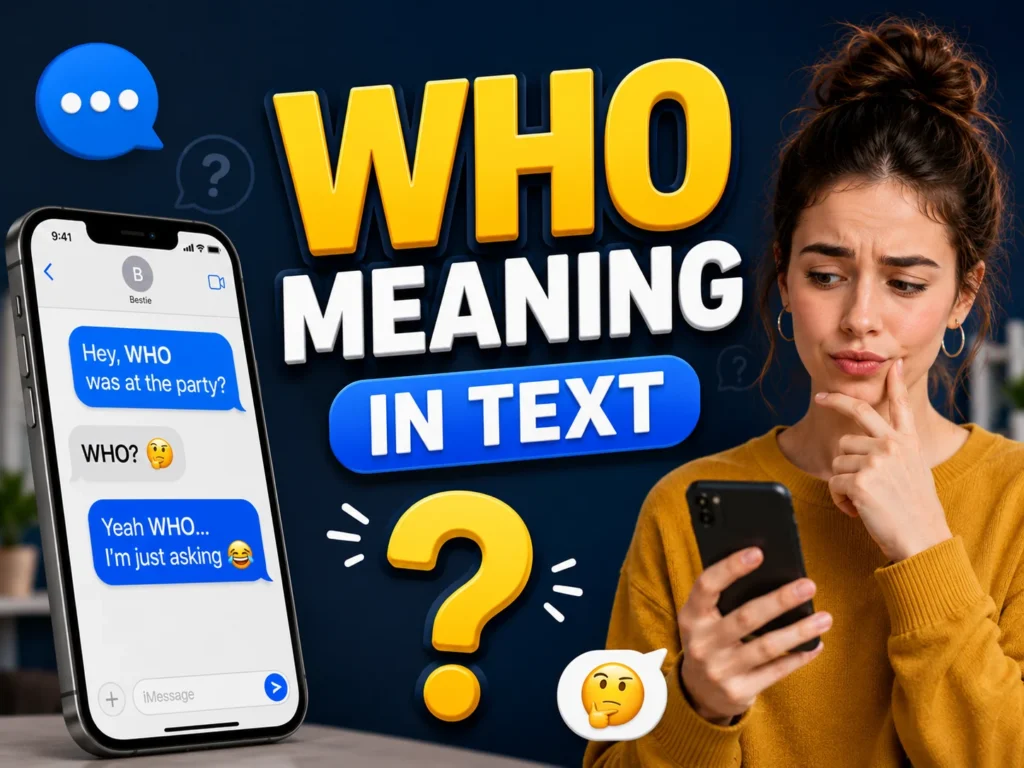
who meaning in text usually means exactly what it means in everyday English: “which person?” or “what person are you talking about?” When someone texts just “who?” they may be asking for a person’s identity, or, depending on context, showing surprise, confusion, or playful indifference.
What Does “Who” Mean in Text?
The most common meaning of “who” in text is a question about a person. If someone sends “who?” after you mention a name, they usually want to know who that person is.
For example:
A: I was talking to Sarah earlier.
B: Who?
A: Sarah from our science class.
Here, “who?” simply means “Who is Sarah?”
“Who” is not normally a texting acronym or abbreviation. It is an ordinary English interrogative pronoun used to ask about a person or people. Dictionaries define it as a word used to ask which person or people someone means.
However, texting changes how short words can feel. A one-word message such as “who?” can communicate more than a complete question would. Depending on the conversation, it can sound curious, confused, surprised, dismissive, teasing, or even sarcastic.
That is why people search “who meaning in text”: the dictionary definition is easy, but the tone behind a short “who?” can be harder to interpret.
Is “Who” an Acronym, Abbreviation, or Slang Word?
In ordinary texting, who is none of these.
It is a standard English pronoun. Cambridge classifies “who” as a pronoun used especially in questions asking which person or people someone means.
There is also an uppercase WHO abbreviation for the World Health Organization, but that is a separate meaning and normally appears in formal, medical, health, or news contexts—not as everyday texting slang. Merriam-Webster lists WHO as an abbreviation for the World Health Organization while separately defining lowercase “who” as the pronoun.
So if a friend texts:
“Who?”
they almost certainly aren’t referring to the World Health Organization.
They are asking something like:
- “Who are you talking about?”
- “Who is that?”
- “Which person?”
- “Who do you mean?”
What Does “Who?” Mean When Someone Texts It Alone?
A standalone “who?” depends heavily on what came before it.
1. Genuine confusion
This is the most straightforward interpretation.
A: I met Daniel yesterday.
B: Who?
A: The guy from the bookstore.
B simply doesn’t know which Daniel A means.
2. Asking for someone’s identity
Someone might text “who?” after receiving a message from an unknown number.
A: Hey, are you coming later?
B: Who?
A: Sorry, it’s Jake from your class.
Here, “who?” means “Who is this?”
3. Asking which person
If several people have the same name, “who?” can ask for clarification.
A: Emma said she’ll come.
B: Who? Emma from work or Emma from school?**
4. Surprise
Sometimes “who?” means “Who? Seriously?”
A: I got invited to the concert by Maya.
B: Who?!
A: Maya—the singer’s assistant.
The punctuation can make the reaction feel more excited or surprised.
5. Playful or dismissive indifference
In some conversations, someone may say “who?” while pretending not to know or care about a person.
A: You know, that famous actor from the movie.
B: Who?
A: You definitely know him 😂
This interpretation is highly dependent on context. A texting guide also notes that “who?” can sometimes be used deliberately to act as though the person being discussed is unimportant.
Who Meaning in Text on Different Platforms
SMS and iMessage
In ordinary SMS and iMessage conversations, “who?” has the same basic meaning as spoken English: asking which person someone means.
The short version is particularly common because texting lets people answer with one or two words.
WhatsApp conversations use “who?” in much the same way.
For example:
“Who is coming?”
asks about the people attending, while:
“Who?”
usually asks you to identify the person you just mentioned.
Instagram, Snapchat, and Discord DMs
In direct messages, “who?” can also be used naturally when someone doesn’t recognize a name, account, person, or reference.
The meaning doesn’t fundamentally change from platform to platform. Context changes the tone more than the app does.
TikTok and X
“Who” can certainly appear in comments or captions, but those aren’t texting contexts. For a “who meaning in text” question, direct messages and actual text conversations are the more relevant settings.
Does Capitalization Change the Meaning?
Usually, no. The basic meaning remains the same.
“who?”
This normally feels casual and neutral.
“Who?”
This is standard sentence capitalization and can still be completely neutral.
“WHO?”
All caps can add emphasis.
It might suggest:
- strong surprise
- confusion
- disbelief
- excitement
- joking emphasis
For example:
“WHO told you that?”
sounds much more emphatic than:
“who told you that?”
“who??”
Extra question marks often make the reaction more animated.
“Who??” can mean:
“Wait, who are you talking about?”
“WHO???”
This usually signals very strong surprise, confusion, or excitement rather than a different dictionary meaning.
Funny, Sarcastic, Playful, and Serious Uses
Funny
A: I finally got my haircut.
B: Who?
A: Me 😭
B: I know. I just wanted to be difficult.
Here, “who?” is intentionally silly.
Sarcastic
A: The teacher said Jason is the smartest person in class.
B: Who?
A: Jason.
B: Never heard of him.
The speaker isn’t genuinely asking. They’re jokingly pretending Jason is insignificant.
Playful
A: Guess who just got tickets!
B: Who??
A: Me!
B: No way 😂
Here, “who??” expresses anticipation and excitement.
Serious
A: Someone called me from your number.
B: Who?
A: I don’t know. That’s why I’m asking.
Here, “who?” is a direct request for information.
Real Chat Examples
1. Friends
A: I saw Alex at the mall today.
B: Who?
A: Alex from our old class.
B: Ohhh, the tall guy?
2. Siblings
A: Mom said someone left their jacket here.
B: Who?
A: She thinks it’s yours.
B: Definitely not mine.
3. Coworkers
A: The new manager wants to talk to you.
B: Who?
A: The one who started Monday.
B: Oh, Priya?
4. Parent and child
A: I bumped into Mr. Khan today.
B: Who?
A: Your old teacher.
B: Oh, okay.
5. Unknown number
A: Hey, are you still coming?
B: Who?
A: Sorry, wrong number.
6. Close friends
A: Guess who I saw today.
B: Who??
A: Your favorite person.
B: Don’t say that 😂
7. Group chat
A: Who invited Sam?
B: Who?
A: The new person in the group.
B: Oh, I didn’t.
8. School conversation
A: Maria said she finished the project.
B: Who’s Maria?
A: The girl who joined our class last week.
B: Got it.
9. Playful conversation
A: I have news.
B: Who?
A: That’s not how you answer that 😂
B: I thought you said someone.
10. Serious conversation
A: Someone was asking about you earlier.
B: Who?
A: I don’t know their name.
B: What did they look like?
11. Family conversation
A: Your cousin called.
B: Who?
A: The one who lives in Lahore.
B: Oh, Hamza.
12. Direct message
A: I think I know you.
B: Who?
A: We were in the same class last year.
B: Oh! Now I remember.
Grammar and Language Role
“Who” is a pronoun, specifically an interrogative pronoun when it asks a question. Cambridge’s grammar reference lists “who” among interrogative pronouns.
It can appear in several positions.
At the beginning of a question
“Who called you?”
As a standalone reply
“Who?”
This is extremely common in casual messaging.
In the middle of a sentence
“Do you know who she is?”
In a longer question
“Who are you going with?”
“Who” can therefore replace a longer phrase such as “which person”.
In formal English, “whom” can sometimes be used when “who” functions as an object. However, ordinary conversation and informal writing commonly use “who,” and Merriam-Webster notes that “whom” often has a formal or stiff feel.
How to Reply When Someone Texts “Who?”
Your best response depends on why they asked.
Funny reply
“The person you definitely know 😂”
Serious reply
“I mean Sarah from our science class.”
Flirty reply
If the conversation already has an appropriate playful tone:
“Take a guess 😄”
Neutral or unbothered reply
“Jordan from school.”
The safest approach is usually simple: identify the person clearly rather than guessing what the other person meant.
Related Terms Compared
| Term | Meaning | Usage Context | Tone | Popularity | Confusion Risk |
|---|---|---|---|---|---|
| who | Which person? | Asking about a person | Neutral | Very high | Low |
| who’s | Who is / who has | Questions or statements | Casual/neutral | Very high | Medium |
| whom | Object form of who | Formal English | Formal | Low in texting | Medium |
| whose | Belonging to which person? | Asking about ownership | Neutral | High | Medium |
| what | Which thing/information? | Asking about things or information | Neutral | Very high | Low |
| nobody | No person | Opposite/general negative idea | Neutral | High | Low |
One especially common texting mistake is confusing who’s and whose. “Who’s” is a contraction of “who is” or “who has,” while “whose” indicates possession.
For example:
“Who’s coming?” = “Who is coming?”
“Whose phone is this?” = “Who does this phone belong to?”
Who Uses “Who” in Text?
Because “who” is a standard English word rather than a niche slang term, there isn’t a meaningful age group that exclusively owns it. Children, teenagers, adults, and older texters all use it.
Gen Z vs. Millennials
The major difference isn’t the word itself. Both groups use “who?” in ordinary messaging.
You may see more expressive punctuation in casual digital conversations, such as:
- “who?”
- “who??”
- “WHO??”
- “who 😭”
Those additions can make the message feel more surprised, humorous, or dramatic. But the basic word remains the same.
Regional Usage
“Who” is standard English in the United States, United Kingdom, and many other English-speaking regions. Its fundamental meaning doesn’t change because of geography. Cambridge gives the same core question meaning across its English dictionary entries.
People around the world who communicate in English may therefore use “who?” in text messages.
Origin and Internet Culture
Unlike newer internet slang, “who” did not originate in texting, Snapchat, TikTok, or meme culture.
It is an extremely old English word. Merriam-Webster traces the pronoun to Middle English and Old English hwā, with a first known use before the 12th century.
That history matters because it explains why “who” shouldn’t be treated like an acronym such as “LOL” or a modern abbreviation.
Texting simply made the word especially easy to use as a one-word response.
A person doesn’t need to type:
“Could you please clarify which person you’re talking about?”
They can simply type:
“Who?”
That efficiency fits naturally into fast digital conversations.
Internet culture has also expanded the ways people can use a simple “who?” for humor. A person might pretend not to recognize someone or use exaggerated punctuation to make the response dramatic. But those are contextual uses, not new dictionary definitions.
Is “Who” Rude or Offensive in Text?
No, “who” is not rude or offensive by itself.
However, a standalone “who?” can occasionally sound blunt.
Compare:
“Who?”
with:
“Who do you mean?”
The second version sounds more complete and polite because it explains what information you want.
In a casual conversation with friends, “who?” is perfectly normal. In a school or workplace conversation, you may want to add a little context when clarity or politeness matters.
For example:
“Who do you mean?”
is usually better than:
“WHO?”
when you’re talking to a teacher, supervisor, or someone you don’t know well.
“Who” is not profanity and doesn’t contain explicit language.
Real-World Observation
The interesting thing about “who?” in texting is how much meaning a tiny word can carry. Grammatically, it simply asks about a person, but punctuation, capitalization, timing, and previous messages can change how it feels. “Who?” can be an honest request for clarification, while “WHO???” might express surprise and “who 😂” might be deliberately playful. The word itself stays stable; the surrounding conversation supplies the tone.
Frequently Asked Questions
What does “who” mean in text?
“Who” usually means “which person?” or “who are you talking about?” It is a normal English pronoun rather than texting slang. When someone sends only “who?”, they usually want you to identify a person.
Is it rude to reply with just “who?” in a text?
Not necessarily. Among friends, a one-word “who?” is completely normal. However, it can sound abrupt in a formal conversation, especially if the person expected a more complete response. “Who do you mean?” is a softer alternative.
What’s the difference between texting “who?” and saying it out loud?
The basic meaning is the same, but text doesn’t carry your voice, facial expression, or immediate tone. As a result, “who?” can sometimes be harder to interpret in a message. Punctuation or additional words can make your intended tone clearer.
Does “who” mean the same thing in a group chat and a 1-on-1 text?
Generally, yes. In both settings, “who?” usually asks for a person’s identity or clarification. In a group chat, however, the message may refer to several people or an earlier message, so context can matter more.
Is “WHO” different from “who” in texting?
Usually, no. Capital letters mainly add emphasis. “WHO?” may sound more surprised, shocked, or dramatic than “who?” without changing the basic meaning.
Is “who” an abbreviation for something?
In normal texting, no. “Who” is a standard English pronoun. WHO can also be an abbreviation for the World Health Organization, but that is a separate formal meaning rather than ordinary texting slang.
What is the difference between “who,” “who’s,” and “whose”?
“Who” asks about a person. “Who’s” usually means “who is” or “who has,” while “whose” asks about possession. For example, “Who’s calling?” asks who is calling, while “Whose phone is this?” asks who owns the phone.
Can “who?” mean “I don’t care”?
Sometimes, but only from context. Someone may deliberately say “who?” to pretend they don’t recognize or care about the person being discussed. That is a conversational or sarcastic use, not the standard meaning of the word.
PAA-Optimized Questions
What does who mean in texting?
It usually means “which person?” or “who are you talking about?” A standalone “who?” commonly asks for clarification.
What does it mean when someone texts “who?”
It usually means the person wants you to identify someone you mentioned. Depending on tone and context, it can also express surprise, confusion, or playful sarcasm.
What does “who?” mean from a girl or boy?
The word itself doesn’t have a gender-specific meaning. It normally means the person wants to know who you’re referring to. The surrounding conversation determines whether the message sounds curious, surprised, playful, or dismissive.
Why would someone text just “who?”
They may not recognize the person you’re talking about, may have forgotten who that person is, or may want clarification. In some conversations, they may also be joking or pretending not to care.
Conclusion
“Who” in text normally means “which person?” or “who are you talking about?” It is a standard English pronoun, not modern slang or a texting abbreviation. Its basic meaning stays the same across SMS, iMessage, WhatsApp, and DMs, although punctuation and context can change its tone.
If someone sends you “who?”, don’t automatically assume they’re being rude. Look at what you said immediately before it. If you mentioned a person, simply give their name or explain who they are.
Usage Tips
- Use “who?” for a quick, casual clarification.
- Use “who do you mean?” when you want to sound clearer or more polite.
- Use “WHO?” when strong emphasis or surprise is intentional.
- Remember that “who’s” and “whose” have different meanings.
Common Mistakes
- Assuming “who” is automatically slang.
- Treating every “who?” as rude.
- Confusing who’s with whose.
- Assuming capitalization creates a completely different definition.
When to Use or Avoid “Who” in Text
Use “who?” naturally with friends, family, classmates, and other casual contacts. In formal situations, especially when you need to sound especially polite, consider writing the complete question instead.
In short, if you receive a message that simply says “who?”, the safest interpretation is straightforward: they’re asking you to identify the person you’re talking about.