In everyday texting, short abbreviations shape how we express thoughts quickly. One of the most commonly used is “IMO”, and many people search for its meaning when they see it in chats, comments, or social media posts.
IMO often appears in discussions where someone is sharing an opinion without sounding too direct or forceful. It solves a simple communication problem: how do you say “this is just my opinion” without sounding rude or overly serious?
People usually search for it when they feel confused in conversations like:
- “IMO, this movie was overrated.”
- “You should try it IMO.”
- “IMO, that’s not the best idea.”
The abbreviation looks simple, but its tone and usage carry subtle emotional meaning that changes depending on context.
IMO – Quick Meaning
What IMO stands for
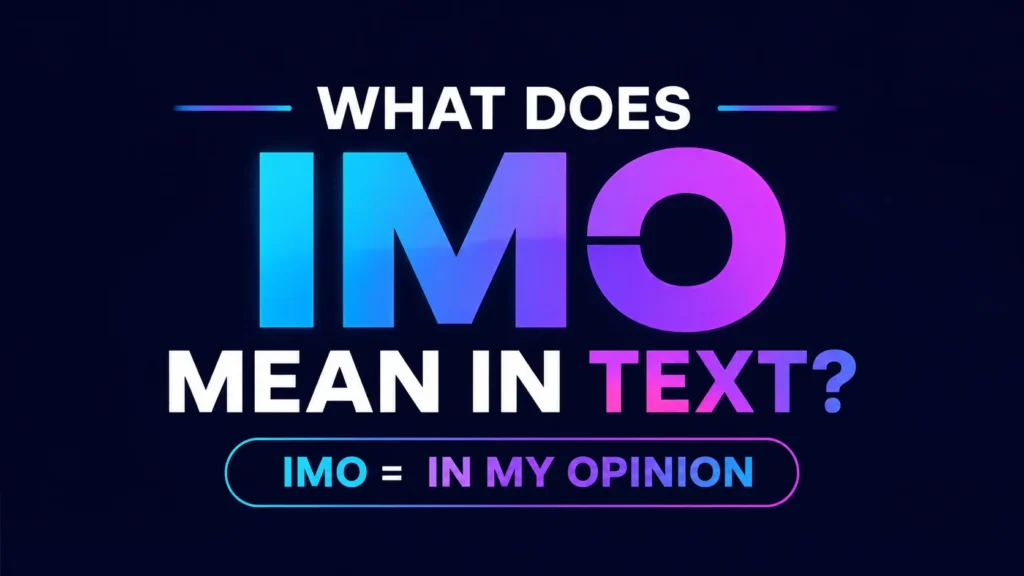
IMO means “In My Opinion.”
It is used to show that what you are saying is a personal viewpoint, not a universal fact.
Simple definition
- A soft way to express an opinion
- A polite disclaimer before sharing thoughts
- A way to reduce disagreement in conversations
Example sentences
- “IMO, this phone has better battery life.”
- “That restaurant is expensive IMO.”
- “IMO, you should wait before deciding.”
In all cases, the speaker is making it clear that their statement is subjective.
Origin & Background
Where IMO came from
IMO originated in early internet chatrooms and email culture in the late 1990s and early 2000s. As online conversations became faster, users started shortening common phrases like “In My Opinion” into acronyms.
Cultural influence
As texting and instant messaging grew, IMO became part of everyday digital language. It spread through:
- Forums like Reddit and early discussion boards
- Messaging apps like MSN and Yahoo Messenger
- Later platforms like Instagram, Twitter (X), and TikTok
Social media impact
Today, IMO is widely used in comments sections where people express opinions quickly without sounding argumentative.
How meaning evolved
Originally formal and neutral, IMO has now become a casual tone marker. It doesn’t just mean “I think”—it also signals softness, humility, and openness in conversation.
Real-Life Conversations (MANDATORY)
WhatsApp Chat
Person A: Do you think I should buy this laptop?
Person B: IMO, wait for the new model. The current one is a bit outdated.
Instagram DM
Person A: This outfit looks good on me?
Person B: IMO, the color could be brighter, but the style suits you.
TikTok Comment Section
User A: This is the best song of the year.
User B: IMO, there are better tracks in the same album.
Text Message
Friend A: Should I join that gym?
Friend B: IMO, it’s good but a bit crowded in the evenings.
These examples show how IMO softens opinions in everyday digital conversations.
Emotional & Psychological Meaning
IMO is more than just an abbreviation. It reflects how modern communication avoids conflict while still allowing expression.
What emotion it expresses
- Politeness
- Humility
- Non-confrontational thinking
- Emotional safety in conversations
Why people use it
People use IMO to:
- Avoid sounding rude
- Reduce arguments
- Make their opinion feel less absolute
- Show respect for other perspectives
What it reveals about modern communication
IMO reflects a shift in digital behavior where people prefer:
- softer tones instead of strong statements
- collaborative conversation instead of debate
- emotional awareness in text-based communication
Short real-life scenario
Imagine giving advice in a group chat. Saying “You’re wrong” feels harsh. But saying “IMO, there might be a better option” keeps the conversation open and friendly. That small shift changes the entire emotional tone.
Usage in Different Contexts
Social media
IMO is extremely common in comments, reviews, and debates. It helps users express opinions without triggering arguments.
Friends & relationships
In personal chats, IMO makes suggestions sound softer:
- “IMO, you should talk to her first.”
Work / professional settings
In professional communication, IMO is used carefully:
- “IMO, this strategy needs revision.”
It adds politeness but should not replace strong, confident statements when decisions are required.
Casual vs serious tone
- Casual: “IMO, pizza is better than burgers.”
- Serious: “IMO, this data needs further review before publishing.”
When NOT to Use It
In formal decision-making
Avoid IMO when giving final decisions in:
- Business reports
- Academic writing
- Official announcements
When clarity is needed
IMO can weaken authority. If something is a fact, avoid softening it unnecessarily.
Cultural sensitivity
In some cultures, excessive use of IMO may seem like uncertainty or lack of confidence.
Risk of misunderstanding
Sometimes people may ignore your point because it sounds like “just an opinion,” even when it matters.
Common Misunderstandings
What people get wrong
Some think IMO means the statement is unimportant. That is incorrect—it still carries meaning, just with softer tone.
Tone confusion
- IMO can sound polite or passive-aggressive depending on context
- Without tone indicators, it may be misinterpreted in text
Literal vs figurative meaning
People sometimes treat IMO as “weak opinion,” but in reality it is just a communication style marker.
Comparison Table
| Term | Meaning | Tone | Usage |
|---|---|---|---|
| IMO | In My Opinion | Neutral | General opinions |
| IMHO | In My Humble Opinion | Softer / modest | Polite disagreement |
| TBH | To Be Honest | Direct | Truthful statements |
| FYI | For Your Information | Informative | Sharing facts |
| NGL | Not Gonna Lie | Honest / casual | Personal truths |
| IDC | I Don’t Care | Negative | Indifference |
| SMH | Shaking My Head | Emotional | Disapproval |
Key Insight
IMO stands out because it balances clarity with politeness, making it one of the most socially flexible texting abbreviations.
Variations / Types
1. IMHO – In My Humble Opinion
Softer version of IMO, used to sound more modest.
2. IMOFR – In My Own Fair Reasoning
Used when someone explains logic behind an opinion.
3. IMOO – In My Open Opinion
Less common, signals openness to discussion.
4. IME – In My Experience
Focuses on personal experience rather than opinion.
5. IMU – In My Understanding
Used when explaining interpretation of information.
6. IMOY – In My Opinion, You…
Used when giving direct advice.
7. IMV – In My View
Formal alternative used in writing.
8. IMOP – In My Own Perspective
Emphasizes personal perspective.
9. IMO (casual shorthand)
Standard everyday texting version.
10. IMOA – In My Objective Assessment
Rare, used in analytical contexts.
How to Respond When Someone Uses It
Casual replies
- “Yeah, I see what you mean.”
- “True, that makes sense.”
Funny replies
- “IMO? That sounds official now 😄”
- “Okay professor, I hear you.”
Mature replies
- “That’s a fair opinion.”
- “I understand your point.”
Respectful replies
- “Thanks for sharing your perspective.”
- “I appreciate your opinion on this.”
Regional & Cultural Usage
Western culture
IMO is widely accepted in casual and professional online communication.
Asian culture
Used more carefully; sometimes people avoid it in formal conversations to maintain respect and clarity.
Middle Eastern culture
Common in informal chats, especially among younger generations.
Global internet usage
IMO is universally understood in digital communication across platforms.
Generational differences
- Gen Z: Uses IMO frequently in casual chats
- Millennials: Use it in both casual and semi-professional contexts
- Older generations: Less frequent, sometimes unfamiliar
Is It Safe for Kids?
Yes, IMO is completely safe. It is a neutral expression used to share opinions politely.
However, children should learn:
- When to use opinions respectfully
- How tone changes meaning in digital communication
- When stronger or clearer language is needed
FAQs
What does IMO mean in chat?
IMO means “In My Opinion,” used to share personal views.
Is IMO rude?
No, it is polite and neutral unless used in a dismissive tone.
What is the difference between IMO and IMHO?
IMHO is softer and more humble than IMO.
Can I use IMO in formal writing?
It is better to avoid it in formal academic or business writing.
Is IMO used in professional emails?
Rarely, but it may appear in informal workplace communication.
Does IMO change the meaning of a sentence?
It doesn’t change meaning, only tone.
Is IMO still popular in 2026?
Yes, it remains widely used in texting and social media.
Conclusion
IMO is a small abbreviation, but it plays a big role in modern communication. It helps people express thoughts without sounding forceful, making conversations more balanced and respectful.
In a world where digital tone matters more than ever, IMO acts like a soft bridge between opinion and understanding. Using it wisely can make your messages feel more thoughtful, human, and socially aware.
As texting continues to evolve, IMO remains a simple yet powerful reminder that not every statement needs to be absolute—sometimes, it’s enough just to share what you think.