If you spend time on Snapchat, TikTok, Instagram, or late-night group chats, you’ve probably seen someone type “IDEK” and wondered what they actually meant.
At first glance, it can look confusing. Some people assume it’s a typo, while others think it has a hidden slang meaning. In reality, IDEK is one of the most common modern texting abbreviations used to express confusion, frustration, disbelief, or emotional exhaustion in a quick and relatable way.
People search for “what does idek mean in texting” because digital conversations move fast. Slang changes constantly, and understanding the emotional tone behind short expressions matters more than ever. A simple four-letter acronym can completely change the mood of a conversation.
The interesting thing about IDEK is that it’s not just about “not knowing” something. Depending on the context, it can sound funny, dramatic, sarcastic, overwhelmed, emotionally tired, or even flirtatious.
That’s why understanding how people actually use it matters more than memorizing a dictionary definition.
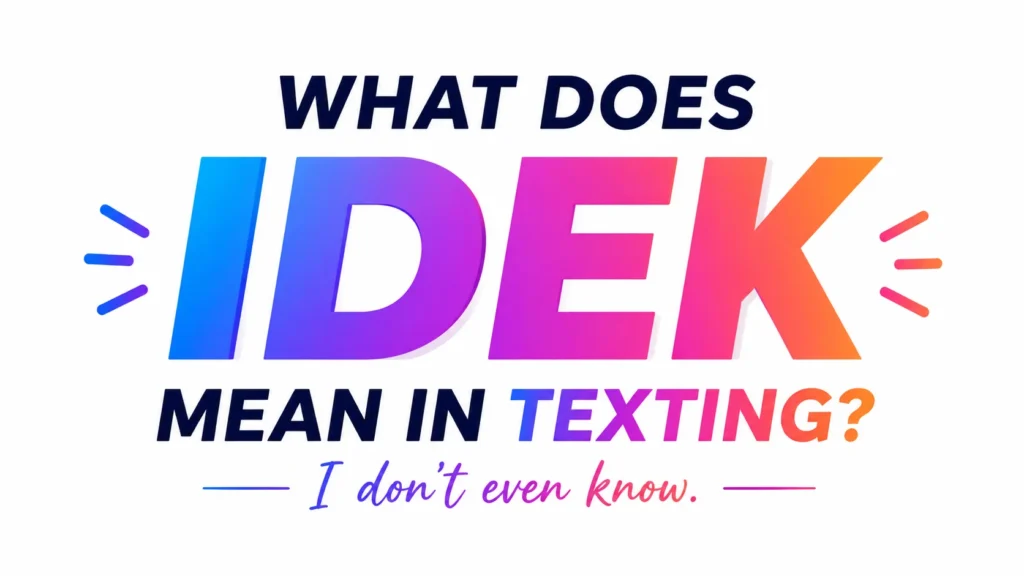
What Does IDEK Mean in Texting? – Quick Meaning
Simple Definition
IDEK stands for:
- I Don’t Even Know
It’s commonly used when someone feels:
- Confused
- Shocked
- Emotionally overwhelmed
- Unsure how to respond
- Too tired to explain something fully
The phrase usually carries emotion behind it rather than just literal uncertainty.
Quick Examples
“IDEK why I stayed awake that long.”
“He texted me after six months… IDEK what to say.”
“IDEK how this happened honestly.”
What Makes It Different From “I Don’t Know”?
There’s a subtle emotional difference.
“I don’t know” sounds neutral.
“IDEK” sounds more emotional, dramatic, relatable, or casual.
That extra word “even” adds intensity. It suggests the speaker feels mentally overloaded, surprised, frustrated, or speechless.
Origin & Background
Where IDEK Came From
IDEK grew out of internet chat culture during the early texting and instant messaging era.
As character limits became common on platforms like Twitter and people started communicating rapidly through smartphones, abbreviations became part of everyday digital language.
Expressions like:
- LOL
- BRB
- IDK
- TBH
eventually evolved into more emotionally expressive slang like IDEK.
The Evolution From IDK to IDEK
Originally, people mostly used “IDK” meaning “I don’t know.”
Over time, younger internet users began adding emotional emphasis by saying:
“I don’t even know.”
Eventually, the phrase became shortened into IDEK.
That tiny addition of “even” transformed the expression from factual uncertainty into emotional confusion.
Social Media Influence
TikTok, Snapchat, Instagram Reels, and meme culture helped IDEK spread globally.
It became especially popular because modern online communication values emotional relatability. People enjoy slang that feels expressive and human.
IDEK fits perfectly into that culture because it can communicate exhaustion, humor, disbelief, and vulnerability in only four letters.
Why It Became So Popular
Modern communication is fast and emotionally compressed.
Instead of typing:
“I honestly have no idea what I’m feeling right now.”
someone simply writes:
“IDEK anymore.”
That short phrase instantly communicates emotional depth.
Real-Life Conversations
WhatsApp Conversation
Feeling Emotionally Confused
Person A:
Did he reply after the argument?
and,
Person B:
Yeah… at 2 AM.
Person A:
What did he say?
More,
Person B:
IDEK how to explain it honestly.
Instagram DM Conversation
Reacting to Something Unexpected
Person A:
I just saw your graduation photos. You look so different.
Person B:
IDEK if that’s a compliment 😭
TikTok Comments
Humorous Usage
Person A:
This song healed my inner child.
Person B:
IDEK why I started crying halfway through.
Text Message Conversation
Overwhelmed Emotionally
Person A:
Are you okay lately?
Person B:
IDEK anymore. I’m just tired all the time.
These examples show how IDEK changes tone depending on context. Sometimes it’s playful. Sometimes it’s deeply emotional.
Emotional & Psychological Meaning
What Emotion Does IDEK Express?
IDEK often expresses emotional overload.
It can represent:
- Mental exhaustion
- Confusion
- Anxiety
- Shock
- Emotional vulnerability
- Social awkwardness
The phrase works because it sounds more emotionally honest than polished responses.
Why People Use It
Modern texting culture rewards authenticity.
People often avoid long emotional explanations. Instead, they use short expressions that imply emotion without fully unpacking it.
IDEK feels relatable because many people genuinely struggle to explain complicated feelings.
What It Reveals About Modern Communication
Today’s digital conversations are emotionally layered.
People want to sound:
- Casual
- Honest
- Funny
- Vulnerable
- Unfiltered
IDEK achieves all of that at once.
Personal-Style Scenario
Imagine someone scrolling through old photos after a breakup.
A friend texts:
“You still miss them?”
Instead of typing a long emotional paragraph, they simply reply:
“IDEK.”
That one word suddenly carries sadness, confusion, nostalgia, and emotional fatigue all together.
That’s the real power of modern slang.
Usage in Different Contexts
Social Media Usage
On TikTok or Instagram, IDEK often appears in captions or comments.
Examples:
- “IDEK why this video made me emotional.”
- “IDEK what I’m doing with my life.”
- “IDEK how people wake up at 5 AM.”
Here, the tone is usually relatable or humorous.
Friends & Relationships
Among friends, IDEK often expresses emotional honesty.
Examples:
- “IDEK if I should text back.”
- “IDEK what happened last night.”
- “IDEK why I’m upset.”
In relationships, it can signal uncertainty or emotional vulnerability.
Work & Professional Settings
IDEK is generally too casual for formal communication.
Avoid using it in:
- Work emails
- Client conversations
- Academic writing
- Professional reports
Instead, say:
- “I’m not certain.”
- “I need to confirm.”
- “I’m unsure at the moment.”
Casual vs Serious Tone
The tone depends heavily on context.
Casual:
“IDEK what movie to watch tonight.”
Serious:
“IDEK how to deal with this anymore.”
Understanding emotional context is important before responding.
When NOT to Use It
Professional Situations
Using IDEK at work can appear careless or immature.
For example:
“IDEK what happened to the report.”
This sounds unprofessional and unprepared.
Sensitive Emotional Conversations
Sometimes IDEK can unintentionally dismiss serious emotions.
If someone shares something deeply personal, replying only with “IDEK” may feel emotionally disconnected.
Cross-Generational Communication
Older generations may not understand the acronym at all.
This can create confusion or make conversations feel less respectful.
Situations Where Clarity Matters
Avoid IDEK when:
- Giving instructions
- Discussing deadlines
- Handling conflict resolution
- Communicating serious decisions
Clear language works better in high-stakes conversations.
Common Misunderstandings
Assuming It Always Means Confusion
Many people think IDEK only means “I don’t know.”
Actually, it often expresses emotion more than uncertainty.
Misreading the Tone
IDEK can sound:
- Funny
- Sarcastic
- Exhausted
- Emotional
- Dramatic
Tone depends entirely on context and punctuation.
Example:
“IDEK 😂” feels playful.
“IDEK anymore.” feels emotionally heavy.
Thinking It’s Rude
Some people interpret shorthand slang as laziness.
However, among younger users, IDEK often feels emotionally genuine rather than dismissive.
Comparison Table
| Expression | Meaning | Emotional Tone | Common Usage |
|---|---|---|---|
| IDEK | I don’t even know | Emotional/confused | Casual texting |
| IDK | I don’t know | Neutral | General use |
| TBH | To be honest | Honest/direct | Opinions |
| SMH | Shaking my head | Disappointed | Reactions |
| IDC | I don’t care | Detached | Casual or rude |
| NGL | Not gonna lie | Honest/confessional | Storytelling |
| ICYMI | In case you missed it | Informational | Social media |
| FR | For real | Agreement/intensity | Casual conversations |
Key Insight
IDEK stands out because it combines uncertainty with emotion. Unlike plain abbreviations, it often reflects someone’s mental or emotional state rather than simple lack of knowledge.
Variations / Types
IDK
Means “I don’t know.”
A more neutral and less emotional version of IDEK.
IDEC
Means “I don’t even care.”
Shows emotional detachment or frustration.
TBH
Means “To be honest.”
Used before honest opinions or confessions.
NGL
Means “Not gonna lie.”
Adds authenticity to statements.
SMH
Means “Shaking my head.”
Expresses disappointment or disbelief.
FR
Means “For real.”
Used to emphasize truth or agreement.
IDC
Means “I don’t care.”
Can sound indifferent or defensive.
LMK
Means “Let me know.”
Often used casually in texting.
IKR
Means “I know, right?”
Shows agreement and shared emotion.
RN
Means “Right now.”
Common in fast-paced texting conversations.
How to Respond When Someone Uses It
Casual Replies
- “Honestly same.”
- “I get that.”
- “Mood.”
- “Fair enough.”
Funny Replies
- “Welcome to the confusion club.”
- “Your brain officially clocked out.”
- “That makes two of us.”
Mature Replies
- “Take your time figuring it out.”
- “You don’t have to have all the answers.”
- “It’s okay to feel unsure sometimes.”
Respectful Replies
- “I’m here if you want to talk.”
- “That sounds overwhelming.”
- “I understand.”
Regional & Cultural Usage
Western Culture
In Western texting culture, IDEK is extremely common among Gen Z and younger Millennials.
It’s often associated with emotional openness and internet humor.
Asian Culture
In many Asian cultures, especially where English slang is heavily influenced by global internet culture, IDEK is mostly used online rather than in real-life speech.
Young users often mix it with local languages.
Middle Eastern Culture
In Middle Eastern online spaces, English slang like IDEK is widely used among bilingual youth, especially on TikTok and Instagram.
However, tone and emotional openness may vary depending on cultural expectations around expression.
Global Internet Usage
IDEK has become internationally recognizable because meme culture spreads slang rapidly across borders.
Even users who are not native English speakers often understand it.
Generational Differences
Gen Z tends to use IDEK naturally and emotionally.
Millennials may understand it but use it less frequently.
Older generations sometimes find it confusing or overly informal.
Is It Safe for Kids?
Understanding the Context
Yes, IDEK is generally safe for kids.
It’s not offensive, explicit, or dangerous slang.
However, parents should still understand how children use internet shorthand because emotional tone matters online.
Sometimes phrases like:
“IDEK anymore”
can signal stress, sadness, or emotional overwhelm.
The expression itself is harmless, but context always matters.
FAQs
What does IDEK mean in texting?
IDEK means “I don’t even know.” It’s used to express confusion, emotional overwhelm, disbelief, or uncertainty in casual digital conversations.
Is IDEK rude?
No, IDEK is not inherently rude. However, in serious conversations it may sound dismissive if used without emotional context.
What’s the difference between IDK and IDEK?
IDK simply means “I don’t know,” while IDEK adds emotional emphasis and usually sounds more dramatic or expressive.
Is IDEK popular on TikTok?
Yes, IDEK is very common on TikTok, Instagram, Snapchat, and texting apps because it fits modern internet humor and emotional expression.
Can adults use IDEK?
Absolutely. While younger people use it more frequently, adults also use IDEK in casual online conversations.
Should I use IDEK at work?
Generally no. It’s too informal for professional communication and may appear unprofessional in workplace settings.
Does IDEK always mean confusion?
Not always. Sometimes it expresses emotional exhaustion, sarcasm, disbelief, or vulnerability rather than literal confusion.
Conclusion
Language online changes faster than ever, but some slang terms stay popular because they capture real human emotion. IDEK is one of those expressions.
At its core, it simply means “I don’t even know.” Yet in everyday texting, it often carries much deeper feelings — confusion, exhaustion, humor, vulnerability, disbelief, or emotional honesty.
That’s why people continue using it across TikTok comments, late-night texts, Instagram captions, and private chats. It feels natural, emotionally relatable, and easy to understand once you know the context behind it.
The key is knowing when and where to use it. In casual conversations, IDEK can make communication feel more authentic and human. In professional situations, though, clearer language usually works better.
Once you understand the emotional tone behind IDEK, you’ll start noticing how often people use it not just to communicate information, but to communicate feelings.