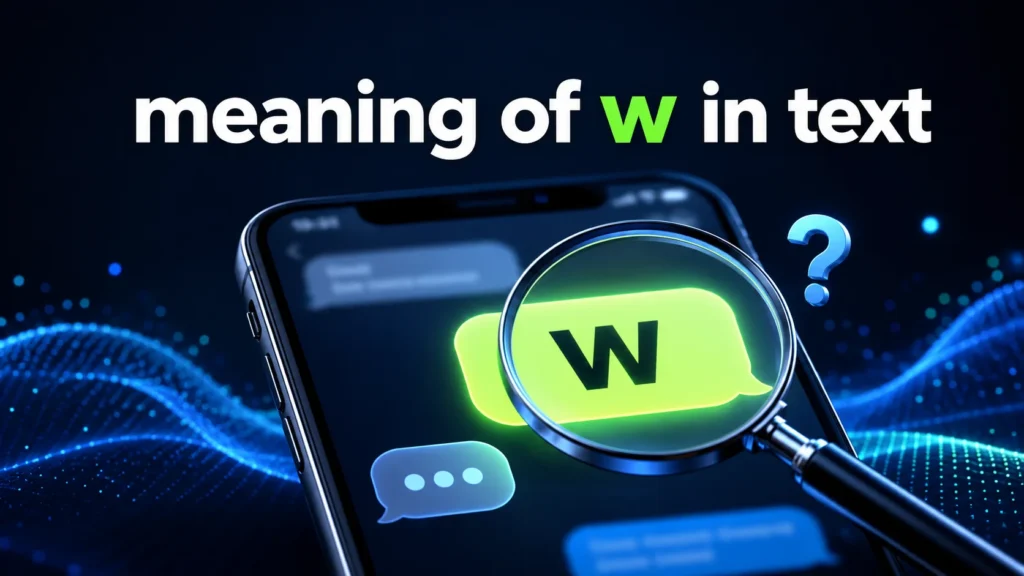
The meaning of W in text is usually “win” or “winning.” People send it to celebrate good news, praise an achievement, or show that they approve of something.
For example, if you tell a friend that you passed an exam and they reply, “Big W,” they are congratulating you. Their response means your result is a major success.
However, W does not always mean “win.” In certain messages, it can be shorthand for “with.” It may also represent the letter itself, a name, a school grade, or part of a longer expression.
People often search for the meaning because a single letter provides very little context. Is the sender celebrating you, agreeing with you, or simply shortening a sentence?
Fortunately, punctuation, capitalization, and surrounding words usually reveal the answer. This guide explains every common meaning, with realistic conversations and easy response examples.
Meaning of W in Text – Quick Meaning
In modern texting and social media slang, W most commonly means “win.” It describes something successful, impressive, positive, or worthy of approval.
Someone may use W to mean:
- A win or victory
- A successful outcome
- Good news
- A smart decision
- An impressive achievement
- Approval or praise
- “With” in shortened writing
- The opposite of an “L,” meaning a loss
Here are a few quick examples:
“I finally passed my driving test.”
“Huge W!”
In this example, “W” means a major success.
“That new haircut is a W.”
Here, the sender approves of the haircut and thinks it looks good.
“Are you coming w your brother?”
In this sentence, lowercase “w” means “with,” not “win.”
The easiest rule is simple: when W appears as a reaction, it normally means win. When it connects two parts of a sentence, it may mean with.
Origin and Background of W Slang
Where Did W Come From?
The slang meaning of W comes directly from the first letter of the word “win.” For many years, sports records, league tables, and competitive statistics have used “W” to represent a victory.
A team’s record might appear as:
- W for win
- L for loss
- D for draw
Because these letters were already familiar in sports and gaming, they naturally entered casual online language.
Instead of saying, “That was a great success,” users could simply type “W.” The single letter was fast, expressive, and easy to understand within competitive communities.
Gaming and Sports Culture
Gaming played an important role in making W popular online. Players commonly discussed wins and losses using short forms because they needed to communicate quickly.
A difficult victory could be called a “big W.” A disappointing result became an “L.”
Sports fans adopted similar language when reacting to players, transfers, performances, and team decisions. Eventually, people began using W for successes outside competition.
Getting a new job, choosing a good outfit, receiving a compliment, or making a funny comment could all count as a W.
Social Media’s Influence
TikTok, Twitch, YouTube, Instagram, X, and meme culture expanded the expression further. Comment sections often fill with “W,” “common W,” or “W creator” when viewers approve of a person’s words or actions.
The term became more than a literal victory. It now works as a quick digital stamp of approval.
For instance, “W teacher” means the teacher did something admirable. “W parents” praises supportive parenting, while “W choice” means someone made a good decision.
As a result, the meaning of W in text evolved from a recorded win into a flexible expression of success, respect, and positive judgment.
Real-Life Conversations Using W
WhatsApp Conversation: Celebrating Good News
Person A: I got the job! They called me this morning.
Person B: That’s a huge W. Congratulations!
Person A: Thank you! I was so nervous about the interview.
Person B: You earned it. I knew they would choose you.
Here, “huge W” means a significant personal success. The reply feels enthusiastic and supportive.
Instagram DM: Complimenting a Choice
Person A: Should I use the first photo for my profile?
Person B: Definitely. The lighting and outfit are both a W.
Person A: Really? I thought the second one looked better.
Person B: The second is nice, but the first one stands out.
In this conversation, W communicates approval. The sender believes the photo’s visual details are successful.
TikTok Comments: Praising a Creator
Creator: I returned the extra money the cashier gave me by mistake.
Commenter A: Massive W.
Commenter B: W honesty. We need more people like this.
Creator: Thank you! Keeping it would not have felt right.
“W honesty” praises the creator’s responsible behavior. It means the person made a morally good choice.
Text Message: W Meaning “With”
Person A: Are you going to the concert tonight?
and,
Person B: Yes, I’m going w Sam and Ali.
Person A: Nice! I’ll see you there.
In this case, “w” is an abbreviation for “with.” Its position inside a complete sentence makes that meaning clear.
Emotional and Psychological Meaning of W
What Emotion Does W Express?
W usually expresses a positive reaction. Depending on the conversation, it can communicate:
- Excitement
- Pride
- Approval
- Celebration
- Admiration
- Encouragement
- Respect
- Relief
- Playful enthusiasm
A plain “W” can feel casual, while “HUGE W!” sounds much more excited. Emojis and additional words also influence its emotional strength.
For example, “W 😂” may praise something funny. Meanwhile, “W decision 💯” strongly validates someone’s choice.
Why Do People Use It?
Digital communication encourages short and immediate reactions. W allows someone to celebrate another person without writing a long message.
It also creates a sense of shared internet culture. People familiar with gaming, sports, or social media understand the expression instantly.
However, short replies can sometimes feel emotionally limited. If a friend shares a deeply meaningful achievement, responding with only “W” may seem less thoughtful than saying, “That is wonderful—you worked so hard for this.”
The expression works best when its brevity matches the moment.
A Relatable Personal-Style Scenario
Imagine telling a group chat that you finally passed a difficult exam after failing it once. Several friends reply:
“W!”
“Big W!”
“Common W from you.”
Although each message is short, the group is celebrating your progress. They are not discussing an actual game; they are treating your achievement as a personal victory.
Still, the friend who adds, “I know how hard you worked,” may make you feel more deeply understood. Slang expresses energy, but personal words add emotional meaning.
Usage of W in Different Contexts
On Social Media
W commonly appears in captions, comments, livestream chats, and replies. Users may post it when they approve of a creator, decision, performance, or opinion.
Examples include:
- “W content”
- “W take”
- “W creator”
- “W parents”
- “W response”
- “Another W for the team”
- “Everybody put W in the chat”
“W in the chat” asks viewers to fill a live comment section with praise or celebration.
Between Friends
Friends often use W to congratulate one another casually.
If your friend buys something at a great price, you might say, “That’s a W.” If they leave an unhealthy relationship, “Major W” can show that you support their decision.
Among close friends, “common W” is also popular. It suggests that the person succeeds or makes good choices regularly.
In Romantic Relationships
W can describe a positive development in dating or a relationship.
For example:
“She planned the whole date herself. W girlfriend.”
This means the speaker appreciates her effort.
A person might also write, “Getting a reply from my crush is a W.” Here, the message playfully describes a small romantic success.
Nevertheless, W is not a hidden declaration of love. It usually communicates approval rather than romantic feelings.
In Gaming and Sports
Gaming and sports offer the most literal use of W. It represents an actual victory.
Examples include:
- “We got the W.”
- “One more W and we qualify.”
- “That comeback was a massive W.”
- “GG, easy W.”
In sports, a W may refer to a match result. In gaming, it can describe winning a round, challenge, or tournament.
At Work or in Professional Settings
W is generally too informal for formal emails, reports, applications, or communication with unfamiliar clients.
A coworker might write “Big W for the team” in a relaxed group chat after securing a contract. However, a professional email should use clearer wording, such as:
“This is an excellent result for the team.”
Similarly, lowercase “w” for “with” should be avoided in formal writing. Write the complete word to maintain clarity and professionalism.
Casual Versus Serious Tone
In casual communication, W sounds energetic and modern. In a serious conversation, it may appear dismissive.
For instance, replying “W” when a friend says they completed a video game is natural. Sending the same reply when they announce a major recovery or life-changing achievement may not provide enough emotional recognition.
Match the depth of your response to the importance of the news.
When Not to Use W
Avoid W when clarity, sensitivity, or professionalism matters more than speed.
It may be inappropriate:
- In formal business emails
- In academic essays
- In job applications
- During serious emotional conversations
- When communicating with people unfamiliar with slang
- In condolences or messages about grief
- When the meaning could be confused with “with”
- While giving medical, financial, or legal information
- In customer-service responses
- When a complete congratulatory message would feel more caring
Cultural and generational differences also matter. Someone unfamiliar with internet slang may think W is a typing error or an unfinished message.
If a person shares important news, combine the slang with sincere words:
“Huge W—congratulations! You worked incredibly hard for this.”
That response preserves the casual energy while showing genuine care.
Common Misunderstandings About W
W Does Not Always Mean “With”
Many people learned “w/” as shorthand for “with.” Therefore, they may assume every W has the same definition.
Its position helps reveal the correct interpretation:
- “That performance was a W.” — win
- “I went w my cousin.” — with
- “W/ extra cheese.” — with
A standalone capital W is more likely to mean “win.”
W Is Not an Insult
W is usually positive. It praises an outcome, action, person, or idea.
Its common opposite is L, which means “loss” or “losing.” If someone says, “Take the L,” their tone is negative. “Take the W,” however, means accepting or enjoying a victory.
“Common W” Is Usually a Compliment
At first, “common” may sound as though the achievement is ordinary or unimportant. In online slang, “common W” usually means the person is known for making good decisions or succeeding.
For example, “Common W for this creator” means, “This creator has done something good again.”
W Can Be Sarcastic
Although W is normally positive, people sometimes use it ironically.
If a friend drops their phone immediately after buying it, someone might say, “Huge W,” as a joke. Their tone actually means the situation is an obvious failure.
Sarcasm depends heavily on context, shared humor, and accompanying emojis.
W Does Not Automatically Mean Romantic Interest
Receiving “W” from a guy, girl, or crush does not prove attraction. The sender is usually approving of something you did, said, bought, or achieved.
Romantic meaning requires additional clues, such as flirting, compliments, consistent attention, or affectionate language.
W Compared With Similar Slang
| Expression | Common meaning | Typical tone | Example |
|---|---|---|---|
| W | Win, success, or approval | Positive | “Passing that test is a W.” |
| Big W | An important success | Excited | “Getting promoted is a big W.” |
| L | Loss, failure, or bad decision | Negative | “Missing the flight was an L.” |
| Dub | Win or victory | Casual | “We secured the dub.” |
| GG | Good game | Friendly or competitive | “GG, that was close.” |
| Based | Admirable or confidently expressed | Approving | “That opinion is based.” |
| Valid | Acceptable, relatable, or good | Supportive | “Your choice is valid.” |
| Fire | Excellent or attractive | Enthusiastic | “That song is fire.” |
| GOAT | Greatest of all time | Highly complimentary | “She is the GOAT.” |
| Mid | Average or unimpressive | Negative | “The movie was mid.” |
| Facts | Strong agreement | Affirming | “Facts, you said it perfectly.” |
| Fail | An unsuccessful action or result | Negative | “That plan was a fail.” |
Key Insight
W is one of the shortest ways to express approval. It can represent a literal victory or describe any person, choice, or outcome that deserves praise.
Variations and Types of W
1. W
Meaning: Win, success, or approval.
A single capital W is the standard form and frequently appears as a standalone reaction.
2. Big W
Meaning: A significant achievement.
People use it when something feels more important than an ordinary success.
3. Huge W
Meaning: An extremely positive result.
“Getting a full scholarship is a huge W” expresses strong excitement and admiration.
4. Massive W
Meaning: A major success or excellent decision.
This variation creates even more emphasis and is common in social media comments.
5. Common W
Meaning: Another expected success from someone impressive.
It suggests the person regularly makes good choices or produces excellent results.
6. Rare W
Meaning: An unusual success from someone who often fails or receives criticism.
This expression may be sincere, playful, or slightly insulting, depending on the relationship.
7. W Take
Meaning: A good opinion or viewpoint.
If someone shares an intelligent or admirable opinion, another user may call it a “W take.”
8. W Person
Meaning: A good, admirable, or supportive person.
Users often create more specific versions, such as “W friend,” “W teacher,” or “W boyfriend.”
9. W in the Chat
Meaning: Show support or celebrate in the comments.
Streamers and creators use this phrase to encourage viewers to post W repeatedly.
10. Take the W
Meaning: Accept and enjoy the victory.
Someone might say this when a friend keeps questioning whether their achievement counts.
11. Another W
Meaning: An additional success.
This version suggests that the person, team, or brand has succeeded before.
12. W/ or w/
Meaning: With.
Unlike the other variations, this is a practical abbreviation rather than praise.
How to Respond When Someone Uses W
Your reply can be simple, funny, mature, or respectful depending on the achievement and your relationship.
Casual Replies
- “Thank you!”
- “We did it!”
- “For real.”
- “I’ll take that W.”
- “Big win today.”
- “You already know.”
- “Finally!”
- “W for both of us.”
Funny Replies
- “A rare victory has appeared.”
- “Let me enjoy this before the next L.”
- “Adding it to my victory collection.”
- “Character development!”
- “The comeback is officially complete.”
- “Please record this historic moment.”
- “I only accept massive Ws.”
- “My luck finally remembered me.”
Mature Replies
- “Thank you. I worked hard for this.”
- “I truly appreciate your support.”
- “It feels good to see the effort pay off.”
- “I’m grateful everything worked out.”
- “This result means a lot to me.”
- “Thank you for celebrating with me.”
Respectful Replies
- “Thank you for your encouragement.”
- “I appreciate the kind response.”
- “It was a positive outcome for everyone.”
- “Thank you. The team deserves the credit.”
- “I’m pleased with the result.”
- “Your support is greatly appreciated.”
If W means “with,” simply answer the actual question. For example, “Are you coming w Sara?” can receive the response, “Yes, we’ll arrive together.”
Regional and Cultural Usage of W
Western Culture
W is widely recognized in the United States, Canada, and other English-speaking online communities. Sports, esports, hip-hop, livestreaming, and gaming culture have strengthened its popularity.
American users commonly apply it beyond literal competition. A kind action, clever response, or fashionable outfit can all receive a W.
Asian Culture
Young English-speaking users across South Asia and Southeast Asia frequently encounter W through TikTok, YouTube, gaming, and international meme culture.
In Pakistan, India, the Philippines, and similar multilingual online spaces, people may use English slang alongside Urdu, Hindi, Tagalog, or another local language.
However, users who learned mainly formal English may recognize W as a letter but not understand its slang meaning immediately.
Middle Eastern Culture
Young users in the Middle East may use W in gaming chats, sports discussions, and English-language social media communities.
Because football and competitive gaming have large online audiences, the literal “win” interpretation is often easy to understand. Older or less internet-focused audiences may still require a clearer explanation.
Global Internet Usage
W has become globally recognizable because its original meaning is simple. The English words “win” and “loss” appear frequently in international sports and gaming environments.
Still, not every audience interprets slang equally. In international professional communication, using the full word remains safer.
Gen Z Versus Millennials
Gen Z frequently uses W as a general sign of approval. Expressions such as “W friend,” “common W,” and “W in the chat” are especially common in short-form video and livestream culture.
Millennials are likely to understand W through gaming, sports, and internet forums. However, they may use “win,” “awesome,” or “great news” more often in everyday texts.
Older generations may interpret W literally as an initial or assume it means “with,” particularly when they are unfamiliar with current social media language.
Is W Safe for Kids?
Yes, W is generally safe for children and teenagers. Its standard slang meaning—win—is positive and not inherently offensive, violent, or sexual.
Children may encounter it in games, sports chats, livestreams, and social media comments. They might use it to celebrate a friend or praise good content.
Nevertheless, parents and educators can explain that slang belongs mainly in casual conversations. Students should write complete words in school assignments, formal emails, and professional communication.
They should also understand that online users may apply W sarcastically. Context helps distinguish genuine encouragement from mockery.
Frequently Asked Questions
What does W mean in a text message?
W usually means “win.” It describes a success, achievement, good decision, or something the sender approves of. In some sentences, lowercase “w” can mean “with.”
What does W mean on social media?
On social media, W represents praise, approval, or victory. A comment such as “W creator” means the commenter likes or respects what the creator did.
What does “big W” mean in text?
“Big W” means a major success or highly positive outcome. People use it to celebrate good news, smart decisions, impressive achievements, or admirable behavior.
What does W mean from a guy?
From a guy, W usually means he considers something a win or approves of what you said or did. It does not have a special gender-specific or automatically romantic meaning.
What does W mean from a girl?
From a girl, W generally expresses praise, celebration, or agreement. Examine the rest of her message before interpreting it as friendly, playful, or flirtatious.
What does “common W” mean?
“Common W” means someone has succeeded or made a good choice again. It is usually a compliment suggesting that positive behavior is normal for that person.
What is the difference between W and L?
W means win, success, or approval. L means loss, failure, embarrassment, or a poor decision. They function as opposites in most online conversations.
Conclusion
The meaning of W in text is most commonly “win.” It is a quick way to celebrate success, approve of a decision, praise someone’s behavior, or react positively to good news.
Expressions such as “big W,” “massive W,” and “common W” strengthen that praise. Meanwhile, phrases such as “W friend” or “W teacher” describe someone as admirable or supportive.
Context remains important because lowercase “w” or “w/” can also mean “with.” A standalone capital W usually signals victory, while a lowercase w connecting words often replaces “with.”
W is simple, positive, and generally safe to use in casual conversations. Still, meaningful achievements sometimes deserve more than one letter. Adding a sincere sentence can make your encouragement feel warmer and more personal.
Use W confidently when you want to say, “That was a success,” “You made a great choice,” or simply, “You won.”