The phrase “I will get back to you” is one of the most commonly used expressions in everyday English communication, especially in emails, interviews, customer service chats, and professional conversations. At first glance, it sounds simple and harmless. However, its meaning often depends on tone, context, and relationship between speakers.
People search for the meaning of “I will get back to you” because it can feel confusing. Sometimes it means a genuine promise to respond later. Other times, it quietly signals delay, hesitation, or even polite rejection.
Understanding this phrase helps you read between the lines in conversations, avoid miscommunication, and respond more confidently in both personal and professional settings.
I Will Get Back to You – Quick Meaning
Clear Definition
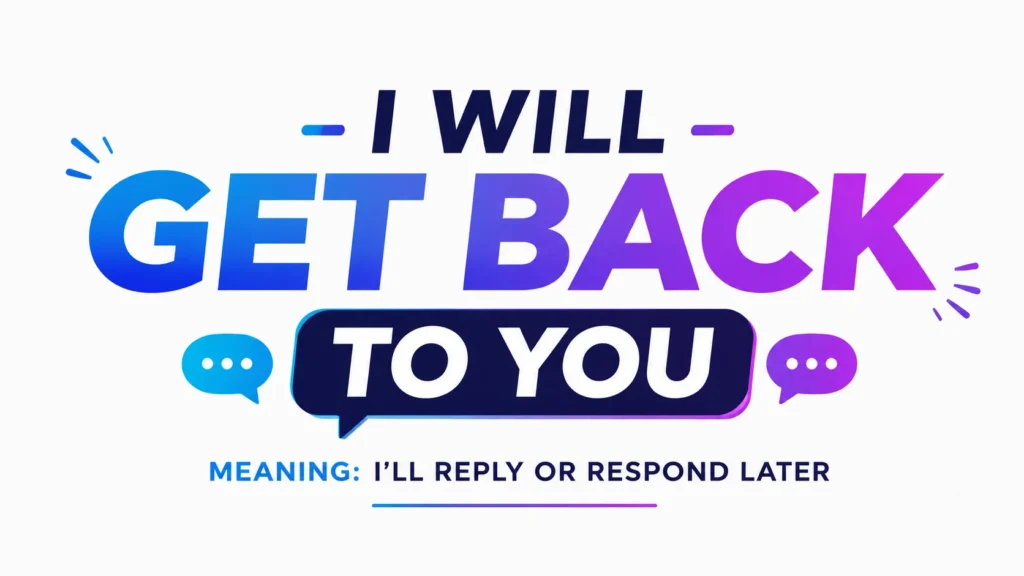
“I will get back to you” means:
- I will respond later after checking or thinking
- I need more time before giving an answer
- I will contact you again with information or a decision
It is often used when someone cannot answer immediately.
Common Intent Behind It
- To delay a response politely
- To show professionalism in communication
- To avoid giving a wrong or rushed answer
- To keep a conversation open-ended
Simple Examples
- “Let me check the details and I will get back to you.”
- “I’m not sure right now, I will get back to you tomorrow.”
- “We will review your request and get back to you.”
Origin & Background
Where It Comes From
The phrase developed from formal business communication. In offices, managers and customer support teams needed a polite way to say they could not respond immediately without sounding rude.
Instead of saying “I don’t know,” English speakers began using softer expressions like:
- “I’ll look into it”
- “I’ll check and come back to you”
- “I will get back to you”
Cultural Influence
In Western professional culture, direct refusal is often avoided. Communication tends to stay polite, neutral, and non-confrontational. This phrase became a standard “buffer expression.”
Social Media Impact
With the rise of emails, WhatsApp, and LinkedIn messaging, the phrase became even more common. It is now used in:
- Job interviews
- Freelancing discussions
- Customer support chats
- Online business negotiations
Evolution of Meaning
Over time, it has developed two layers:
- Literal meaning: I will reply later
- Hidden meaning: I need time, or I may not be fully interested
Real-Life Conversations (MANDATORY)
WhatsApp Chat
Person A: Did you check the proposal I sent?
Person B: Not yet, I have been busy. I will get back to you tonight.
Instagram DM
Person A: Are you still interested in the collaboration?
Person B: Yes, let me discuss with my team and I will get back to you.
TikTok Comment Exchange
Person A: When will you post part 2?
Person B: Working on it, I will get back to you with a date soon.
Text Message
Person A: Can you join the meeting at 5?
Person B: I’m not sure about my schedule. I will get back to you in an hour.
Emotional & Psychological Meaning
“I will get back to you” is not just a sentence. It reflects how people manage time, pressure, and social expectations in communication.
What Emotion It Expresses
- Uncertainty
- Caution
- Professional control
- Avoidance of immediate commitment
Why People Use It
People use it because:
- They don’t want to say “no” directly
- They need time to think
- They want to stay polite and respectful
- They want to avoid conflict or pressure
What It Reveals About Modern Communication
Modern communication is fast, but decisions are not always instant. This phrase acts like a “pause button” in conversations.
It shows:
- People prefer soft answers over harsh refusals
- Delays are socially acceptable
- Emotional intelligence matters more than speed
Personal-Style Scenario
Imagine you are offered a freelance project but you are unsure about workload. Instead of rejecting immediately, you say “I will get back to you.” This gives you time to evaluate without losing the opportunity or sounding rude.
Usage in Different Contexts
Social Media
Used when replying to messages, comments, or brand inquiries. It keeps conversations open.
Friends & Relationships
Used when someone needs time before confirming plans:
- “I’ll get back to you about the trip.”
Work / Professional Settings
Very common in emails, meetings, and corporate communication:
- “We will review your application and get back to you.”
Casual vs Serious Tone
- Casual: relaxed, sometimes vague
- Serious: formal, structured, and time-based
When NOT to Use It
Inappropriate Contexts
Avoid using it when:
- Immediate answer is required
- Emergency situations
- Legal or urgent commitments
Cultural Sensitivity
In some cultures, repeated use of this phrase may be seen as:
- Avoidance
- Lack of clarity
- Indecisiveness
Situations That May Cause Misunderstanding
- Job interviews (if overused)
- Customer complaints
- Time-sensitive negotiations
Common Misunderstandings
What People Get Wrong
Many people assume:
- It always means yes (not true)
- It always means no (also not true)
Tone Confusion
The meaning changes depending on:
- Speed of response
- Relationship between speakers
- Past communication behavior
Literal vs Figurative Meaning
Literal: I will respond later
Figurative: I am delaying a decision or avoiding commitment
Comparison Table
| Phrase | Meaning | Tone | Usage |
|---|---|---|---|
| I will get back to you | I will respond later | Neutral | Professional & casual |
| I will think about it | I need time to decide | Hesitant | Personal decisions |
| I will let you know | I will inform you later | Slightly formal | Updates & information |
| Not sure yet | No decision made | Direct | Casual communication |
| Maybe later | Uncertain availability | Informal | Friends & chats |
| I’ll check and confirm | Need to verify first | Professional | Work communication |
Key Insight
The phrase is flexible and depends more on context than literal meaning. It often acts as a polite “pause” in communication rather than a final answer.
Variations / Types
1. I’ll get back to you soon
Means response will come shortly.
2. I’ll get back to you later
No fixed time, general delay.
3. I’ll get back to you shortly
Very soon, usually within minutes or hours.
4. I’ll get back to you tomorrow
Clear time reference.
5. I’ll get back to you after checking
Needs verification first.
6. I’ll get back to you once I confirm
Decision depends on confirmation.
7. Let me get back to you
Informal version of the phrase.
8. We will get back to you
Used in organizations or teams.
9. I’ll circle back to you
Corporate-style variation.
10. I’ll revert back to you
Common in South Asian professional English usage.
How to Respond When Someone Uses It
Casual Replies
- “Sure, take your time.”
- “Alright, I’ll wait.”
- “No problem.”
Funny Replies
- “I hope you don’t disappear 😄”
- “Don’t ghost me now!”
- “I’ll hold my breath then!”
Mature Replies
- “Thanks, I appreciate the update.”
- “Looking forward to your response.”
- “Take your time, let me know.”
Respectful Replies
- “Sure, I understand. Please update me when ready.”
- “Thank you, I’ll wait for your response.”
Regional & Cultural Usage
Western Culture
Used widely in business emails and formal communication. Seen as polite and neutral.
Asian Culture
Very common in professional English usage, especially in India, Pakistan, and Philippines. Sometimes used more broadly even in informal chats.
Middle Eastern Culture
Used in business environments to maintain politeness and respect in negotiations.
Global Internet Usage
On social media, it can feel vague or delayed, sometimes even frustrating if overused.
Generational Differences
- Gen Z: prefers faster, more direct responses
- Millennials: comfortable with polite delay phrases
- Older professionals: use it as standard communication etiquette
Is It Safe for Kids?
Yes, it is a safe and neutral phrase. It does not contain harmful or inappropriate meaning. However, children should understand its context so they don’t misinterpret it as a final answer.
FAQs
What does “I will get back to you” mean in simple words?
It means the person will reply later after checking or thinking.
Is “I will get back to you” a rejection?
Not always. It can mean delay, not refusal.
How long does “get back to you” usually take?
It depends—could be minutes, hours, or days based on context.
Is it formal or informal?
It is both, depending on usage. Common in professional communication.
What should I reply when someone says it?
You can say “okay,” “sure,” or “looking forward to it.”
Does it mean they are interested?
Sometimes yes, sometimes uncertain. Context matters.
Why do people use this phrase so much?
Because it sounds polite and avoids direct refusal.
Conclusion
“I will get back to you” is more than just a simple sentence. It is a bridge between uncertainty and response. It helps people maintain politeness while buying time to think, decide, or verify information.
In modern communication, where speed is high but decisions are complex, this phrase plays an important role in keeping conversations respectful and open-ended.
Understanding its meaning helps you read between the lines better and respond more confidently in both personal and professional life. Use it wisely, and you will notice how much smoother your communication becomes.