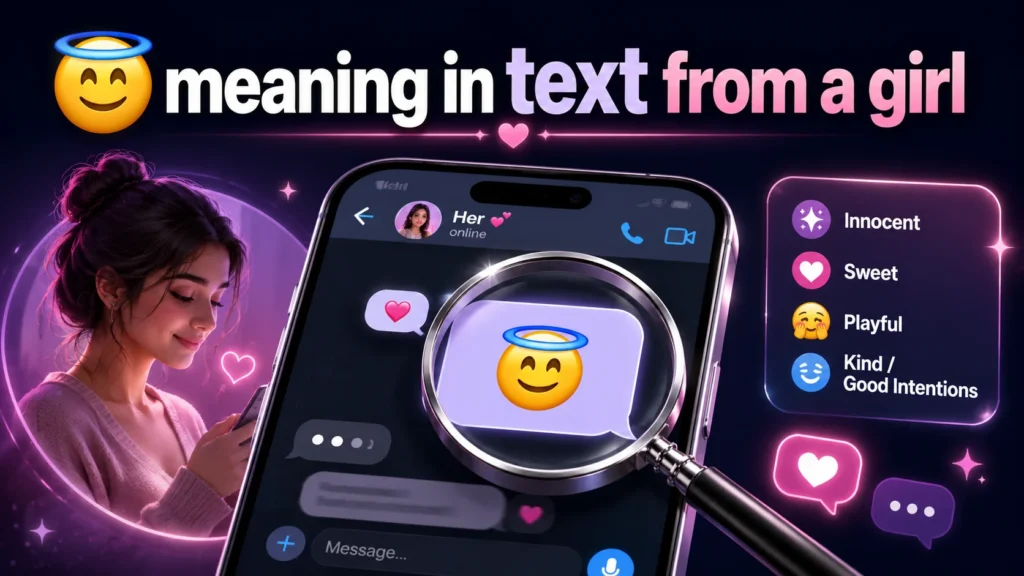
The 😇 meaning in text from a girl usually suggests innocence, sweetness, kindness, playful guilt, or “angelic” behavior. However, the exact message depends on what she says before the emoji and the relationship you share.
A girl may send 😇 after giving you a compliment, admitting something mischievous, asking for a favor, or pretending that she has done nothing wrong. Therefore, the emoji can feel genuinely caring in one conversation and teasingly flirty in another.
People often search for its meaning because emojis do not have one fixed emotional definition. A smiling face with a halo looks innocent, yet someone may use it sarcastically after behaving in a very un-angelic way.
For example, “I saved you the last piece 😇” sounds thoughtful. In contrast, “Maybe I looked at your profile a few times 😇” feels playful and possibly flirtatious.
This guide explains what 😇 means when a girl sends it, how to read the tone, when it signals attraction, and how you can respond naturally.
😇 Meaning in Text From a Girl – Quick Meaning
When a girl sends 😇, she may be expressing kindness, innocence, gratitude, playful mischief, or gentle flirting.
In simple terms, the emoji can mean:
- “I am being sweet.”
- “I am innocent.”
- “I did nothing wrong.”
- “Please forgive me.”
- “I am teasing you.”
- “I am trying to look adorable.”
- “I genuinely appreciate you.”
- “I may like you, but I am keeping it subtle.”
The surrounding message usually reveals the intended meaning.
Consider these examples:
“Thank you for always helping me 😇”
Here, the emoji expresses sincere appreciation and warmth.
“I definitely did not steal your hoodie 😇”
In this case, she probably uses the halo ironically because she knows she did something mischievous.
“You looked really good today 😇”
This message may be a soft compliment, although it can also carry a gentle flirty tone.
The emoji rarely proves romantic attraction by itself. Nevertheless, repeated use alongside compliments, teasing, personal questions, and consistent attention may suggest that she feels interested.
Origin and Background
Where Did the 😇 Emoji Come From?
The 😇 emoji officially represents a smiling face with a halo. Traditionally, a halo symbolizes innocence, goodness, holiness, purity, or angel-like behavior.
As digital communication grew, people began using the emoji for much more than literal innocence. Today, it can express genuine kindness, exaggerated sweetness, pretend innocence, playful guilt, or flirtation.
Cultural Influence
Angels often represent goodness and protection in Western art, religion, literature, and popular culture. Therefore, people naturally associate the halo with someone who behaves well.
However, online users frequently reverse that meaning for humor. Someone may add 😇 after admitting a harmless mistake because the innocent expression makes the confession funnier.
For example:
“I only bought three more dresses 😇”
The sender does not necessarily believe that shopping makes her angelic. Instead, she playfully presents herself as innocent while admitting that she probably overspent.
Social Media Impact
Instagram, TikTok, Snapchat, and messaging apps helped turn 😇 into a flexible social signal.
Girls may use it in captions to create a soft, cute image. Likewise, they may place it after bold or teasing statements to reduce their intensity.
As a result, the emoji often helps a sender balance two tones at once. She can flirt without sounding too direct, apologize without becoming overly serious, or joke without appearing aggressive.
Real-Life Conversations
WhatsApp Conversation
Person A: Did you finish the assignment?
Person B: Almost. Can you help me with the last question? 😇
Person A: So the halo appears whenever you need help?
Person B: Maybe it increases my chances 😂
In this conversation, the girl uses 😇 to make her request sound cute and harmless. She may not be flirting, although the playful tone shows comfort and friendliness.
Instagram DM
Person A: You liked three of my old pictures.
Person B: Did I? I must have slipped 😇
Person A: Three times?
Person B: Your profile was interesting. Do not make it a big deal.
Here, 😇 suggests playful guilt. Additionally, her decision to view and like older posts may show curiosity or attraction.
TikTok Comments
Person A: You always look so innocent in your videos.
Person B: That is because I am innocent 😇
Person A: Your last video says otherwise 😂
Person B: I have no idea what you mean.
The girl uses the emoji sarcastically. Her “innocence” is part of the joke rather than a serious claim.
Text Message
Person A: I had a rough day today.
Person B: I am sorry. Call me when you get home, okay? 😇
Person A: Thank you. I really needed that.
Person B: I am here for you.
In this example, the halo adds warmth and emotional support. The tone feels caring rather than flirty.
Emotional and Psychological Meaning
The 😇 emoji often allows a girl to appear warm without making her message feel too intense.
Digital conversations can feel emotionally risky, especially when someone wants to flirt, apologize, or show affection. Consequently, an emoji gives the sender a small layer of protection.
If the receiver responds positively, she can continue the playful conversation. If the response feels uncomfortable, she can treat the emoji as a harmless friendly gesture.
What Emotion Does It Express?
Depending on the context, 😇 may communicate:
- Innocence
- Kindness
- Gratitude
- Playful embarrassment
- Harmless guilt
- Affection
- Soft flirtation
- Sarcasm
- Emotional reassurance
For instance, “You are honestly so thoughtful 😇” usually communicates admiration. Meanwhile, “I may have told everyone your embarrassing story 😇” expresses mischievous guilt.
Why Girls Use It
A girl may use the halo emoji because she wants her message to sound gentle, cute, and non-threatening.
Moreover, the emoji can soften a request. “Can you pick me up?” may sound direct, while “Can you pick me up? 😇” feels warmer and slightly more persuasive.
She might also use it to protect herself from embarrassment. A direct compliment such as “You are attractive” feels vulnerable. However, “You looked cute today 😇” sounds lighter and easier to send.
A Personal-Style Scenario
Imagine that a girl regularly sends you good-morning messages, notices small details about your day, and adds 😇 after compliments.
One evening, she writes, “You make talking feel so easy 😇.”
The emoji alone does not confirm that she likes you romantically. Still, her consistent attention, personal compliment, and emotional openness create a stronger signal together.
Instead of focusing only on the halo, examine the pattern of communication. Genuine interest usually appears through effort, consistency, curiosity, and warmth.
Usage in Different Contexts
Social Media
On social media, girls commonly use 😇 in captions, comments, bios, and direct messages.
A caption such as “Just an angel living her best life 😇” creates a cute or confident image. Sometimes, the caption feels sincere. At other times, it contrasts humorously with a bold photograph.
In comments, the emoji may also show support:
“You deserve all this happiness 😇”
Here, the sender likely expresses kindness and encouragement.
Friends and Relationships
Between friends, 😇 often indicates playful innocence.
For example:
“I may have eaten your snacks 😇”
Because the situation is harmless, the halo turns the confession into a joke.
In romantic relationships, the emoji can add affection or teasing. A girlfriend might write, “I miss you, but I am not admitting it twice 😇.”
That message combines emotional honesty with playful self-protection.
Dating and Flirting
During early-stage dating, 😇 often creates a soft flirty tone.
Examples include:
“Maybe I was hoping you would text me 😇”
“You are more charming than I expected 😇”
“I behaved all evening, so I deserve a reward 😇”
Each message invites a playful response. Nevertheless, the emoji works as a supporting clue rather than definite proof of attraction.
Work and Professional Settings
In friendly workplace chats, someone may use 😇 after saying thank you or making a small request.
For instance:
“Could you send me the report before lunch? 😇”
Although the message sounds polite, the emoji may feel too casual in formal workplaces. Therefore, professional emails, serious client discussions, and official messages usually require straightforward language instead.
Casual vs. Serious Tone
The halo works best in light, warm, or playful conversations.
However, it may feel dismissive during serious conflicts. If someone expresses genuine hurt, replying “I am sorry 😇” could make the apology seem insincere.
For emotional conversations, clear words matter more than a cute symbol.
When Not to Use It
Avoid using 😇 when the situation demands seriousness, accountability, or emotional clarity.
It may cause misunderstanding in the following situations:
- After deeply hurting someone
- During a serious apology
- While discussing grief or trauma
- In formal business communication
- During an argument about trust
- After breaking an important promise
- When someone has asked for a direct answer
- In sensitive cultural or religious discussions
For example, “Sorry I forgot our anniversary 😇” may sound as though the sender does not understand the seriousness of the mistake.
A better message would be:
“I am genuinely sorry that I forgot. I understand why you feel hurt, and I want to make it right.”
The halo should not replace accountability.
Common Misunderstandings
It Does Not Always Mean She Likes You
A girl may use 😇 because she is naturally friendly, expressive, or polite.
Therefore, one halo emoji does not automatically mean romantic interest. Look for additional signs such as frequent messages, personal compliments, playful teasing, and a desire to spend time together.
It Does Not Always Mean Innocence
Although the halo symbolizes goodness, people often use it ironically.
A message such as “I definitely did not read the group chat drama 😇” probably means the opposite. She likely knows exactly what happened.
It Is Not Necessarily Religious
Some people associate halos with religious imagery. However, most everyday uses of 😇 remain social and emotional rather than religious.
The sender usually wants to look sweet, innocent, or playful.
It Can Hide Sarcasm
A girl may add 😇 after a bold statement to create sarcastic contrast.
For example:
“I only reminded him of the truth 😇”
The halo suggests that she knows her comment may have caused drama.
A Cute Tone Does Not Remove Boundaries
Someone may use 😇 while making a request, but you still have the right to say no.
The emoji can make a message feel charming. Nevertheless, it should not pressure you into agreeing with something that makes you uncomfortable.
😇 Compared With Similar Emojis and Expressions
| Emoji or Expression | Common Meaning | Typical Tone | Main Difference |
|---|---|---|---|
| 😇 | Innocence, kindness, playful guilt | Sweet or teasing | Can be sincere or ironic |
| 😊 | Warm happiness and friendliness | Gentle | Less mischievous |
| 🙂 | Polite smile or controlled emotion | Neutral | May feel distant |
| 😉 | Flirting, teasing, or hidden meaning | Playful | More openly suggestive |
| 😏 | Confidence, attraction, or suggestiveness | Bold | Stronger flirting signal |
| 🥰 | Affection, love, and emotional warmth | Romantic or loving | More openly affectionate |
| 😌 | Relief, calmness, or quiet confidence | Peaceful | Less focused on innocence |
| 🙃 | Sarcasm, awkwardness, or frustration | Ironic | Often hides discomfort |
| 🤭 | Shyness, surprise, or playful secrecy | Cute or embarrassed | Suggests giggling or hiding |
| “I’m innocent” | Denial or playful defense | Depends on context | Words make the meaning clearer |
Key Insight
Compared with 😉 or 😏, the 😇 emoji offers a softer and less direct style of flirting. It suggests sweetness first, while attraction remains a possible secondary meaning.
Variations and Types
Genuine Angel 😇
This version expresses real kindness, gratitude, or emotional support.
Example: “Thank you for listening to me 😇”
Playfully Innocent 😇
Here, the girl pretends she did nothing wrong, even though both people know she did.
Example: “I did not take your charger 😇”
Flirty Angel 😇
The halo softens a compliment or romantic hint.
Example: “I may have dressed up because I knew you would be there 😇”
Apologetic Angel 😇
A girl may use it after a small, harmless mistake.
Example: “Sorry, I fell asleep before replying 😇”
Favor-Requesting Angel 😇
The emoji makes a request sound sweeter and more persuasive.
Example: “Could you bring me coffee? 😇”
Sarcastic Angel 😇
In this variation, the halo means the opposite of innocence.
Example: “I only caused a little drama 😇”
Proud Angel 😇
The sender highlights her good behavior in a playful way.
Example: “I finished all my work before dinner 😇”
Shy Angel 😇
A girl may use it after a compliment because she feels slightly embarrassed.
Example: “I think you have a really nice smile 😇”
Caring Angel 😇
The halo expresses emotional warmth and protection.
Example: “Message me when you reach home safely 😇”
Angel-and-Devil Combination 😇😈
This pairing represents a mix of innocence and mischief.
Example: “I can be sweet, but do not test me 😇😈”
How to Respond When a Girl Sends 😇
Your reply should match the message rather than the emoji alone.
Casual Replies
- “You are welcome 😇”
- “That is sweet of you.”
- “No problem at all.”
- “Anytime!”
Funny Replies
- “That halo looks suspicious.”
- “I am not convinced you are innocent.”
- “Should I believe the emoji?”
- “The angel act will not save you 😂”
Flirty Replies
- “You look innocent, but I have questions.”
- “That halo suits you.”
- “Are you always this sweet?”
- “I think there is a little mischief behind that smile.”
Mature Replies
- “I appreciate you saying that.”
- “Thank you for being honest.”
- “I am glad you felt comfortable telling me.”
- “Let us talk about it properly.”
Respectful Replies
- “Thank you. That means a lot.”
- “I understand what you mean.”
- “I appreciate your kindness.”
- “You are thoughtful for checking in.”
If you are unsure about her intention, respond naturally instead of immediately asking whether she likes you. A relaxed reply keeps the conversation comfortable and allows her tone to become clearer over time.
Regional and Cultural Usage
Western Culture
In Western texting culture, 😇 commonly expresses innocence, sweetness, playful guilt, or light flirting.
Girls may also use it ironically after describing rebellious, bold, or mischievous behavior.
Asian Culture
Across many Asian online communities, the emoji often adds politeness and softness to messages.
A girl may use 😇 after asking for help, thanking someone, or giving a respectful compliment. However, younger users also understand its sarcastic and flirty meanings.
Middle Eastern Culture
In Middle Eastern and South Asian conversations, 😇 may communicate modest friendliness, gratitude, prayerful positivity, or respectful affection.
Because direct flirting may feel uncomfortable in some social settings, a girl might use the halo to keep her message subtle.
Still, the meaning depends heavily on personal values, family background, and the closeness of the relationship.
Global Internet Usage
Globally, 😇 remains one of the most flexible “cute” emojis.
People use it to combine innocence with humor. Additionally, influencers and creators may include it in captions to appear sweet, confident, or knowingly mischievous.
Gen Z vs. Millennials
Millennials often use 😇 for sincere kindness, gratitude, or playful innocence.
Gen Z also uses those meanings, although younger users may lean more heavily into irony. For example, they may add the halo after a chaotic or unapologetic statement.
Is It Safe for Kids?
Yes, the 😇 emoji is generally safe for children.
It usually represents goodness, kindness, innocence, or angel-like behavior. However, teenagers may also use it sarcastically or alongside mild flirting.
Parents do not need to worry about the emoji by itself. Instead, they should consider the complete conversation, especially when unknown people send personal or suggestive messages.
Context remains more important than the symbol.
FAQs
What does 😇 mean when a girl sends it?
When a girl sends 😇, she may be expressing sweetness, innocence, gratitude, playful guilt, or subtle flirting. The surrounding message reveals the most likely meaning.
Is 😇 from a girl a flirting emoji?
It can be flirty, especially when she uses it with compliments, teasing, romantic hints, or personal attention. However, it may also show simple friendliness.
What does 😇 mean after a compliment?
After a compliment, 😇 usually makes the message feel gentle, shy, or affectionate. She may want to show interest without sounding too direct.
Why would a girl send 😇 after asking for something?
She may use the halo to make her request sound cute, polite, and harmless. In other words, she hopes the sweet tone will persuade you.
Does 😇 mean she is pretending to be innocent?
Sometimes, yes. When her message admits mischievous behavior, the halo often signals playful or sarcastic innocence.
What should I reply to 😇 from a girl?
You can match her tone with “That halo looks suspicious,” “You are sweet,” or “Are you always this innocent?” Choose a reply that fits your relationship.
Is 😇 more friendly or romantic?
The emoji usually feels friendly and sweet. Nevertheless, romantic meaning becomes more likely when it appears with flirting, compliments, consistent attention, and emotional closeness.
Conclusion
The 😇 meaning in text from a girl can range from genuine sweetness to playful mischief. She may want to thank you, appear innocent, soften a request, hide embarrassment, or flirt without becoming too obvious.
However, one emoji cannot reveal her entire intention. The words around it, your relationship, her usual texting style, and her overall effort provide much stronger clues.
When she sends 😇 after a caring message, it probably expresses warmth. When she adds it after a suspicious confession, she may be pretending to be innocent. Meanwhile, compliments and teasing can give the halo a softly romantic edge.
Rather than overthinking a single symbol, focus on the complete conversation. A confident, natural response will help you understand her tone far better than making an immediate assumption.